Category Archives: Lexicology

Word of the Day: eldritch


Here I am again, sinister reader, entombed in the perpetual, soupy miasma that my humble hamlet of Fecal Creek. CA, has apparently decided to adopt as its permanent personality.  You see, this town, indeed the entirety of Anhedonia County, has been swallowed whole by fog for at least three weeks now, fog so thick you could spread it on toast and call it despair.  Nights are a wet, milky blindness where streetlamps die at twenty paces and every dog refuses to bark because even they know something is listening.   Days are just a brief negotiation with a sun that is now more a rumor than a fact.  Everything drips.  It’s the kind of weather that seeps into your bones, a damp that clings not just to your clothes but to your spirit.  And what does a self-respecting, newly and brutally sober, quasi-hermetic literary type do when faced with such an atmospheric siege?  One leans in, naturally, toward the only honest literature for weather like this.  Because I’m nothing if not a masochist for mood, my reading has become a direct reflection of the meteorological morass outside.  It started, as it must, with Poe, because of course Poe; the man who knew how to weaponize atmosphere understood that the real horror is when the architecture itself wants you dead.  His tales of premature burial and sentient abysses read less like fiction and more like a local weather report.  From there, it was almost a predestined slide back into the embrace of Stoker’s Dracula, because nothing says “cozy” like aristocratic necrophilia in a castle that smells like a crypt’s taint (and because fog and vampiric dread are basically peanut butter and jelly).  Carpathian menace felt perfectly at home here, his vaporous transformations mirroring the air I was breathing.
Now, I find myself deep in H.P. Lovecraft’s The Shunned House, a choice so fitting it borders on cosmic satire.  The story’s fungal horrors and subterranean emanations are in terrifying synchronicity with the damp decay that seems to have become the Creek’s primary export.
The combination of these particular fictions with the perpetually unsettling atmosphere has rendered my world a place of profound and disquieting strangeness, a place where the veil between the mundane and the monstrous feels perilously thin.  Which, conveniently, brings us to today’s word, the only one that still works when the air itself feels like it’s conspiring:

Eldritch (adj.)
/weird and sinister or ghostly; unearthly; uncanny; strange, eerie, and unnatural in a way that provokes fear, unease, or dread/
From Scots, probably from Middle English elrich, itself maybe from Old English ælf-rīce “elf-realm” + a twist through centuries of border ballads where the fairies weren’t cute and the night had teeth.  First citation 1508, but it feels older, like it crawled out of a peat bog still wearing the face of something that should have stayed drowned.
And now, because the fog demands tribute, a short story showing the word at work in the wild:
The fog never lifted; it merely thinned to the consistency of a dying man’s breath on a mirror.  I walked the cracked spine of Miner’s Ravine Road where the blackberry brambles had grown so bold they’d begun knitting themselves into arches, forming a thorny cathedral that no priest would ever consecrate.  Somewhere behind the veil, Fecal Creek’s lone traffic light blink its yellow eye, like a warning it had forgotten the point of.  The house at the bend, everyone knew the house, had stood empty for decades, yet every third night its attic window glowed the color of spoiled buttermilk.  I told myself I was only cutting through the yard to shave forty seconds off my trudge to the liquor store, but the fog had other curricula.  Halfway across the weed- choked lawn the ground exhaled.  Not a wind, not a scent; something between a sigh and a belch, centuries of basement rot rising through the soles of my boots.  The mist folded around me until the world reduced to a single wet coin of visibility.  And in that coin, for one heartbeat only, the house was not a house.  It was a face, vast and fungal, its shingles the scales of something that had learned carpentry the way leukemia learns bone marrow.  Its windows were eyes filmed with cataract and ancient hunger, and from the black porch gaped a mouth that had never bothered with doors.  The entire structure leaned forward the way a praying mantis leans before it remembers it is allowed to be cruel.  That was the moment, the single systolic throb, when the night revealed its true and eldritch geometry.
Then the fog inhaled, the face collapsed back into clapboard and neglect, and I was running, lungs full of grave-damp, boots slapping through puddles that reflected no moon because the moon had apparently filed a restraining order.  I did not stop until the neon of the liquor store bled across my retinas like a mercy killing.
I bought two bottles of the cheapest red wine and drank one in the parking lot just to remind my heart it was still allowed to beat.
Fecal Creek is still out there, sopping, listening.
The fog is not hiding anything.
It is showing us, very patiently, what was always here. 

So here we are, spooky reader: a town marinated in fog, a reader marinated in gothic dread, and a word marinated in centuries of linguistic strangeness.  If the weather doesn’t break soon, I’ll be forced to reread House of Leaves and start scribbling paranoid diagrams on my walls.

N.P.: “Temple of Love 1992” – Sisters of Mercy

Word of the Day: epicaricacy


Epicaricacy is a noun referring to the quiet, delicious, morally indefensible little orgasm you get when some smug motherfucker finally eats the exact shit sandwich he or she spent years force-feeding everyone else.
German has schadenfreude, sure, but that’s the tourist version, the Disneyland of malice.  Epicaricacy is the back-alley, no-safe-word edition.  Think of it as schadenfreude’s eccentric cousin who insists one wearing velvet pants to funerals and ordering wine in Latin while correcting your pronunciation of “bruschetta.”
It’s etymology is a straight up Latin/Greek smash-and-grab:
epi– (“upon”)
chara (“joy”)
Kakos (“evil” or “misfortune”)
So, literally: joy-upon-evil, with a hard middle-finger detour through the medieval habit of pretending you’re enjoying someone’s downfall for “pedagogical reasons.”  The word itself was basically invented in 1715 by some wigged Brit who wanted to sound smarter than the Germans while still getting his rocks off watching dukes slip on ice.  Respect.

The sign outside the cantina flickered like a dying insect: “Carnaval de Gasolina.”¹ Nobody cared. By midnight, the joint was a pharmacological zoo—cheap mezcal poured into motor oil cans, cocaine cut with talcum powder, and tabs of acid shaped like Biden’s neck waddles.²
I was three shots past coherence when Frankie “Dos Cuchillos” decided to rob the bar.³ He didn’t bother with a mask—just stormed in waving machetes like he was auditioning for a narco telenovela. The jukebox kept playing “Sweet Caroline,” which made the whole thing feel like a parody of violence.
Somebody threw a chair. Somebody else threw up. Frankie screamed about “redistributing wealth” while pocketing pesos and half a bag of Doritos. Then the federales showed up, already drunk from the bowling alley across the street. One officer tried to tase Frankie, missed, and electrocuted the jukebox instead. Neil Diamond died mid-chorus.
As Frankie got tackled into a puddle of spilled mezcal, the entire bar erupted in laughter. Not nervous laughter, not relief—just pure, uncut joy at watching chaos eat itself alive. That’s when I realized the word for this exact moment existed: epicaricacy.⁴ The pleasure of watching someone else’s disaster, the giddy schadenfreude of seeing a man with two knives get flattened by his own stupidity.
I lit a cigarette off the sparking jukebox, raised my glass to the carnage, and thought: Mexico, you beautiful bastard, never change.

Footnotes & Citations

  1. See “Semiotics of Neon Failure in Border Economies,” Journal of Applied Cantina Studies, Vol. 12, No. 3 (1998), pp. 45–67.
  2. For a comparative analysis of Biden iconography in psychedelic paraphernalia, consult “Sleepy Joe and the Acid Tab: A Psychoactive Presidency,” Annals of Illicit Semiotics, Vol. 7 (2024).
  3. Nicknames in Tijuana function as both biography and prophecy. Cf. “The Ontology of Narco Sobriquets,” Revista de Crimen y Cultura, Vol. 2, No. 1 (2011).
  4. Epicaricacy: see “Obscure Lexicons of Schadenfreude,” Proceedings of the International Symposium on Pretentious Vocabulary, Vol. 1 (2009).

N.P.: “Sad But True” – Mexican Institute of Sound

Word of the Day: fard

Today’s Word of the Day is fard.
Verb – to apply cosmetics, especially to the face.
From Middle French farder, meaning “to paint or embellish,” which itself traces back to the Latin fardare, a verb that sounds like it should involve medieval jousting but instead refers to the ancient art of facial camouflage.

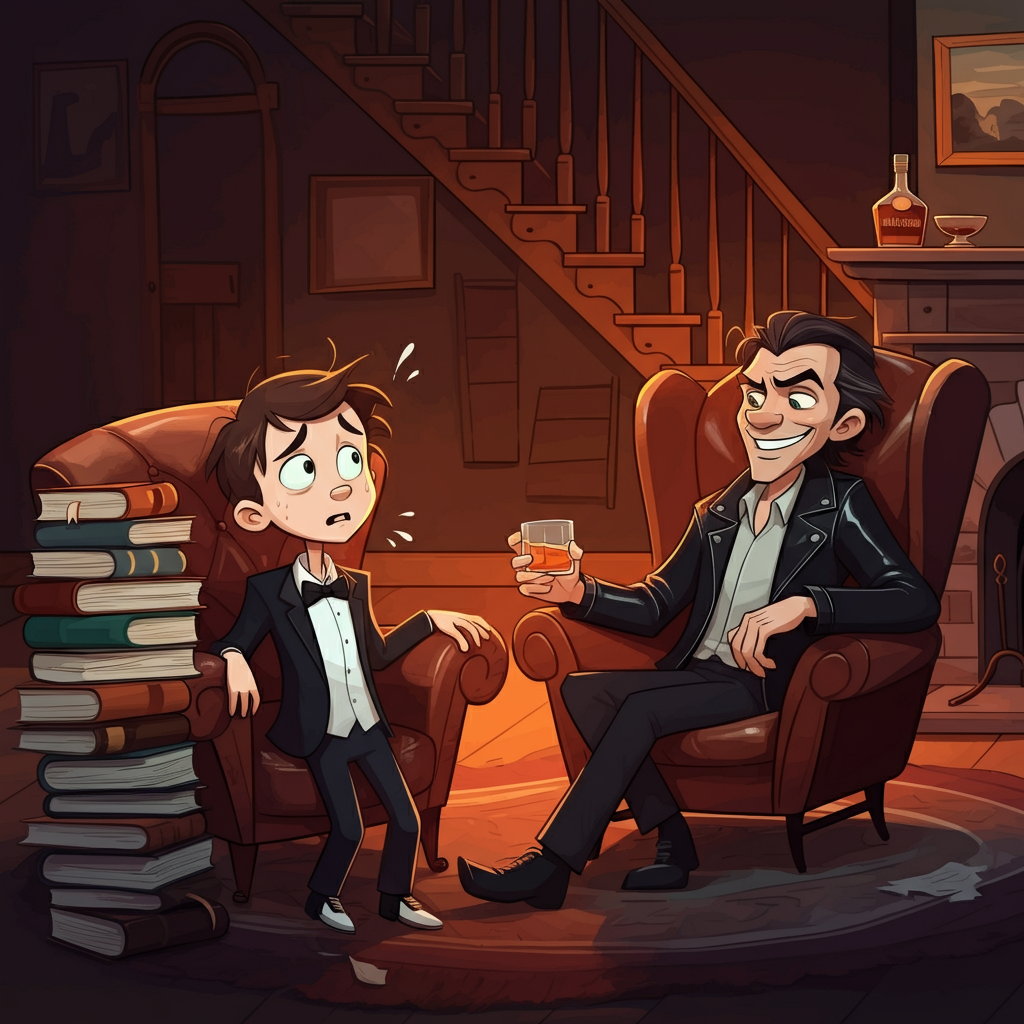
The doorbell chimes, a tinny, synthesized death knell signaling the arrival of The Proletariat.   I swing open the door to find him vibrating on my porch: a human pimple in a shitty rented tuxedo, a creature of such profound adolescent awkwardness that his very existence is a form of passive-aggressive warfare against good taste.  He’s wearing a clip-on tie and the kind of cologne that smells like Axe body spray had a baby with a urinal cake.  He’s here to take my daughter to Homecoming, which is already a problem because she’s fifteen and he looks like the kind of kid who thinks Nietzsche is a Fortnight skin.
I let him in.  I do not offer him a seat.  I do not offer him water.  I do not offer him mercy.  We sit in silence.  The kind of silence that makes your ears ring.  He tries to smile. I stare at him like I’m trying to telepathically induce a nosebleed.  His eyes dart around the room, landing on the towering stack of books and the half-empty bottle of bourbon on the mantlepiece.  The silence stretches, thick and suffocating.  I let it linger, a tactical weapon of my own design.
“So,” I begin, leaning back, a predator enjoying his work.  “Homecoming.  A veritable pageant of hormonal panic and shitty decisions.  You must be thrilled.”
A sound escaped his throat, something between a gulp and a squeak.  “Y-yes, sir.  It should be fun.”
“Fun,” I repeat, savoring the word like a piece of cheap candy.  “An interesting metric.  Is the pursuit of ‘fun’ the primary driver of the human condition, do you think?  Or is it merely a distraction, a fleeting palliative to soothe the existential dread that accompanies the slow, inexorable march to the grave?”
His face is a canvas of pure, unadulterated terror.  His Adam’s apple bobs.  “I…I don’t know, sir.”
What a moron.  Time to really fuck with him.
After another minute of staring, I say, “So.  You believe in free will?”
He blinks stupidly.  Sheepishly.  He blinks like a stupid sheep.  “Uh.  Yeah?”
“Interesting.  So you think you chose to wear that tie?”
He looks down, confused.  “My mom picked it.”
“Ah,” I say, nodding sagely.  “So you believe in maternal determinism.”
He shifts in his seat.  I can smell the panic.  And his panic smells like fear and cheap deodorant.
“She’ll be down soon,” I say.  “She’s upstairs farding.”
The kid freezes.  His face goes from pale to a blotchy, horrified crimson.  The single word hangs in the air between us, a foul and misunderstood specter
“She’s…she’s what?” he stammers, his voice cracking.
I lean forward, conspiratorially.  “Farding.  Oh, yeah.  She fards all the time.  Can’t stop, really.  A terrible habit.  I’ve tried talking to her about it, but she gets embarrassed.  But it’s out of control.  Sometimes it goes on for hours, the farding.  She just didn’t want to do it in front of you.  She’s shy about her farding.”
The boy’s brain, bless its undeveloped prefrontal cortex, has clearly gone to a very different, very gross place.  He nods, but he’s not nodding like someone who understands.  He’s nodding like someone who’s trying to pretend he didn’t just walk into a house where the father casually discusses his daughter’s alleged gastrointestinal habits with Socratic flair.  I can see the frantic calculations behind his eyes, the dawning horror, the desperate search for an exit strategy.  The silence returns, but this time it’s electric with his revulsion.
After a few more agonizing seconds that I enjoyed immensely, he shoots to his feet.  “You know what?  I…I just remembered.  I have to…go.  I think I forgot something at home, “he says.
“Was it your dignity?” I ask, cheerfully.
And with that, he was gone.  A blur of cheap polyester and shattered dreams, fleeing my house, and, hopefully, my daughter, forever.
I walked to the bottom of the stairs, glass in hand.
“Honey!” I called up.  “You can take your time!  Your ride seems to have been unavoidably detained.”
My daughter descends the stairs, radiant and furious.  “Where’d he go?”
He couldn’t handle your farding,” I say.
She groans.  I pour myself a drink.  I am victorious.  And victory, dear reader, is a dish best served with a side of deliberate, weaponized vocabulary. 

N.P.: “Cities in Dust” – Night Club

Word of the Day: gongoozler

Today’s Word of the Day, dear reader, is gongoozler.  Though it sounds like something Willy Wonka whipped up in his lab over the course of several sleepless weeks, it is not.  Gongoozler is a noun, meaning a person who enjoys watching activity on canals.  Yep, there is a word for one who derives low-key, almost spiritual satisfaction from watching other people work on boats in a canal.  Not the Instagram kind of watching – real, salt-crusted, binocular-free gawking while the gulls scream overhead and diesel fumes braid with your cigarette smoke.  Like a perverse, waterborne version of birding, but with barges and the occasional guy named Chuck who’s been living on a houseboat since the Reagan administration.

The word gongoozler sloshed into existence sometime in the early 20th century, likely birthed from Lincolnshire dialect or the linguistic swamp of canal-worker slang.  It’s a Frankenstein of “gawn” (to stare) and “goozle” (throat), which is somehow both accurate and vaguely obscene.  The term was used to describe the idle gawkers who’d congregate near locks and bridges, watching boats pass like it was the Super Bowl of slow aquatic movement.

Let me tell you about the time I became a gongoozler, which is to say: a broke, semi-deranged canal voyeur with a penchant for sewage-adjacent existentialism. 

Let me set the scene: it’s Seattle, circa my personal apocalypse.  I had just moved to Fremont- a neighborhood north of Seattle that smells like kombucha and liberal artisanal despair – and I was living in a shoebox apartment that had the architectural charm of a Soviet interrogation room.  I had no friends, no money, was in the middle of a prolonged nervous breakdown, and I couldn’t afford therapy.  My only coping mechanism (and the only thing I could afford) was walking.  So I walked.  Specifically, I walked down by the ship canal, which is not a canal in the romantic Venetian sense but more like a concrete trench where boats go to die. 

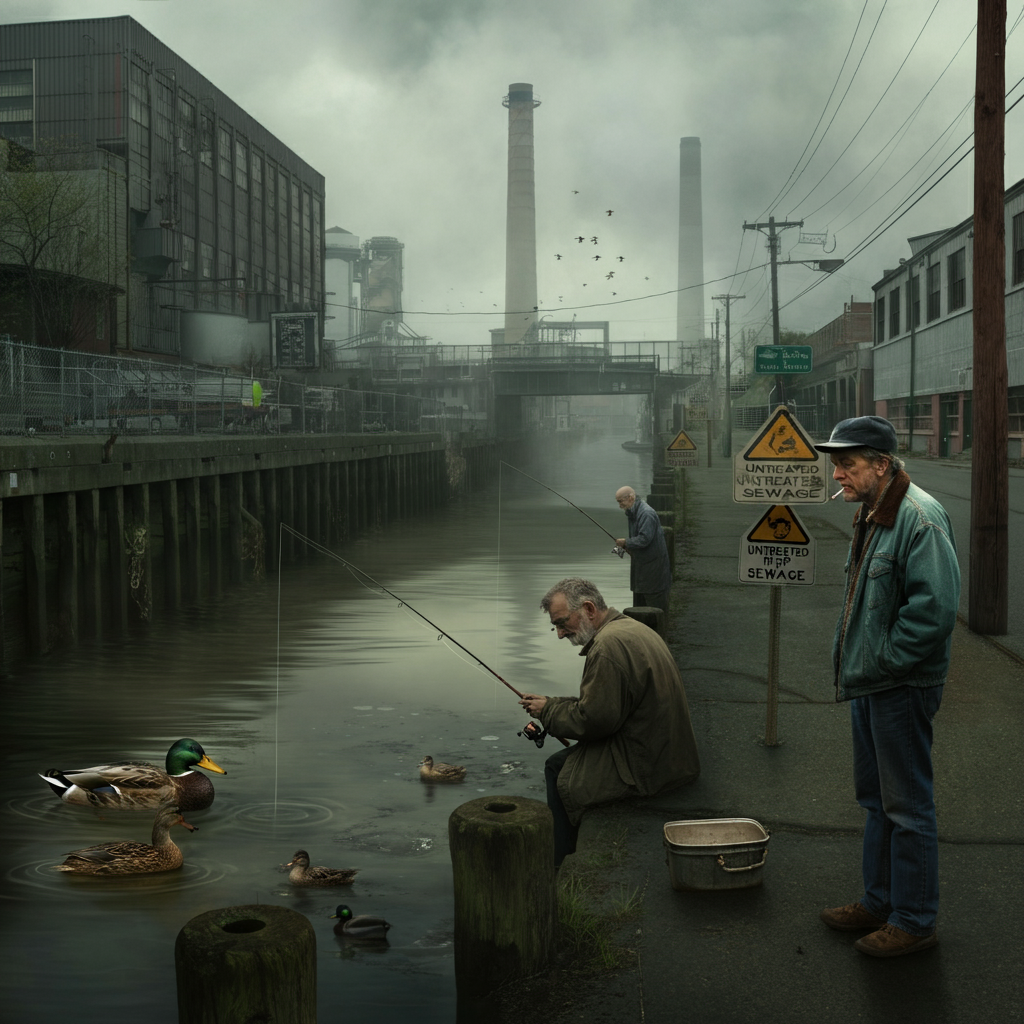
The Fremont ship canal is not what you’d call picturesque.  It’s a manmade waterway that looks like it was designed by someone who hated both nature and joy.  The water is a murky shade of “don’t ask,” and there were signs everywhere warning you not to fish because, apparently, the canal doubles as a sewage slip-n-slide.  Naturally, this did not deter the local fishermen, who were mostly older Asian men with the kind of grim determination you’d expect from people who’ve seen some shit – both figuratively and, in this case, literally.  It boggled my mind…there were dozens of them – warning you, quote, “untreated sewage is routinely discharged into this waterway.”  Which is bureaucratic for: This canal is full of shit.”

But like some kind of secret society of defiant anglers who had collectively decided that gastrointestinal risk was a small price to pay for the thrill of catching a three-eyed trout.  I tried talking to them.  I really did…I was pretty desperate for a friend at that point.  But, alas, they didn’t speak English, and I didn’t speak whatever dialect of “leave me alone” they were fluent in.  They’d glare at me like I was interrupting a sacred ritual, which I probably was. 

So I stopped trying to talk.  I just watched.  I watched the ships.  I watched the fishermen.  I watched the ducks that looked like they’d been though a chemical spill.  I watched the joggers who ran like they were being chased by their own regrets.  I became a kind of paragongoozler – not just watching the canal, but the entire ecosystem of weirdness orbiting it.  It was like a slow-motion circus, and I was the sad clown in the audience, applauding the sewage ballet.  Sometimes, when your brain is a dumpster fire and your wallet is a cruel joke, all you can do is stand by a canal and bear witness to the absurdity. 

N.P.: “When The Lights Go Out” – Oingo Boingo

Word of the Day: jentacular

Fuckin’ Tuesdays, dear reader…am I right?  Anyway, today’s lexical artifact, plucked from the dusty, cobwebbed archives of words that ought to be used more, is jentacular.

Jenatacular (adjective): Relating to breakfast.

Yes, really.  There exists a specific, glorious, and for my money tragically underutilized word just for things pertaining to the first meal of the day.  It’ a Latin hand-me-down, derived from ientaculum, which means, you guessed it, breakfast.  The Romans, between bouts of conquering and plumbing innovations, apparently had enough time to coin a dedicated term for their morning nosh.  And we, in our infinite wisdom, have let it wither on the proverbial vine.  A crime against language, I tell you.  Now, for a practical application.
The alarm – a sonic atrocity that sounded  less like a chime and more like a pterodactyl being fed into a woodchipper – had already done its unholy work.  I peeled on eye open to a world rendered in the depressing grayscale of pre-dawn misery.  My head throbbed with the ghosts of shitty decisions past, each pulse a tiny hammer on the back of my eyes.  This, I thought with a profound sense of cosmic injustice, is the price of admission.
The kitchen was a war zone.  The toaster, a malevolent chrome cube with a death wish, had immolated its bread-based hostages, belching a plume of acrid smoke that now clung to the ceiling like a lost soul.  A Jackson Pollock of coffee grounds decorated the counter, the result of a fumbled, pre-caffeinated attempt to operate the grinder.
I stood there, barefoot on the cold floor, observing the tableau of my domestic failure.  The smoke detector chirped a single, mocking note.  My stomach growled, a low, guttural protest against the very concept of continued existence.  I looked at the blackened toast, the coffee-splattered carnage, the existential void staring back at me from the bottom of an empty mug.  It was in the moment, surveying the smoldering ruins of my morning ambitions, that the full, unvarnished horror of the entire jentacular catastrophe truly landed.  I sighed, grabbed the bottle of whiskey from the cabinet, and decided to just start the day over tomorrow. 

N.P.: “No Yes More Less” – PIG

Word of the Day: perendinate

It’s confession time, dear reader: I have had, for quite some time, a likely pathological problem with procrastination.  It’s always been an issue, but lately, it’s become more of a lifestyle.  This last year, I have begun working in procrastination the way the Inuit work in scrimshaw.  I have seemingly, inadvertently, elevated it to an art form.  A philosophy.  Someone trusted recommended seeing a hypnotherapist for help dealing with it…and this idea is being seriously considered.

This was all very much on my mind when I picked today’s Word of the Day: perendinate.  This verb means “to put off until the day after tomorrow.”  Not tomorrow.  Not later.  The day after tomorrow.  The procrastinator’s procrastination.  The Olympic-level delay.  The art of kicking the can so goddamn far down the road it ends up in a different zip code.

From the Latin perendinare, rooted in perendie meaning “the day after tomorrow.”  It’s what the Romans did when they didn’t want to deal with Ceasar’s wine hangover or Brutus’s existential dread.  They perendinated.  Like superstars.

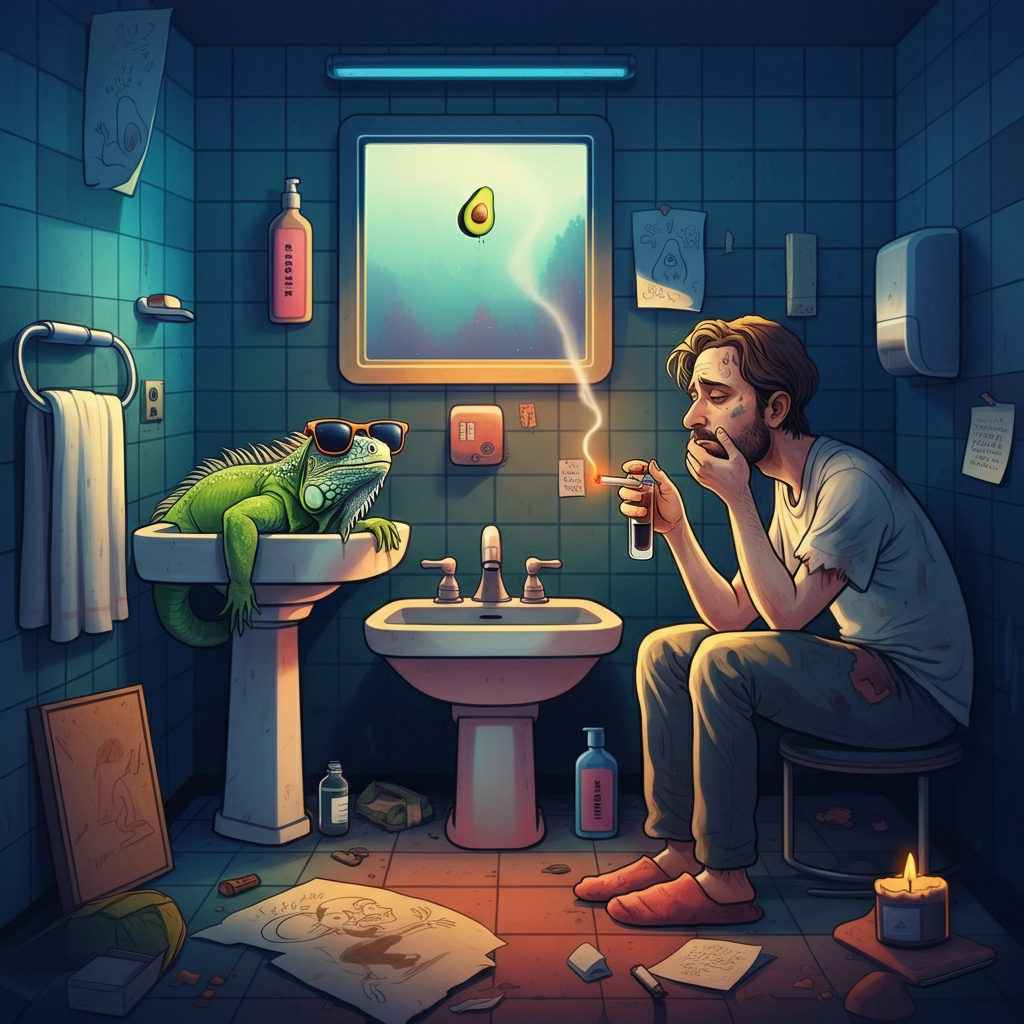
So I wake up in a Motel 6 in San Ysidro with a mouth that tastes like a bum’s nutsack and a head full of regret, tequila, and what I hope was consensual karaoke.  There’s a note duct-taped to my chest that says, “You promised to fix the bidet.  It’s still screaming.”  No signature.  Just a drawing of a crying avocado.
I stumble into the bathroom, which smells like a crime scene and a botanical garden had a baby and left it to rot in a bus-station urinal.  The bidet is indeed screaming.  Not metaphorically.  It’s emitting a high-pitched whine like a banshee trapped in a plumbing seminar.  It’s awful.  I consider fixing it.  I really do.  But then I remember I have a half-written blog post about the sociosexual implications of furries at political protests due yesterday, and what I’m guessing is half-an-order of carne asada in my boot. 

So I do what any self-respecting American Man of Letters would do: I perendinate.  I light a cigarette with a scented candle, pour myself a shot of the expired cough syrup I keep on hand for Times Like These, and whisper sweet nothings to the iguana in the sink.  His name is Carlos.  He’s in the country both illegally and involuntarily.  He’s wearing my sunglasses.  He’s dead, but he seems to be judging me. 

N.P.: “Touché” – Tigerblood, Jewel

Word of the Day: absquatulate

Alright, degenerate reader, gather ’round the flickering fire of Uncle Jayson’s laptop screen.  It’s time to inject a little polysyllabic venom into your otherwise monosyllabic grunts of existence.  Today’s lexical champion, a real pearl of a word that sounds like something a Victorian butler would shout before cannonballing into a vat of gin, as absquatulate.

Let’s dissect this beautiful beast.

Absquatulate (v.): To leave somewhere abruptly.  To depart without ceremony.  To vamoose, skedaddle, bolt, or in less delicate terms, to fuck off post haste.

It’s a magnificent American-made mutt from the 1830s, likely a jocular mashup of abscond, squat, and perambulate.  It’s a word that wears a top hat while giving you The Finger.  It’s got that pseudo-Latin flair that makes you sound smarter than you are, which is the whole point of this goddamn exercise, isn’t it?

Now, for a practical application.  A demonstration from the field.  We go back to the previous century, when I was first getting to know Boochie.

The bachelor party for one Teddy “The T-Bone” Bonesteel had achieved a state of what can only be described as high-entropy depravity.  We were someplace awful, in the swampy, palmetto-choked hinterlands of Coastal Georgia, the air so thick with humidity and the thrumming of insect wings you could practically chew it.  The groom-to-be, a man whose primary virtues were his impossibly square jaw and his ability to metabolize truly heroic quantities of bourbon, was duct-taped to a lawn chair, his face a Jackson Pollock of Sharpie-drawn phalluses.  The rest of us, a motley crew of shambling, sweat-drenched apostles of bad decisions, were orbiting a chipped Formica table.

Upon this table sat the last bastion of our collective will to continue: a small, tragically finite mound of premium Bolivian marching powder.  It represented the final push, the summit of Everest, the one last charge against the encroaching dawn and the brutal hangover it promised. 

And then there was Boochie.

Boochie – real name Aloysius, a fact he guarded with the ferocity of a mother bear defending a cub made of secrets and shame – was Teddy’s second cousin.  He was a young man whose entire personality seemed to be a composite sketch of other, more interesting people’s vices.  He had the nervous energy of a cornered ferret and the kind of darting, avaricious eyes that suggested he was perpetually calculating the resale value of your dental fillings.  All night he’d been hovering near the supply line, a hyena circling a wounded wildebeest, making these weird, wet, smacking sounds with his lips. 

The best man, a slab of a human named Dirk, had just finished a long, rambling, and anatomically improbable story about a girl he met in Phuket.  A momentary lull descended.  In this sacred pause, where the only sounds were the buzz of a dying fluorescent light and Teddy’s rhythmic, bourbon-soaked snores, Boochie made his move.  It was a blur of frantic, graceless motion – a symphony of pure, uncut scumbaggery.  With the desperate speed of a man snatching the last life raft off the Titanic, he palmed the entire remaining pile of cocaine, scraped it into a crumpled Waffle House napkin he produced from God-knows-where, and, without a word, a glance, or even the slightest hint of a goodbye, proceeded to absquatulate through the screen door and into the shrieking, insect-filled darkness of the Georgia night. 

We just sat there for a second, stunned into a rare and profound silence, processing the sheer, unmitigated ballsiness of the act.  Then Dirk, slow and deliberate, stood up, walked to the door, and bellowed into the void, “YOU ARE NO LONGER WELCOME AT THE WEDDING, BOOCHIE, YOU COWARDLY NOSE-RAVAGING FUCK!”

The echo died.  The cocaine was gone.  The party was, for all intents and purposes, over.  All that remained was the humidity, the hangover, and the indelible memory of a perfect word made flesh. 

N.P.: “The Revolution Is Here” – Thomas Vent

Word of the Day: limerence


Today’s Word of the Day is limerence.  It’s a noun meaning a state of mind resulting from romantic or obsessive infatuation with someone, typically involving an intense emotional longing and a near-constant preoccupation with the object of one’s affection.  Think of it as love’s unhinged, over-caffeinated cousin who shows up uninvited and refuses to leave.

Coined in the 1970s by psychologist Dorothy Tennov, the word “limerence” has no clear linguistic ancestry, which feels appropriate for a term describing something so primal and chaotic.  It’s a Frankenstein of a word, stitched together to name the electric storm of dopamine and delusion that hijacks your brain when you’re smitten beyond reason.

Let me confess something, dear reader, because I believe in transparency, even when it’s messy and embarrassing: I am in full-blown, unapologetic hetero limerence with Taylor Sheridan.
This isn’t some casual admiration or polite nod of respect for a fellow creative.  No, this is the kind of obsessive, all-consuming fixation that makes you questions your own sanity.  It’s the kind of thing that has you Googling “Taylor Sheridan ranch photos” at 2 a.m. while your whiskey glass sweats on the nightstand.
It all started innocently enough, as these things often do.  I watched Sicario several years back, and it hit me like a tactical strike to the soul.  The tension, the moral ambiguity, the sheer audacity of the storytelling – it was like someone had cracked open my skull, scooped out my cinematic preferences, and weaponized them into a film.  I was hooked, but I didn’t yet know the name of my dealer.
Fast forward a few years, and I stumble across Hell or High Water.  Same reaction: instant love, like a shotgun blast to the chest.  But again, I didn’t connect the dots.  It wasn’t until earlier this year, after a rewatch of Sicario 2: Day of the Soldado (a sequel that, against all odds, doesn’t suck), that I finally decided to investigate.  Who was this mad genius behind these films?  Who was the puppet master pulling the strings on my cinematic emotions?
Enter Taylor Sheridan.
What I discovered sent me spiraling deeper into the rabbit hole.  This man isn’t just a screenwriter; he’s a goddamn force of nature.  A cowboy-poet with a $200 million deal at Paramount and a ranch the size of a small European country.  He’s not some Ivy League dilettante who lucked into Hollywood success.  Nope, he’s the real deal – a Fort Worth native who grew up wrangling cattle and probably knows how to castrate a bull without breaking a sweat.
It was his prolificity that rocked me.  The man churns out scripts and shows like he’s got a direct line to the Muses.  Yellowstone, 1883, 1923, Mayor of Kingstown, Tulsa King, Landman, Lioness – it’s like he’s single-handedly trying to keep the Western genre alive while the rest of Hollywood churns out shitty superhero sludge.
Here at the Safe House, we’ve been on a steady diet of Sheridan’s work all summer.  It’s become a ritual…after my day’s writing is done: whiskey, popcorn, and whatever new frontier of moral complexity he’s decided to explore.  And now, as we count the days to the second season of Landman, I find myself in a state of feverish anticipation.
Here’s the thing about limerence: it’s not rational.  It doesn’t care about logic or moderation.  It’s a wildfire, and Taylor Sheridan is the spark that has set my brain ablaze once again.  So here I am, a grown-ass adult, confessing my borderline-embarrassing obsession with a man I’ve never met but feel like I know well through his work.  For those of you who’ve been following me for a while, you know that a common complaint over the last several years has been that most of the artists I used to get inspiration and energy from are dead, and that things just aren’t the same now that, say Prince is gone.  I used to get a lot of energy from knowing that whatever I was doing, Prince was out there at the same moment creating brilliant art, and if he was staying up late working, then I needed to too.  The artists I’m referring to were like bright lights on the distant horizon, but gradually, those lights went out.  But now I’ve got Taylor.  We’re completely different writers, with completely different agendas and styles, but he is a welcome inspiration.  You may have noticed my output increasing significantly in the last six months or so, and this has a lot to do with that.  For the first time in a long time, there’s a writer I’ve never met who I’d love to go on a whiskey bender with, who’s badass enough to actually keep up.  And now I find out dude has his own brand: Four Sixes Whiskey!
It’s official…I want to be Taylor Sheridan when I grow up. 

N.P.: “Tide & Timber” – Edries Br

Word of the Day: Xanthippe

Today’s Word of the Day is Xanthippe.  It’s a noun meaning a shrewish, ill-tempered woman; a scold whose tongue cuts like my switchblade through butter.  Named after Socrates’ wife, reputedly a harpy of such mythic proportions she could make a philosopher question existence itself.

Derived from the Greek Xanthippe (Ξανθίππη), the name of Socrates’ spouse, whose alleged nagging became the stuff of ancient Athenian gossip.  First used in English around the 16th century to denote a woman whose vitriol could curdle wine.  From xanthos (yellow, fair-haired) and hippos (horse), though the etymological irony of “fair horse” for a termagant is a linguistic middle finger to decorum.  It’s either a weird flex or a sick burn, depending on how you look at it.

So there I am, three whiskeys deep into a Wednesday dusk, my typewriter humming like a junkyard Pontiac, when the air splits with the bellow of my neighbor, Brianna (we call her Big Brian), a “woman” built like a linebacker with the charm of a hungover wolverine.  She’s pounding on my door, her meaty fists rattling the hinges, hollering about a late-night drum circle that got going with some friends just back from Burning Man and the “goddamn jungle cacophony” of my half-feral parrots.  I fling open the door, shirt unbuttoned, a Camel dangling from my lip, ready to parry her outrage with my own.
“Brianna,” I snarl, “you miserable twat!  Your complaints are unwelcome.  Go back under your bridge and wait for your prandial goat to wander by, you troll.”
She looms, her face a topographic map of rage, eyes glinting like the business end of a chrome-plated shotgun.
“You degenerate goddamn scribbler,” she roars, “your noise is peeling the paint off my walls!”
The parrots, sensing blood, screech their approval from the living room, a feathered Greek chorus egging us on.  What ensues is a verbal cage match, a linguistic demolition derby.  She accuses me of harboring “a zoo for lunatics”; I counter that her nighty outdoor showers after swimming in her pool are traumatizing the local wildlife.  Her jowls quiver, her voice a foghorn of indignation, and I’m half-convinced she’s about to bench-press me into the next county.  But I’m no wilting poet – I lean in, whiskey breath and all, and lob a  barb about her grotesque yard décor, specifically her stupid fucking lawn gnomes, those “creepy ceramic bastards” staring into my soul.  She gasps, clutching her imaginary pearls, and I know I’ve hit the mark.
Then, in a moment of pure, unscripted glory, she unleashes her inner Xanthippe.  “You think you’re clever, you booze-soaked word-monger?” she thunders, her voice a sonic boom that sends the parrots into a flapping panic.  I’ll have your lease revoked faster than you can misquote Kerouac!”  It’s magnificent, her fury a force of nature, like a hurricane with a perm and a grudge.
“Lease?  I
own this bitch!”  I cackle, salute her with my glass, and retreat to my typewriter, making a mental note to shit in their pool again the next time they leave town. 

N.P.: “One Way Or Anther” – Broken Peach

Word of the Day: imprecation


Today’s Word of the Day is “imprecation.”  It’s a noun meaning “a spoken curse; an invocation of evil or misfortune upon someone; a profane oath or malediction hurled with the specific intent of summoning cosmic retribution upon one’s enemies, rivals, or that idiot who cut you off in traffic while you were already running late for your court-mandated anger management session.

From the Latin imprecatio, meaning “to invoke” or “to call down upon,” which itself derives from im- (upon) + precari (to pray).  Because apparently, even our ancestors understood that sometimes prayer needs a little…creative direction.  The word first slithered into English around the 15th century, presumably when people realized that simply muttering “darn” wasn’t quite cutting it anymore.

Picture this, dear reader: it’s Friday night, and in a move I can only blame on equal parts bourbon and catastrophic optimism, I invited Tasha – hot, terrifying, and probably allergic to commitment – back to my lair for a “home-cooked dinner.”  My definition of “home-cooked” being whatever hellish combination of fire and bad decisions I could wrangle from a Dudes Living Alone recipe blog. 

The kitchen was already a goddamn war zone.  I’d tried to wipe up yesterday’s ramen explosion with a sock.  The smoke detector hung in the corner like a pissed-off ex, daring me to make one wrong move.  On the stove: a pan of bananas foster that looked less like “dessert” and more like “evidence in an arson investigation.” 

So what do I do?  I pour twice as much rum into the pan “for flavor,” which we all know is culinary code for “to see God.”  I light the match, and an eruption of blue flames whooshes to the ceiling.  Within seconds, I have set fire not only to dessert by also to my decrepit linoleum, part of the curtains, and possibly the lower atmosphere. 

Tasha – credit where it’s due – doesn’t scream.  She doesn’t even flinch. She just watches, stone-faced, as my IKEA spatula melts into ’90s plastic goo and my dog (Beelzebub) bolts straight out of the dog-door at Mach 2.  The fire alarm is bellowing like Satan’s kazoo, and I’m slap-dancing at the flames with a wet Rolling Stone back issue, which is not both on fire and somehow stuck to my jeans. 

My neighbors are banging on the front door.  Beelzebub is barking somewhere in the alley, possibly summoning lesser demons.  Smoke fills the house like I’m auditioning for “Worst Hotboxer in America.”  And all I can do is unleash a spectacular torrent of imprecation at the universe, the smoke alarm, the goddamn bananas, and honestly, at myself – creative profanity so loud and sustained I’m pretty sure the Pope just renounced me by proxy. 

Tasha orders an Uber in three silent swipes without losing eye contact – bold power move, honestly – and walks out, stepping over my flaming vinyl copy of “Bat Out of Hell” like it’s another Tuesday.  I’m left shirtless, coughing, and considering whether calling the fire department or moving to Guam is less humiliating. 

Dinner was ultimately pizza.  The dog came home eventually, smelling like brimstone and judgment.  And every time I walk into that kitchen, the burn mark on the ceiling still spells out “Never Try.” 

N.P.: “We All Scream” – Five Alarm Funk