Category Archives: Lucubrations

August 1, 2025


Ugh, dear reader.  Your boy was laid low by a particularly pernicious case of The Crud.  Not just your common corner-store head cold, either – no, this was full-on pestilence, like consumption but with fewer dramatic gasps and more snot.  I’ve been sweating through my sheets like…I dunno, something that sweats inordinate amounts in the night, throat raw enough to be legally declared sushi, and my voice was just shot to hell.  Imagine Tom Waits gargling gravel in a hurricane.  It’s be a goddamn opera of misery with yrs. truly singing lead.

Alas, life, of course, refuses to press “pause” just because I’m horizontal and leaking from the face.  Which brings us to more pleasant things, a couple of things that made me smile whilst suffering the sickness.  To wit:

  1. The days, dear reader, are getting noticeably shorter, while the nights are stretching their long, velvety fingers further and further into our lives.  This is the ever-shortening runway to autumn, the season that smells like woodsmoke and tastes like apple cider donuts.  And
  2. Halloween is just 91 days away.  Just enough time to make panic decisions about costumes, pretend you’re thrilled when someone inevitably starts barking about pumpkin spice season, and stockpile a metric shit-ton of candy you have no intention of sharing with children.

As you know, dear reader, I love Halloween.  Think it’s great.  And I can’t wait for it to get here.  That said, however, a week ago…ya know, back in July…as I was driving skillfully through a college marching band, my eye was caught by something orange, black, and familiar: a sign for a Spirit Halloween Store.  In fucking July!  Then, the next night, I walked into the Fecal Creek Costco and couldn’t help but notice a 20-foot skeleton standing in the middle of a huge Halloween section.  Also in fucking July!  Again, I’m all about Halloween, but god damn!

Here’s the thing: Halloween is great in its own right, but a big part of why I love it has to do with all the other decidedly fall/winter things the holiday brings: Fall, and cooler weather, longer nights, the smell of rain on dead leaves.  And it’s the kick of “the holiday season.”  Time to watch horror movies and make beef stew.  It’s the same reason seeing pro football on tv makes me so happy.  I don’t give a shit about football, and fuck the NFL anyway.  No…football on TV means fall and winter are upon us.  Doing anything Halloweeny while it’s 100°F outside is grotesque.

Anyway, so much for all that.  We have a bit of D.P.S. business: today is Herman Melville’s birthday.  Uncle Herm was a master of deep-sea metaphors, perverse literary masochism, and radically labyrinthine sentences.  He took a whale, shock it so hard it became an existential crises, and then made everyone read 800 pages about it.

For the non-English majors joining us this evening, Melville is the mad bastard responsible for Moby-Dick, a painfully massive tome about a Captain obsessive war with a big-ass whale (it’s a bit more complicated and layered than that, but we’re not going down that rabbit hole tonight, dear reader).

Cheers to you, Herman.

N.P.: “Love & Happiness (Ghetto Filth Remix)” – Wiccatron

July 24, 2025


I’m gonna let you in on a bit of a secret, dear reader: my favorite book, my favorite story, ever, the one that has captured my psyche and imagination since the first time I heard it, at the age of six, is The Count of Monte Cristo by Alexandre Dumas.  The movie was going to be on TV back then, and my father seemed very interested in watching it (back then, nothing was on-demand: the three networks showed what they showed when they showed it, and if that didn’t work out with your schedule, tough shit – you didn’t get to see it.  My father, as I recall, had done a bit of schedule adjusting and planning to watch this movie).  Before it started, I asked him what it was about, and he told me: a young man is betrayed by his friends and acquaintances, even the woman he loves.  His friends conspire and lie and have the young man thrown in a gothic abomination of a prison for life for a crime he didn’t commit.  While he’s in prison, his father suffers greatly due to his son’s imprisonment and eventually dies from grief and poverty.  But then the young man escapes, finds a massive treasure, gets a new identity, and sets about taking his revenge on all those who betrayed him.  And that clicked so strongly in my head that I suspect my father actually heard the click.  I couldn’t imagine a more righteous fight: escaping from wrongful punishment and destroying those who were behind its infliction.

So then we watched the movie.  Back then, I thought most of what my father watched on TV (i.e., not cartoons) was boring.  Not that night.  That night I watched the entirety of the movie absolutely rapt.  I learned the young man’s name was Edmond Dantès, and he was my kindred spirit…or at least the first time I related to anyone, fictional or otherwise, in that way.  I also learned the best revenge is played in the long game.  It requires patience and unwavering will power to endure suffering and neglect.  I learned a lot of things that night…a surprising amount.  I didn’t know it at the time, but the experience of that story would be formative.  From that moment until right now as I’m sitting here typing this, revenge was, is,  and likely always will be my biggest motivator.  Seriously.  Fear not, dear reader…I’m aware of how problematic this is, and I have spent a great deal of time on various mental health professionals’ couches “dealing” with it.  For a while, on the advice and under the care of one such professional, I attempt to “let it go.”  All of it.  Quit viewing life as time to take out those on The List and spend my time in my head doing something else…feeling gratitude or some such hippie hooey.  I spent a couple years trying (I mean really trying) and failing (I mean really failing) to meditate.  Hell, I went to hypnotherapist about it.  Which was interesting, and those closest to me at the time noted that I was “a lot nicer,” but alas, it didn’t really take.  After a couple of awkward years, I said “fuck it” and went back to my vengeful ways.  It felt like coming home.  During a very uncomfortable time in my life, I was suddenly comforted.

Okay…gotta stop…all of this belongs in the book.  Besides, this isn’t supposed to be about me.  This is supposed to be about the birthday boy…the author of my favorite book.

Alexandre Dumas was born on this day in 1802, and if there’s any justice in the afterworld, the man is somewhere today picking sword fights with angels and uncorking bottles of celestial champagne.  He was larger than this messy, meat-grinding life – an unapologetic tornado of appetite, ambition, and literary brilliance.  This was the guy who gave us not only The Count of Monte Cristo, but also the more popular The Three Musketeers, which is, while I was diving into the story of the Count, what the other kids in my class were into.  He wrote about six jillion other tales of intrigue, betrayal, and swagger-dripping heroism.

But here’s the thing.  Among all his triumphs – and there are many – it’s The Count that sits at the top of the mountain, an exquisite cocktail of vengeance service ice-cold and spiked with the kind of high-stakes drama most writers can only fantasize about.  Reading it (for me) is like stepping onto a battlefield armed with rage, cunning, and a self-righteous thirst that could flatten nations.  And yet, my one complaint – with zero apology – is that Edmond Dantès, the Count himself, wimps out at the finish line.  Forgiveness?  Redemption?  Goddammit, no!  No, no, no.  Not in this house.

I am, as usual, almost completely alone in my opinion, here.  The Count of Monte Cristo is a supposed to be a redemption story, the redemption happening when Edmond/The Count realizes that his quest for revenge, which is a thing of absolutely beauty in my book, has consumed him and caused suffering to others (well, yeah!  Why else embark on a quest for revenge?) including “innocent” people (in my world this is known as “collateral damage”).  If you want to make an omelet, you’ve got to break some eggs.  But the Count suddenly seems to misplace his balls somewhere and decides to forgive his enemies and let go of his hatred.  Apparently the Count is capable of this, and good for him, I guess.  But this part of the story, when he just goes soft and starts listening to Taylor Swift and watching Disney content, is always a crushing disappointment for yrs. truly.

Here…allow me to elaborate a tad.  Imagine being Dantès.  Twenty-something, engaged to a beautiful woman, on the verge of your life’s dream, and then BAM!  A Machiavellian screwjob of the highest order.  Then you’re framed for treason, locked away in some wretched dungeon while your enemies profit from your ruin.  One guy marries your fiancée, for chrissakes!  Another climbs the career ladder using your blood as rungs.  But then, you escape!  Against all odds, you claw your way back into the land of the living, armed with a new name, a pile of Fuck You money and Titanic-level resources, and one singular purpose: make everyone who destroyed you pay.

For most of the book, Dantès embodies vengeance in its purest, most operatic form.  A chess master orchestrating ruin with surgical precision.  Poisonings, psychological warfare, financial annihilation – his betrayers are crushed one by one beneath the weight of their own sins, which he amplifies like some vengeful, God-tier conductor.  It’s satisfying in that primal, blood-thirsty way that it seems humanity doesn’t really like to admit.  This is revenge as art.

But then.  Then.  After something like 1400 glorious pages of well-earned savagery, Dantès does the unthinkable – he gets soft.  He fucking forgives.  He decides vengeance has consumed too much of his soul or whatever philosophical drivel we’re meant to accept as closure.  Sure, maybe that makes him a “better person,” but some of us don’t read The Count of Monte Cristo for moral improvement.  Some of us want to see these backstabbing weasels buried six feet under with nothing but ruinous regret to keep them company.  Redemption is Disneyesque, kindergarten nonsense.  I want scorched earth.  Blood.  I want heads on spikes.

Which isn’t to say that the book is anything less than one of the greatest novels ever written.  I just rewrite the last chapters in my head every time I finish it – and in my version, no one crawls out unscathed.  Danglars doesn’t get to slink off after losing his fortune.  Fernand doesn’t bite his own bullet just because he happens to feel bad at the end.  No.  They all go down.  Every.  Single.  One.  That’s the ending I celebrate.

Still, Dumas, even at his softest, deserves nothing but awe.  The man was a magician, telling timeless stories while also bedding half of Europe and shaking hands with history itself.  (The guy once fought a duel once over a nasty theater review.)

So here’s to you, Monsieur Dumas.  Your words have outlived you by centuries, and your spirit will linger long after we’re all dust.  Raising a glass in your honor, and maybe, just maybe, plotting a hypothetical alternate Dantès ending where nobody gets forgiven and every wrong is avenged tenfold.  Cheers to a legend.

N.P.: “That Death Cannot Touch” – The Black Queen

July 21, 2025

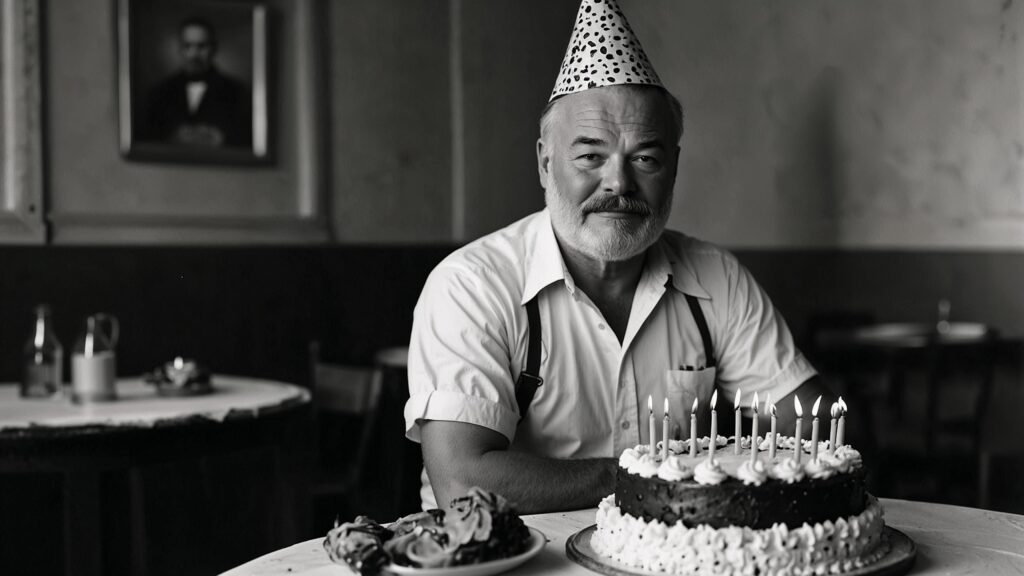
Seems like the last week or so has been a busy week or big-name literary births and deaths and such, does it not, dear reader?  Maybe it’s just me.  But the proverbial hits, as they say, just keep on coming.  Today, July 21, we hoist our glasses, sloshing with the good stuff (with the good stuff today being defined as a big fuck-off bottle of Dark Hedges Irish Whiskey…I’m about to find out how good it is), to the indomitable, beard-shadowed colossus of America letters, Ernest Hemingway, born this day in 1899.  The man carved his stories from the raw meat of existence, bloodied his knuckles on the world, and left us prose so lean it could cut glass.

I felt that paragraph deserve a snort of Whiskey…first impressions: burns a bit…a little raspy going down.  But it will clearly get the job done.  So now please join me, dear reader: pour one out, preferably something that burns going down, and let’s get to it.

Hemingway was a one-man war zone, a walking manifesto of grit and gusto.  Born in Oak Park, Illinois, he didn’t waste time sipping tea with the bourgeoisie.  By 17, he was banging out copy for the Kansas City Star, learning to strip sentences to their bones – short, sharp, true.  That style, that relentless economy of words, became his machete, hacking through the jungle of horseshit that passes for literature.  To wit:

  • The Sun Also Rises – More of a bullfight than a book, all blood and dust and broken hearts in Pamplona.  This 1926 novel follows Jake Barnes, a war-wounded expat journalist nursing a literal and figurative impotence, as he drifts through the booze-soaked cafés of Paris and the sun-scorched fiestas of Spain.  He’s tangled up with Lady Brett Ashley, a magnetic, reckless beauty who loves him but can’t stay faithful, and a crew of disillusioned drifters – lost souls of the Lost Generation.  They drink, they bitch at each other, they chase bullfights and heartbreak, all while grappling with the emptiness of a world that’s been shot to hell.  It’s a story about longing you can’t satisfy, purpose you can’t find, and the cruel grace of just keeping on.  Hemingway’s sparse prose makes every glance, every drink, every bull’s charge feel like a wound you didn’t see coming.  [A second slug of the Dark Hedges…burns less than the first one, which is usually how these things go.  Less of a shock to the system.]
  • A Farewell to Arms – A love story that kicks you in the teeth and leaves you gasping.  Set against the chaotic Italian front of World War I, it’s the tale of Frederic Henry, an American ambulance driver who falls hard for Catherine Barkley, a British nurse with a past as haunted as the war-torn landscape.  Their romance is desperate, all-in, a fleeting sanctuary amid the mud, blood, and betrayal of war.  Of course, Hemingway doesn’t do bullshitty fairy tales – love gets battered by shellfire, bureaucracy, and fate’s cold indifference.  When the couple flees to Switzerland, the story’s liver-kick of an ending reminds you that life doesn’t owe you a happy ending, just the strength to face the wreckage.
  • For Whom the Bell Tolls – Robert Jordan, a Montana dynamiter, joins a gang of Spanish guerrillas fighting Franco’s fascists in the Civil War.  His mission is to blow a bridge to stop the enemy’s advance.  Over four days, he grapples with love (enter Maria, a survivor with fire in her eyes), loyalty, and the ticking clock of mortality.  The title, cribbed from John Donne, says it all: no man’s an island, and every death chips away at us all.

But let us not, as you might in some other lit classes, get lost in the canon.  Hemingway’s life was the real novel – louder, messier, and more alive than any page could hold.  The man drove ambulances in World War I, got himself blown up and still crawled back for more.  He hunted big game in Africa, fished marlin that could swallow your ego whole, and boxed like he was settling scores with God.  He drank like a pirate, caroused in Parisian cafés, and turned Key West into his personal fiefdom of whiskey and words.  He did time in Cuba, slinging daiquiris and stories with equal swagger.  He jumped into Spain’s Civil War, dodging bullets and scribbling almost surreal dispatches.  And yeah, the man had flaws – big, jagged ones.  He could be a prick, a chauvinist, a violent storm of ego and insecurity.  But what writer isn’t at some (or most) points?  Four wives, countless feuds, and a temper that could torch a room.  But so what?  Who wants a saint?  Saints don’t stare into the abyss and come back with The Old Man and the Sea.  That book, that lone fisherman battling the ocean’s wrath, is Hemingway distilled – stubborn, solitary, and unyielding, even when the sharks come circling.

Gen Zers tend not to get it.  They tend to stare with stunning jadedness and mumble something about how “the world has changed.”  We’re drowning in tweets and memes, and Papa’s iceberg theory, where seven-eighths of the story lurks beneath the surface, feels like a relic.  But fuck them.  Hemingway’s still relevant, still dangerous.  In a world fat and bloated with hot takes and clickbait, his clarity is a switchblade.  And his life is a reminder to live hard, love fiercely, and write like your heart’s on fire, even if it leaves you scarred.

So here’s to you, Ernest…on your 126th birthday, we’re raising a glass of Dark Hedges, no ice, no apologies.  Happy birthday, Papa.  Keep swinging in the great barroom brawl of eternity.

Now, dear reader – go read A Moveable Feast, chase it with a shot of absinthe, and write something that’d make Hemingway nod from the great beyond.  Or at least spill some booze in his honor.  Cheers.

N.P.: “Bottle With Your Name On It” – Thomas Rhett

July 20, 2025 – Raising a Glass to Cormac McCarthy: A Birthday Rant on the Dark Prophet of American Letters

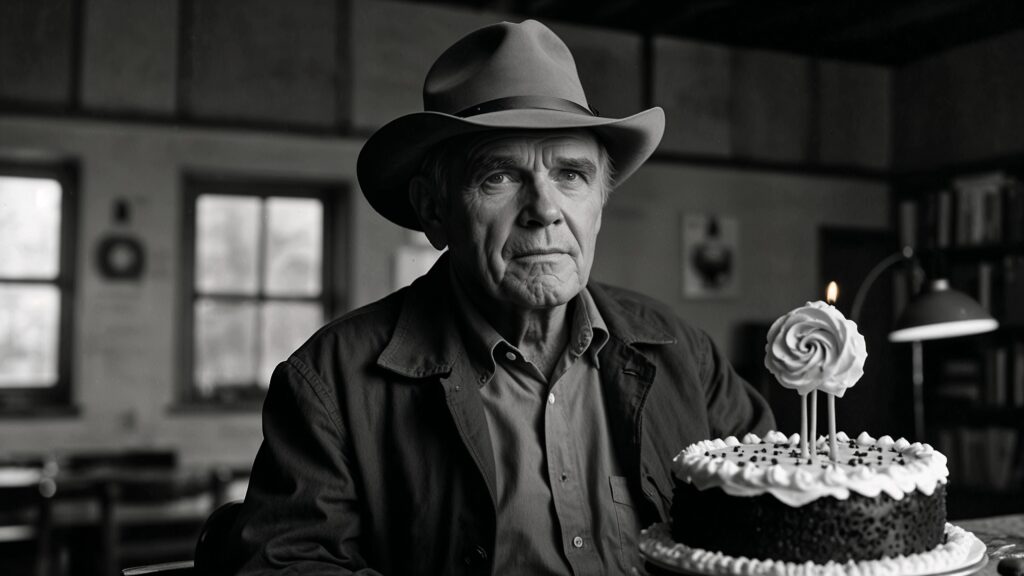
Well, hell, dear reader…it’s July 20, and the ghost of Cormac McCarthy’s birthday is rattling its chains, demanding a toast.  Cormac was, for my money, one of the two greatest novelists of my time (the other is Don DeLillo, who is still, thankfully, very much alive).  But today is for the late Mr. McCarthy.
Born in 1933, the old bastard would’ve been 92 today, probably still squinting into the void, penning sentences sharp enough to flay your soul.  He’s gone now – kicked the bucket on June 13, 2023, leaving us poorer for it – but his words still very much burn like cheap whiskey on a busted lip.  So here I am, half-cocked on desk whiskey and deep reverence, to sling some ink about the three McCarthy novels that have and shall always claw at my guts in the best way: No Country for Old Men, Child of God, and The Road.  If you haven’t read them, stop what you’re doing, light a cigarette (even if you don’t smoke), and prepare to have your soul dragged through the dirt.  Reading any of these three books is basically a bar fight with the abyss.  For you Gen Z creatures of comfort who can’t be bothered to crack an actual book, all three of these books were made into very respectable movies, so have at it.

First up, No Country for Old Men.  This is McCarthy at his most nihilistic, which is saying something.  It’s a story about a big bag of money, a psychopathic hitman, and the kind of moral decay that makes you want to shower in bleach.  This thing is philosophical meat grinder, a West Texas bloodbath where fate’s got a coin toss and a cattle gun.  Llewelyn Moss stumbles on a drug deal gone sour, snags a satchel of cash, and sets off a chase that’s less cat-and-mouse and more buzzard-and-corpse.  Anton Chigurh (that name alone is a blade in the dark) stalks the pages like death’s own CPA, balancing the books with a silencer. Javier Bardem’s portrayal of Anton in the movie version of the story has been called, correctly, the most accurate and realistic portrayal of a psychopath on the big screen.  The movie is one of my favorites, but the book is where it’s really at.  McCarthy’s prose is leaner than a starved coyote, every sentence a bullet.  The dialogue crackles, sparse but heavy, like men muttering over a campfire before the world ends.  It’s about chance and fate, sure, but also about how the old codes – honor, grit, whatever – get chewed up by a new kind of evil that doesn’t negotiate.  Reading it makes one want to punch a wall, then cry into one’s drink.  It’s that kind of book.

Then there’s Child of God, which is basically McCarthy saying, “Oh, you thought No Country was dark?  Hold my beer.”  Lester Ballard is a character so twisted, so utterly devoid of redemption, that you almost feel bad for him – until you remember he’s a necrophiliac living in a cave.  Yes, our boy Lester is a depraved little gremlin, a Tennessee hillbilly gone feral, humping corpses and scuttling through caves like some reject from God’s assembly line.  You shouldn’t like him, but McCarthy makes you stare, makes you see the humanity in a monster – because, hell, most of us are just one bad day from digging graves for company.  The prose here is raw, almost biblical, painting a world so bleak you can smell the rot.  It’s short, too, like a shot of rotgut that burns going down and leaves you queasy.  I love it for its nerve, for how it dares you to look away and knows you won’t.  McCarthy doesn’t flinch, and neither should you.

And finally, The Road.  Sweet, merciless Road.  This is the book that makes you want to hug your kids, stockpile canned goods, and never, ever take a sunny day for granted.  This one’s a sledgehammer to the heart.  A father and son trudging through a world scorched to ash, where hope’s a memory and cannibals are the neighbors.  It’s apocalypse stripped to the bone – no zombies, no sci-fi bullshit, just survival and love in a place that doesn’t give a shit.  The father’s cough, the boy’s questions, the way they carry “the fire” – it’s all so fragile you want to scream.  McCarthy’s style here is stark, almost poetic.  I read it when I’m feeling too cocky, when I start to mistakenly think the world’s got my back.  It humbles you, makes you want to hug your kids or your dog or hell, even a stranger, just to feel something warm.  It’s a love letter to what’s left after everything’s gone.

McCarthy’s dead now, and the world feels thinner without him.  He wrote like he was carving epitaphs, each one daring you to face the dark and keep walking.  So today, I’m pouring some out for Cormac, that grim old poet of blood and dust.  Happy birthday, you magnificent bastard.  May your shade find a barstool in whatever dive serves the afterlife’s best whiskey.  Here’s to No Country, Child of God, and The Road – three shots of truth that hit far harder than a hangover.  Cheers, and rest in chaos.

N.P.: “Up Jumped the Devil” – David & the Devil

July 18, 2025

Alright, dear reader, if you don’t know what day it is, you should.  Somewhere, in the halls of bourbon-soaked eternity, sits a man who once pistol-whipped conventional journalism, shoved it down a sandpaper slide, and baptized it in a pool of acid-laced self-awareness.  That man, born on July 18, 1937, amid the southern gothic sprawl of Louisville, Kentucky, would erupt into existence nothing less than a human bunker buster for the literary world – Hunter Stockton Thompson.  Today, we light a ceremonial joint, shotgun a tallboy, and salute the King of Gonzo in all his unhinged chaos.

To properly talk about Thompson (and honestly, to even try to keep your adjectives in place while doing so), is to ride shotgun in a careening Cadillac speeding toward the sharp cliff edge of meaning itself.  His invention of gonzo journalism was less a writing style and more a manifest scrawled in blood-red Sharpie on the back of society’s Ikea instruction manual.  Objectivity be damned; Thompson wasn’t about observing the story – he was the story.  He waded into the filthy trenches with his subjects, mainlined their madness, and stitched his fractured psyche across every page he produced.  Subtle? Hell no.  Effective?  Absolutely.

Take Hell’s Angels, for example.  He didn’t just “write about” those smoke-belching, bar-brawling apostles of chaos.  Nope…Thompson got in the saddle, ate their dust, drank their beer, and got his face caved in for the privilege.  He emerged – bloody, patched up, and somehow syllabically sharper – with one of the most brutally honest dissections of America’s outlaw soul.  But did he stop there?  Shee-it.  HST didn’t dabble in rebellion – he deep-throated the shotgun of conformity and loaded both barrels himself.

And then, of course, there is Fear and Loathing in Las Vegas.  If the American Dream was an actual physical object, that book would’ve taken a staple gun to it and lit it on fire.  It’s a masterpiece of gonzo depravity – a demolition derby held inside the fragile collective skull of a nation limping out of the 1960s, hungover and disillusioned.  Riding high on mescaline, ether, and enough high-proof liquor to get entire third-world nations drunk, Thompson peeled back the tacky, neon-lit veneer of Vegas and revealed…well, ourselves.  Ugly.  Greedy.  High as hell.  And blaming it all on everyone else.  And I found it all very relatable.

I was an undergrad trying to figure out whether to major in music or English, and was dividing most of my class time between subjects.  I was taking a couple of creative writing classes, and in those classes, people kept asking me after class if I’d heard of Hunter Thompson and/or Fear and Loathing in Las Vegas.  Eventually I went to Tower Books and picked up a copy.  It was a Friday afternoon.  I went home to my apartment, got comfortable on the couch, and started reading.  And I read the entire thing straight through (which was something I’d never done before), howling and cackling throughout the entire thing.  But more importantly, aside from being the funniest thing I’d ever read to that point, Vegas kicked me in the mind.  The next night I was on a dinner date, and I drank Chivas with my meal.  When Monday morning rolled around, I went to the Registrar’s Office and changed my major from Music to English.  Dr. Thompson had just blown open the possibilities of writing in my head…I didn’t know you could do that with writing.

But it wasn’t just what he wrote that mattered.  It was how he burned himself, raw and live, into the fabric of the narrative.  He shredded the wall between the observer and participant, reporter and drug-fueled maniac, proving that some truths are so ugly you have to punch them straight in the throat to make them talk.  And right there, bleeding in the dirt, is where he lived.  Where most authors tiptoed around controversy or built polite little fences to sit on, Thompson set the whole field on fire and rode through it naked on a motorbike.

Thompson ultimately left the world the same way he moved through it, with a thunderclap and zero regard for everyone’s fragile sensibilities.  But even in his absence, his spirit lingers in some of us, in every defiant middle finger flipped at the bastards trying to quash originality and every word typed by a writer who refuses to “play nice.”

Today, we remember not just Thompson’s birth but the explosion that came with it.  A reminder that the best way to honor a literary outlaw who lived without brakes is to live: messy, loud, and unapologetic.  Because fear is boring, conformity is worse, and the truth, no matter how grotesque, always tastes better when served raw with a fifth of Jack.

Happy birthday, Hunter.  Wherever the hell you are, I hope they’re letting you smoke.

Now, if you’ll excuse me, I’ve got a bottle of bourbon and a typewriter calling my name.  It’s what the good doctor would have wanted.

N.P.: “Lawyers, Guns & Money” – Warren Zevon

July 17, 2025

Seventy-eight years ago, a 25-year-old kid with a notebook and a bad case of existential itch packed himself into a car headed straight for the raw, writhing guts of America.  That kid was Jack Kerouac, and what he did that summer wasn’t just a road trip.  It was an existential tantrum dressed up as adventure – a booze-drenched fever dream of freedom with jazz riffs for punctuation and a reckless sprint toward something like divinity.  Or maybe the whole thing was just a desperate stab at drowning out the noise in his own head.  Either way, what came out the other end was On the Road, a book more combustible than a jerrycan of gas in a bonfire.

Picture it, dear reader.  July heat, just like the kind baking wherever you are right now in the northern hemisphere.  The kind of heat that makes the pavement shimmer, as if the road isn’t  just something to be traveled but something alive and pissed off, daring you to drive faster.  Kerouac had the windows rolled all the way down, likely because the car was either without A/C or it was simply harder to breathe in when the windows were shut.  And there he was, pinballing across the country with the verve – and perhaps hygiene – of a man who needed this drive not just to live but to avoid imploding.  There’s probably a word for the energy he was chasing, but it’s not in English.  It’s a headspace between euphoria and collapse, where everything burns brighter and breaks harder.

And the kid?  He scribbled through it.  Through the truck stops and motel ashtrays, through the miles of asphalt stretching out ahead like some cosmic dare.  Jazz on the radio, junkie poets for company, and God knows what in the flask riding shotgun.  Kerouac wrote like a man possessed – not by demons, but by something much scarier: hope.  Not the easy Hallmark variety, but the bone-deep, terrifying kind that makes you wonder if somewhere, out there, there’s a way to fill whatever black hope keeps chewing through your insides.

When On the Road his shelves in 1957, it was a lit match in a room full of dynamite.  Suddenly, every Poor Bastard in America who’d been staring down the barrel of nine-to-five mediocrity had permission to trash the manual.  This wasn’t about winning; it was about searching.  About saying “fuck it” to the scripts we’re handed and chasing the kind of truth that burns like whiskey going down.

Many made the mistake of calling it romantic.  But the road isn’t about romance – it’s about friction.  [The same could be said about sex, of course.]  The kind of friction that leaves you scorched and skinned and shaking but alive in a way you forgot you could be.  Kerouac wasn’t glorifying anything.  He was giving us the messy, bloody glory of coming undone – and maybe finding God in the process.  Although, spoiler alert, it probably wasn’t the God you’re thinking of.

Fast forward to right now.  July 17, 2025.  Do the math, dear reader.  You’re not too old, too broke, or too goddamn civilized to take your own swing at this.  You won’t be Kerouac – good.  He already did it, and you wouldn’t survive on the kind of coffee and amphetamines that fueled him anyway.  But was you can do is crack open a notebook, climb into whatever vehicle you’ve got, and chase something that’ll look different from freedom but feel just as dangerous.

And maybe when you’re out there burning rubber through the sticky American night, you’ll catch a little of the jazzed-up chaos Kerouac found.  And I’ll be out there with you, chasing the same thing.  Just make sure when you catch it, write it down.

N.P.: “I Gotcha” – Eleven Triple Two, Ghostwriter

July 16, 2025

It’s been a helluva day, dear reader, and I am exhausted.  Far too tired to commit any great literature, that is certain.  I’m probably pretty incoherent at this point.  But I would be remiss if I didn’t acknowledge the significance of this date on the calendar of badass American letters.  July 16, 1951 was the date J.D. Salinger’s The Catcher in the Rye was published.  It’s impact on the culture in the ’50s was massive, but the book’s impact on me was just as great.  I was 13 when I first met Holden Caulfield, and felt, as many of us did, like we were looking into a sort of mirror.

At 13, the books themes – alienation, identity, and societal hypocrisy –  were right up my alley, and Holden was instantly my boy.  There was nothing precious or polite about Holden Caulfield’s voice.  He mumbled, cursed, and eye-rolled his way through alienation and lightweight identity crises like a champion, pissed off by the state of the human race from the jump.

The book was banned in some schools when it was first unleashed, but kids tore into it like contraband candy.  What made Catcher shine – what still makes it shine as brightly as anything can in our social-media speckled ADD dystopia – is how flagrantly it said a big fat “Nope!” to sanctimony.  It spit in the fact of what was “decent.”  It said it was okay to push back against rules nobody remembers consenting to.  Salinger’s magic was in creating a protagonist so disaffected, so sick of the bullshit, that every kid on the fringe (including yrs. truly) saw themselves in him.

God…I need to sleep.  But real quick: my two favorite part of the book are 1) when his teacher throws his essay…but I may be misremembering that.  Someone throws something “like a turd,”…that always stuck with me, and 2) Holden hires a prostitute named Sunny, but when she arrives, he feels uncomfortable and decides not to go through with it.  He still pays her the agreed amount, but later her pimp, Maurice, shows up to demand more money, and when Holden doesn’t pay, Maurice beats him up.  Not sure why, but that scene always stuck with me too.

It’s funny what we remember.

Anyway, if, in the unlikely but shameful event that you have not read Catcher, I shall include you in my nightly prayers and encourage you to check it out.

Okay, goodnight.

N.P.: “Under My Thumb” – Ministry & Co-Conspirators

July 14, 2025


Campaign Speech #1, Delivered 13 July 2025 at the Pregnant Lesbian Irish Pub, San Francisco, CA
Ladies and gentlemen, there is simply no arguing the fact that since 2012, under the leadership of a Democratic supermajority, the once beautiful and enviable State of California has become an unmitigated, festering shithole.  This state is a cancerous blight on an otherwise thriving nation.  Nothing thrives here except homelessness, drug-addiction, and third-world criminals.
Last night I asked AI to create a word cloud of the words most commonly used to describe California  across the internet.  Here it is.  “Worst…ballooning…clusterfuck…unsustainable…hellscape…cesspool…disaster…mismanagement…toilet…miasma…fecal vortex…woke shithole.”  And so on.  The biggest word on this tapestry of travesty, as you can see, is “worst.”  “Worst” is the word most used by the world to describe California in 2025.  And for good reason.  This state is the worse in everything: education, illegal immigration, water management, violent crime, theft, housing, environment, energy, insurance, cost of living, taxes and fees, healthcare…you name it.
Consumer Affairs recently compared all 50 states along with D.C. across five categories: affordability, economy, education and health, quality of life, and safety.  California was ranked the least desirable state to move to.
Compared to the other 49 states, California has:

  • The highest poverty rate
  • The highest state income tax rate
  • The highest median home price
  • The highest gasoline tax
  • The highest number of federal welfare recipients
  • The highest amount of unemployment benefit fraud
  • The highest number of illegal immigrants
  • The highest percentage of high-school dropouts
  • The highest rates of human trafficking
  • The highest homeless population (over 50% of the homeless in the U.S. are in California)
  • The highest electricity prices

This list goes on and on and on the fuck on.  It’s hard to see how things would be any worse if we had no government at all.
Three years ago, California had a state budget surplus of $100b.  Today, it has a deficit of $75b.  No wonder half a million of our smartest, richest residents have fled the state for the greener pastures of literary any other state.
At this point, I think the best thing for all concerned is for the entire west coast to cleave off from the rest of the continent and just fall the fuck in the ocean.  With me on it…that’s fine.  If my 170lbs contributes to whatever makes this rotten carcass of a state disappear into the Pacific forever taking me with it, I will have died a noble death.
But I’m not here to give up.  I’m not here to let this shitty state sink into the abyss of its own incompetence and corruption.  I’m here to fight.  I’m here to drag California, kicking and screaming if I have to, out of the sewer it’s been wallowing in for too long.  I’m here to rip the rot out by its roots, to burn the deadwood, and to rebuild this state into something that doesn’t make the rest of the country gag when they hear its name.
We deserve better.  We deserve a state where your hard work isn’t punished with crushing taxes.  We deserve streets that aren’t covered with Fentanyl and shit.  We deserve schools that actually teach your kids, not indoctrinate them into the Woke Cult.  We deserve a government that words for us, not against us.
And so, tonight, I’m announcing my candidacy for Governor of California.  Thank you…thank you.  Thank you.  Thank you.  Wow…thank you.  Does that mean I have your vote?  Ha!  Thank you.  Then let’s do it!  Let’s fix what’s broken!  Let’s clean up the mess!  Let’s make California a place people are proud to call home again.
My name is Jayson, and I’m running for Governor.  Because fuck these people!

N.P.: “Shake That” – Eminem, Nate Dogg

July 13, 2025

Partial Transcript of  Strategy Rap Session, Sunday, 13 June 2025, In The Safe House, Fecal Creek, CA.  Participants: Jayson Gallaway, Author and Presumptive Gubernatorial Candidate, Boochie Collins, Drug Dealer and Political Analyst/Advisor.

Jayson: We need something better than that.  Something with some flair, but not too much flair.  Something with pizzazz.  Something with élan.  Something with some goddamn panache!  And we need it for tonight’s rally.
Boochie:  There’s a rally tonight?  Holy shit.  Since when?
Jayson: Since I decided to have a rally tonight, which was in the middle of the night last night when I couldn’t sleep.
Boochie: Shit, man…I’m your campaign manager…I need to know about these things.
Jayson: I just told you.  Now you know.  Now we need a slogan.
Boochie: How about Make California Great Again?
Jayson: How about no, you unoriginal dolt.
Boochie: But isn’t that what you’re trying to do?
Jayson:  Damn right.  But that’s not the point.
Boochie:  So what’s the point?
Jayson:  The point is I can’t run for governor and expect to win without a kickass slogan.  What else is on your list?
Boochie:  Well, I don’t know.  If you didn’t like that first one, you’re probably not going to like the rest.
Jayson:  Dude, I need a slogan!  Read!
Boochie:  Uh…how about this: “Jayson – Fuck It, Let’s See What Happens.”
Jayson:  Jesus, Booch…if you’re not going to take this seriously….
Boochie: I do take it seriously.  I was just spitballing.
Jayson:  You were just high. Were you high when you wrote these?
Boochie: Not those two…I did get high as hell later and I think I came up with a couple.  Lemme see….
Jayson: Hit me.
Boochie:  Here…”Jayson for Governor: He’ll Get Things Done.”
Jayson: ….
Boochie: ….
Jayson:  Booch…you always come through in a clinch. Yes!  There it is!  Simple, to the point.  I love it.
Boochie:  Does it have panache?
Jayson:  Fuck yeah it does, Booch…fuck yeah it does.
Boochie:  So what do we do now?
Jayson:  With the slogan?  Well, tomorrow we’ll call Finger and have his weird manservant stick it on a bunch of t-shirts and bumper stickers…shit like that.  But first, we must celebrate!  You and me, on the town. Let’s get weird.
Boochie:  Yes…let’s!
Jayson:  Because you know what comes before Part B…
Jayson and Boochie:  Partaaaaaaaaaay!
Boochie: But…wait a sec.
Jayson: Now what?
Boochie: What about what you just said for a slogan?
Jayson: What did I just say?
Boochie: How ’bout this: “Jayson for Governor – Let’s Get Weird!”
Jayson:  ….
Boochie:  ….
Jayson:  Damn.  It does have a ring to it.
Boochie: And we are talking about California…clearly the weirdest state in the U.S.
Jayson:  Shit.  We may have to reconsider the slogan.  But only over cocktails…let’s go!
Boochie: When was the last time you checked on your marijuana?
Jayson: Good thinking!  It’s been a couple of days.  We should probably see how it’s doing before we go to the bar.
Boochie: Yes, we’d probably better had.
Jayson:  And then we need to start writing out a platform…get my actual plans on paper.  We need to figure out how to be taken seriously.  This campaign needs so goddamn gravitas!
Boochie: We can do that at the bar.
Jayson: Indeed.

N.P.:  “Actors Have No Shame” – AWOLNATION