Category Archives: Lucubrations

December 31, 2025

There comes a moment, dear reader – usually sometime between the third whiskey and the creeping suspicion that the universe is laughing at you rather than with you – when a person must plant a flag in the scorched earth of his own life and declare, loudly, profanely, and with the kind of reckless optimism that borders on a diagnosable condition, that next year will be different.

And by Christ, 2026 is going to be different.  This is the year I ascend.  This is the year I transcend the mundane filth of mediocrity and carve my name into the bedrock of history with a rusty spoon if I have to.
Resolutions are usually the lies we tell ourselves to stave off the crushing weight of our own inadequacy, little sticky notes of hope we slap onto the refrigerator of our souls.  “Eat more kale.”  “Call mom.”  “Stop arguing with strangers on X about the socio-economic implications of Freddy Got Fingered.”  Pathetic.  No, my resolutions for 2026 are not mere suggestions; they are commands issued from the burning bush of my own ego.  They are tripartite, a holy trinity of self-actualization that will either kill me or make me a god.

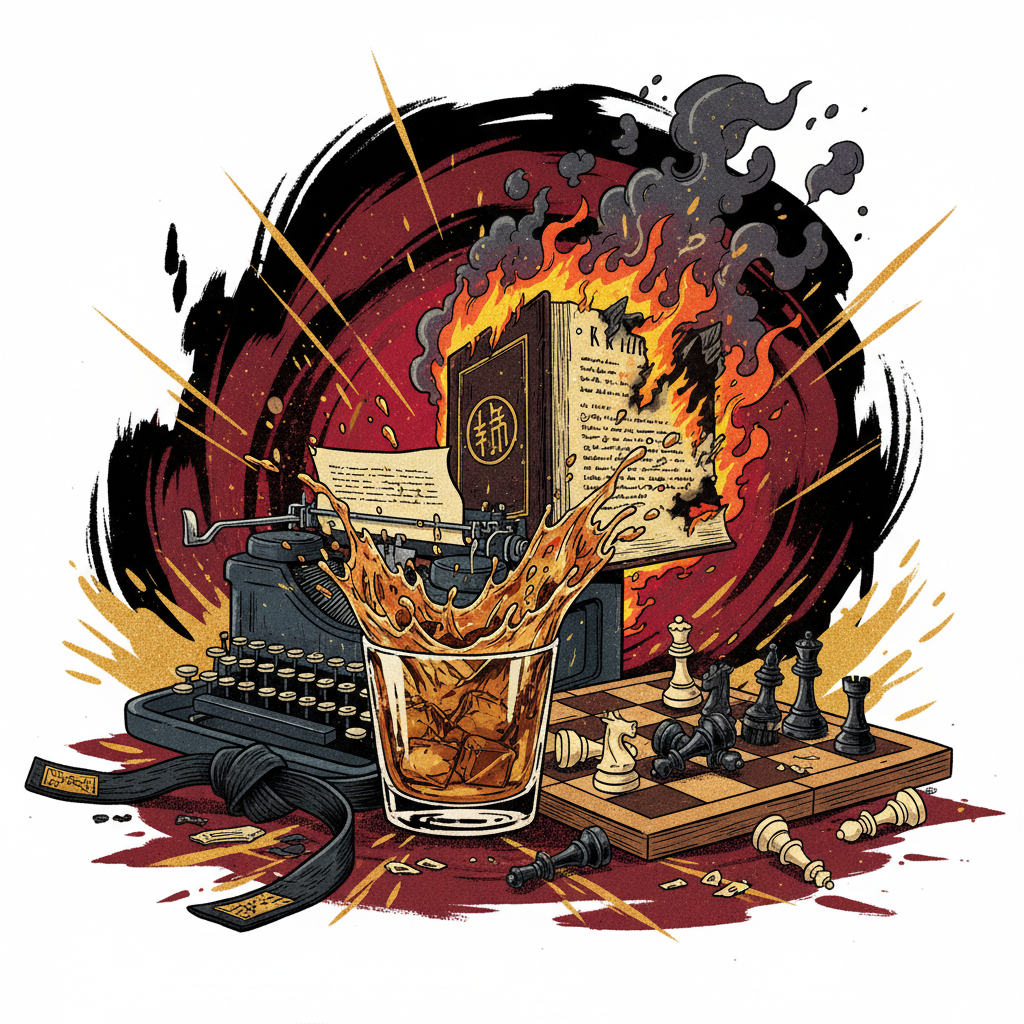
  1. Sell the Goddamn Book
    The publishing industry is a shark tank filled with people who wear scarves indoors and use the word “synergy” unironically.  I hate them.  I need them.  My resolution is to sell this damn thing…to force some poor, unsuspecting editor at a major house (expect a phone call, Luke) to look at my genius and weep tears of joy and terror.  All the folks on X have been wondering why I’m going the traditional publishing route rather than self-publishing.  Their arguments are compelling.  And one never knows.  One thing is certain: Ima get paid!

2. Get My Black Belt
I’ve been training for years, and I now have a red belt – the one before black. I can disarm a knife- or gun-wielding lunatic before my morning coffee and fight my way out of an attempted bear hug from a Russian mobster built like a refrigerator, all while composing a pithy inner monologue.  Though the red belt is pretty sexy, I want the belt that says: this man has kicked enough metaphorical and literal ass to be dangerous in polite company.  The belt that requires sweat, blood, bruises, discipline, and the occasional moment of clarity while face-down on a dojo mat.  By the end of 2026, I want to tie that thing around my waist and feel the quiet, smug satisfaction of someone who has weaponized his body and his attitude.

3. Become Unbeatable at Chess
I’ve been locked in an all-out blitzkrieg campaign to drag my chess game out of the primordial ooze and up onto Grandmaster Beach all year, and honestly, the results are frightening – for my opponents, anyway.  Heh.  Gone are the days where I’d blunder a rook because I was too distracted plotting my next snack run.  This year was about openings, endgames, tactical drills that melted my corneas, and embarrassing a fair few cocky strangers (and at least one exceptionally smug AI that now twitches at the name Carlsen).

But 2026?  That’s the year I bring utter annihilation to the 64 squares. Frankly, I’m tired of losing to online avatars with names like “KnightDaddy420.”  I’m coming for your bishops, your pawns, your dignity.  I will turn trash talk into an art form, sprinkle humiliations like confetti at a Soviet New Year, and my Queen’s Gambit will haunt your dreams.  Prepare to be obliterated.
So, dear reader, wish me luck.  Or don’t.  I’ll do it anyway.
Here’s to 2026: the year I sell the book, earn the belt, conquer the board, and generally behave like a man who refuses to accept the small, quiet life the universe keeps trying to hand him.
Raise a glass.  Light a fuse.  Kick the damn door in.  We’re coming in loud.

N.P.: “Kiss This” – The Struts

December 26, 2025 – Boxing Day


Christmas 2025 was another great one, spent overindulging in both food and drink with family (with one conspicuous absence).  Meteorologically, it may have been the best Christmas in Fecal Creek history.  Holy shit!  Truly violent storms on both Christmas Eve and Christmas Day…biblical thunder and lightning, lashing winds, multiple inches of rain, extensive flooding…it was beautiful.

But today, the goddamn sun is out, dear reader…the skies are clear.  And there’s nothing left to talk about except the Day After.  The Great Hangover.  That weird, gray, interdimensional fart of a day squashed between the forced cheer of Christmas and the looming dread of New Year’s Eve.  I speak, of course, about December 26th, a day, according to my calendar, some of our more, shall we say, monarchically-inclined cousins across the pond have apparently christened “Boxing Day.”  I know this only because it pops up every year on my calendar with a parenthetical “UK” next to it, as if I’m supposed to know what it is and how to celebrate it.

I’ve traditionally ignored it, but this year, I’ve decided it was high time I figure this horseshit out.

I started with this fact: nobody in America knows what the hell Boxing Day is.  Not really.  Not in any way that would survive even the gentlest cross-examination by a bored customs agent or a half-sober pub historian.  At best we treat it like some cryptic British ritual involving foxes, tweed, and the ghost of Queen Victoria handing out coupons for discounted marmalade.  And yet – every December 26th – there it is on the calendar, staring at us like a smug, overfed cat.  Boxing Day.  A holiday that sounds, for my money, like a mid-tier UFC event sponsored by a failing energy drink.

Which is what I was hoping for as I began to dissect this calendric pustule.  Because taken at face value, the name itself suggests some sort of officially sanctioned, post-yuletide pugilism, which I could absolutely get behind.  A national holiday dedicated to settling familial scores that had been building up all year.  Maybe it involves bare-knuckle brawls in a parking lot behind a pub.  Or at least some quality fisticuffs after Uncle Tommy starts whining and bitching like some old lady about Republicans over the turkey carcass.  That would be the shit.  Uncle Randy made another crack about your “creative” career path?  Fine.  To the ring.  Grandma Mildred weaponized her disapproval with a strategically gifted bathroom scale?  Lace up, Mildred, it’s time for the main event when you get your dentures knocked out of your octogenarian skull.  Hell yes.  A glorious, kingdom-wide festival of fights, with the King himself officiating from a gilded ringside seat, perhaps nodding sagely as a cousin gets a well-deserved right hook for snatching the last pig-in-a-blanket.

Yes, this I could get behind.  This has a certain raw, cathartic honesty to it.  It’s a vision of beautiful, state-sponsored chaos.

But no.  A quick and deeply disappointing dive into the digital muck reveals a truth far more mundane, more depressingly…British.  The theories are as limp as thirty-day-old tinsel.  One story claims it’s the day the landed gentry, their bellies swollen with swan and their hearts filled with microscopic drops of noblesse oblige, would box up their leftovers and gift them to the downstairs staff.  Here you go, Jeeves.  Enjoy this gnawed-on drumstick and a half-eaten terrine.  A spectacular display of generosity that I’m sure made up for a year of serfdom.

Another, equally soul-crushing theory suggests it’s about alms boxes in churches being opened and distributed to the poor.  Which, again, has a certain Dickensian charm if you’re into institutionalized pity.  But it lacks the unadulterated madness the name promises.

The modern reality, of course, is a monster of a different stripe entirely.  It’s a day of rabid, foam-mouthed consumerism.  A retail-driven bloodbath where otherwise sane people trample each other for 40% off a 73-inch television they don’t need.  It’s the Black Friday of the Commonwealth, a second, even more pathetic lap in the unending marathon of buying shit. We’ve just finished a holiday centered on the ritual of giving and receiving objects, and now, not even a full 24 hours later, we’re back in the trenches, wrestling a stranger for a discounted Nespresso machine.

It seems to be a holiday that feels like a symptom of a deeper sickness.  A cultural glitch.  An excuse to either A) do absolutely nothing, melting into the sofa like a forgotten cheese sculpture, watching sports and picking at the desiccated carcass of the Christmas feast, or B) participate in a full-scale assault on the local shopping mall.  There is no middle ground.  There is only sloth or savagery.

No.  This will not do.  I say we reclaim this hollowed-out husk of a holiday and give it some real American spirit.  Let’s create our own “American Boxing Day,” where the name isn’t just some quaint, dusty relic of classist charity.  No, our Boxing Day would be a glorious, nationwide catharsis.  The “Boxing” would be a mere vestigial nod to tradition, as we’d embrace all forms of glorious combat to settle our post-holiday grievances.  Did your brother-in-law burn the roast?  Settle it with a round of arm-wrestling.  Neighbor’s inflatable snowman still blinking obnoxiously?  Challenge him to a duel, swords or pistols, his choice.  From organized jousting tournaments in suburban cul-de-sacs and martial arts showdowns in public parks to the satisfying finality of a disagreement resolved with Mac-10s, this would be a day for clearing the air.  It’s the American way: turning a confusing and stupid foreign custom into a spectacular, heavily-armed festival of personal expression.

N.P.: “Body Burn” – Cubinate

December 24, 2025


Here we are, dear reader…Christmas Eve 2025.  All is quiet on the West Coast…almost boringly so.  I was bitching about being bored at a bar today when I was reminded of the Eggnog Riot of 1826 and I thought, “Hot damn!  That’s right.  This is something my dear reader needs to be reminded of.”  So let’s get to it.

It was Christmas Eve, 1826, and the United States Military Academy at West Point was sitting on a powder keg of repressed adolescent testosterone and enforced sobriety.  The administration, in a fit of puritanical buzz-killing pique, had declared the campus dry.  No booze.  Nary a drop.  Which, if you know anything about military history or just human nature in general, is sort of like trying to stop a tidal wave with a sternly worded memo and a napkin.  You are essentially begging the universe for catastrophe.

Which, of course, is precisely what they got.

The cadets – one of whom was a young Jefferson Davis, who would later go on to make some arguably poor career choices involving secession, decided that a Christmas without spirit(s) was unconstitutional.  Or at least un-American.  So, they did what any self-respecting group of future leaders would do: they pooled their resources, bribed a sympathetic enlisted man (bless his mercenary heart), and smuggled in gallons of whiskey.  Gallons.  Enough rotgut to pickle a horse.

This illicit nectar was destined for the holiday eggnog.  Of course, eggnog is a polarizing beverage at the best of times – a sludge of dairy and regret that sits in your stomach like a concrete block – but when spiked with contraband whiskey by a bunch of sexually frustrated cadets in wool uniforms, it becomes a revolutionary accelerant.

The evening started quietly enough, presumably with some light caroling and the surreptitious passing of cups.  But as the ethanol hit the bloodstream, the shit hit the fan, and the decorum disintegrated faster than a cheap tent in a hurricane.  By the witching hour, North Barracks had transformed into a scene from a Bosch painting, if Bosch had been really into muskets and drunken singing.

The logistical grandeur of the chaos is staggering to contemplate.  This was about 70 cadets – roughly a third of the student body – getting absolutely, catastrophically shithoused.  Far beyond tipsy, they were operating on a plane of existence where gravity was a suggestion and authority was a hilarious abstract concept.  Around here, we refer to people in this state as Alconauts.

When the officers (the poor, beleaguered “tactical officers” whose job it was to maintain order) tried to intervene, things went sideways.  Captain Hitchcock, a man who probably just wanted to go to bed, burst into a room to find a party raging.  He tried to read the Riot Act.  In response, a cadet tried to shoot him.

Let me repeat that for the folks in the back: a cadet tried to shoot a superior officer over eggnog.  The pistol misfired, or Hitchcock would have been the first casualty of the War on Christmas.

The riot spread.  Windows were smashed – glazing being apparently being the enemy of liberty.  Banisters were torn from staircases.  Furniture becomes airborne.  Muskets – actual functioning muskets – are waved around with the kind of reckless theatricality that suggests both a deep commitment to chaos and a total misunderstanding of firearms safety.  Additional officers attempting to restore order are greeted not with obedience but with slurred threats, drunken philosophy, and the kind of belligerent holiday cheer that makes you wonder whether the entire institution was built on a cursed ley line.

Swords were drawn.  One cadet reportedly tried to duel a superior officer.  Another attempted to lead a breakaway faction of equally hammered comrades in what can only be described as a proto-revolutionary splinter movement.  It was Animal House with bayonets.  At one point, Jefferson Davis, thoroughly pickled, stumbled into a room to warn his comrades that the officers were coming, only to realize the officers were already there.  He shouted, “Put away the grog, boys!” which is 19th-century slang for “Hide the evidence, we are so fucked.”

The “Eggnog Riot,” as it was later dubbed by historians with a flair for the absurd, raged until Christmas morning.  When the sun rose over the Hudson, the barracks looked like they had been shelled.  The hangover was no doubt biblical.  The commandant was apoplectic.  The court-martial that followed was one of the largest in U.S. military history.  Nineteen cadets were expelled, though many, including Davis – managed to wiggle out of serious punishment because they hadn’t actually broken anything important or successfully murdered anyone.  Nonetheless, careers teetered.  And the academy’s reputation is dragged through the snow like a corpse.

And yet, American survives.  Hell, America thrives.  Some of the riot’s participants go on to be  respected officers, engineers, and public servants.  The republic doesn’t crumble because a bunch of 19-year-olds got black-out drunk on weaponized eggnog and tried to overthrow their dorm monitors.

It’s a beautiful, stupid reminder that even the most disciplined institutions are only ever one bad decision and two gallons of whiskey away from total anarchy.  And I kind of respect the commitment.  If you’re going to ruin your military career, you might as well do it while defending your right to get wasted on spiced milk punch.

So raise a glass – preferably one not spiked with enough whiskey to trigger a congressional inquiry – and toast the cadets of 1826, who gave us the greatest holiday riot on U.S. military history.

And if I don’t see you tomorrow, have a very merry Christmas.

N.P.: “You’re a Mean One, Mr. Grinch” – Gary Hoey

December 23, 2025


Alright, dear reader, I suppose it’s time to officially switch into Christmas gear for a couple of days, so here we go:

As my young and historically benighted reader might not know, Christmas in the 19th century was a very different thing than what we have now.  No Santa, no reindeer, none of that horseshit.  What changed?

It’s December 22, 1823.  The world is a grimy, pre-industrial smudge-pot of coal dust and dreadful hygiene.  Christmas, to the extent that it’s even a thing, is a muddled affair of stern religious observance mixed with a bit of wassailing-adjacent public drunkenness.  The idea of a jolly, fat man delivering toys is about as plausible as a steam-powered unicorn.  St. Nicholas is still some gaunt, vaguely terrifying Turkish ghost bishop, not a cookie-addled home invader with a branding deal.

Then, some ink-stained wretch at the Troy Sentinel in upstate New York, likely fueled by bad whiskey and the bleakness of a Tuesday, decided to run a poem.  Anonymously.  Because of course.  You don’t sign your name to something so patently deranged.  It was less poetry and more hallucinatory fever dream printed on newsprint, a piece of pure, uncut narrative insanity that would, against all odds, hijack an entire holiday.

As one who has always cherished and aspired to the societal role of writer as cultural terrorist, I say with certainty that “A Visit from St. Nicholas” is the single most effective piece of cultural propaganda ever deployed.  Before this poem dropped, our conception of Santa was a chaotic mess.  But after?  Bam.  Instant fat-guy-in-a-red-suit consensus.  This anonymous screed built the character of Santan from the ground up, bolt by bloody bolt.  It dictated the whole damn scene: the sleigh, the eight tiny named reindeer.  Before this, did anyone think to call a flying ungulate “Vixen”?  No.  It’s genius.  It’s the kind of specific, world-building detail that worms its way into the collective brainstem and just stays.

The poem itself is a masterclass in lexical precision, sort of a high-velocity descriptive barrage.  The narrator, roused from a “long winter’s nap,” witnesses a whole psychotropic tableau unfold on his lawn.  It goes beyond a “jolly old elf.”  The text insists on a near-forensic level of detail.  The twinkle in his eye, the dimples, the cherry nose, the beard “as white as the snow.”  And the stump of a pipe held tight in his teeth, the smoke encircling his head “like a wreath.”  He’s not described as a saint but a hard-living, possibly Dutch, magical trucker with a serious tobacco habit and a bottomless sack of contraband.  He is a “right jolly old elf,” a creature of pure, unadulterated joy who laughs with a belly that shakes “like a bowlful of jelly.”

This portly specter doesn’t just arrive; he comes in “with a bound.”  He works fast, a blur of fur and soot, filling stockings with a twitch of his wrist, a creature of pure, libidinal efficiency.  He’s like Seal Team Six.  He’s all business.  No small talk, no bullshit.  Just a quick nod, a finger laid aside his nose, and then – poof – up the chimney like a bat out of hell.  The closing lines, “Happy Christmas to all, and to all a good-night,” aren’t a gentle blessing; they’re a mic drop.  A declaration of a new world order delivered from the seat of a flying sleigh, disappearing into the cold, indifferent sky.

The poem is a Trojan horse of holiday mythmaking.  You read it thinking you’re getting a cozy fireside ditty, but what you’re actually getting is a full-scale cultural operating system update.  The whole thing is engineered – whether consciously or not – to be repeated, recited, reprinted, and ritualized until it becomes indistinguishable from the holiday itself.

And we certainly complied.

We recited it in classrooms with the same solemnity usually reserved for national anthems.  We printed in on greeting cards, stitched it onto pillows, slapped it onto department-store displays.  We let it take over our Decembers until the poem wasn’t a poem anymore – it was the blueprint for an entire season of sanctioned madness.

For decades, the authorship was a literary mystery.  Clement Clarke Moore, a stuffy academic, eventually claimed it, but the family of a Dutch-descended dude named Henry Livingston Jr. screamed bloody murder, insisting their guy wrote it.  Personally, I think authorship is a very big deal, but most seem to think the mystery is an essential part of the power of the poem.  They argue the point isn’t the author, but rather the blast radius.  This anonymous poem, slipped into a provincial newspaper, became the foundational text for the modern commercial-religious-industrial complex we call Christmas.  It’s one of the most reprinted poems in the language, not because it’s high art, but because it’s a perfect machine.  It did its job with such terrifying competence that we’re all still living inside its weird, sugary, reindeer-powered world, more than 200 years later.  You can’t escape it.  It’s in the air.  It’s in the goddamn malls.  It’s the ghost in the machine.  And it all started on a Tuesday, with a little bit of anonymous ink.

N.P.: “Forsaken” – Adam Hurst

December 22, 2025


On This Day in Doom

Let’s be honest, dear reader: history is a malfunctioning carnival ride operated by a meth-addled gibbon, and December 22 stands as a particularly glitchy gear in the machine.  It’s a day that grabs you by the lapels, shakes the loose change out of your pockets, and whispers, “Hey kid, wanna see something really fucked up?”
Because on this specific calendar square – separated by roughly 130 years and several thousand miles of icy/suburban wasteland – we have two distinct flavors of nightmare fuel.  One involves the near-death of literature’s gloomiest heavyweight, and the other involves a clown who wasn’t joking.
Strap in.  The brakes were cut miles ago.

The Great Siberian Psych-Out (1849)
First up, we have Fyodor Dostoevsky, the guy who made existential dread fashionable before French people ruined it with cigarettes and turtlenecks.
Imagine this: you’re 28, a literary upstart with a naïve taste for utopian socialism who’s been arrested for reading banned books and talking too much about justice.  The Tsar doesn’t like that.  So you’re sentenced to death, natch.
It is cold.  Not “put on a sweater” cold, but “your soul is freezing into a jagged little icicle” cold.  You’re dragged out to Semyonov Square.  You and your Petrashevsky Circle buddies are lined up.  You are read your death sentences.  You are given the white shirts of the condemned, which is a fashion statement no one wants to make.  You’re blindfolded.  You hear the click of rifles being raised.  The drums roll.  The priest does his mumbling bit with the cross.  You feel the cold breath of eternity on your neck.  You stand there, probably thinking, “Well, this is going to severely impact my ability to write 800-page novels about guilt.”  This is it.  The Big Sleep.  The dirt nap.  And then a messenger gallops in – presumably in slow motion, possibly while an eagle screeches overhead – waving a piece of paper.  “Psych!” screams the Tsar (paraphrasing).  “Just kidding!  You aren’t dying today!  You’re going to Siberia for four years of hard labor.  Four years of frostbite, dysentery, and theological whiplash.  Enjoy!”
It was a mock execution.  A prank.  A piece of psychological theater designed to break his sprit so thoroughly that he’d be sweeping up the shards of his own psyche for decades.  And it worked, sort of.  He walked away from the firing squad with a rewired brain.  Dostoevsky went to the klink, got epileptic, found Jesus, and came back to write Crime and Punishment, The Brothers Karamazov and other breakup letters to God.
Essentially, the Tsar’s twisted sense of humor gave us the entire canon of Russian existentialism.  If the command to “Fire!” had been given three seconds earlier, your college lit syllabus would look drastically different, and we’d have fewer metaphors for suffering.  The Tsar played Russian roulette with a writer’s soul and lost.

The Clown in the Crawl Space (1978)
Fast forward to 1978.  We trade the frozen wasteland of Russia for the frozen wasteland of Des Plaines, Illinois.  Different continent.  Different kind of horror.
Enter John Wayne Gacy.  A contractor.  A precinct captain for the Democrats.  A guy who dressed up as “Pogo the Clown” to entertain sick kids, which in retrospect is the darkest irony in the history of polyester costumes.
By December 22, the cops had been buzzing around Gacy like flies on roadkill.  He’d been playing this cat-and-mouse game, strutting around with an arrogance that suggested he thought he was smarter than the collective moral universe.  He wasn’t.  He was just a contractor with a really bad smell coming from his heating ducts.
On this day, the dam broke.  Gacy, likely realizing the jig was up or perhaps getting tired of the charade, started talking.  And once he started, he didn’t stop.  He admitted to killing 33 young men and boys.  He drew a map.  He pointed to the crawl space beneath his house – a ranch-style suburban home that looked exactly like every other ranch-style suburban home – and essentially said, “Yeah, they’re down there.”
It’s hard to process the logistical horror of it.  Twenty-nine bodies buried under the floorboards while he ate dinner and watched TV about them.  It’s the ultimate suburban gothic nightmare: the monster isn’t in the closet; the monster is the guy checking your permits, and he’s literally built a life on top of his victims.

N.P.: “Scarecrow” – Meg Lee Chin

December 14, 2025


Sobriety, dear reader, has been a trip.  Not the fun, kaleidoscopic kind where you’re riding a wave of serotonin and questionable decisions, but the kind where your brain decided to chuck a I.E.D into your circadian rhythm just for the fuck of it.  In the early days, I became what I can only describe as “insomniatic.”  [Yes, I know it wasn’t (previous to today) a recognized English word, but I found the English language to be lacking in this specific instance, so I created this neologism.  You’re welcome.]  Sixty-two hours.  That’s how long I was awake.  Sixty-two hours of raw, unfiltered consciousness.   It was like being trapped in a David Lynch film, minus the jazz and creepy dwarves.  Fascinating, sure, but also the kind of fascinating that has you questioning the nature of reality itself.

Then came the dreams.  Those annoyances had been gone for decades, and they weren’t missed.  But they’ve come back now, in 4K resolution, Dolby surround sound, and full fucking Technicolor.  And they sucked.  Not in a “wake-up screaming” kind of way – I don’t do nightmares, thank you very much – but in a “why is my subconscious so goddamn annoying?” kind of way.  They were petty, irritating little vignettes that stuck to my brain like gum on a hot sidewalk.  But last night?  Last night, my dreams finally got their act together.  They started with a delightful little scene of vengeance – me, absolutely eviscerating a certain pitiful bitch who had the stupid audacity to approach me in a restaurant.  It was glorious.  Then, a hard cut to something far more wholesome: a dream about the release of my next book, the one I’m about to hurl into the publishing void.  No spoilers, of course, but let’s just say I woke up feeling like a goddamn superhero.

That feeling didn’t last.  Because, as is the way of the world, reality came knocking with its usual bag of horrors.  The news of the antisemitic terrorist attack in Australia hit like a liver kick.  Utterly vile.  My hat’s off to the badass who wrestled one of the attacker’s guns away – and act of courage that deserves more than a passing mention.  Would that he had finished the job, though.  My thoughts are with the victims, their families, and my Jewish friends around the world on this first day of Hanukkah.  It’s a bitter reminder that the world is still full of monsters, and not the fun, fictional kind.

On a brighter note, let’s talk about Shirley Jackson.  Today marks the birth of one of the most ferocious minds to ever put pen to paper.  If you didn’t read The Lottery in school, stop what you’re doing and fix that.  It’s a short story that will slap you across the face and leave you questioning everything you thought you knew about human nature.  And then there’s The Haunting of Hill House, a gothic masterpiece that opens with one of the most chilling paragraphs in all of literature:

No living organism can continue for long to exist sanely under conditions of absolute reality; even larks and katydids are supposed, by some, to dream.  Hill House, not sane, stood by itself against its hills, holding darkness within; it had stood so for eighty years and might stand for eighty more.  Within, walls continued upright, bricks met neatly, floors were firm, and doors were sensibly shut; silence lay steadily against the wood and stone of Hill House, and whatever walked there, walked alone. 

Chills. Every damn time.  That opening is a masterclass in atmosphere, a slow, deliberate tightening of the noose before you even realize it’s around your neck.  Jackson dissected the human condition with the precision of a surgeon and the malice of a cat toying with its prey.  Suburban conformity, psychological terror, the uncanny – she turned these into her playground, and the results were nothing short of devastating.  She was, in every sense of the word, a literary badass.

I aspire to write something even a fraction as haunting, as sharp, as utterly unforgettable as her opening paragraph to Hill House.  Until then, I’ll keep hammering away at these keys, dreaming in 4K, and occasionally indulging in a little dream-world vengeance.

Here’s to Shirley Jackson, to the courage of those who stand against Islamic-extremist hate, and to the strange, maddening, beautiful journey of sobriety.  Stay weird, stay wild, and for the love of all things holy, stay awake for less than 62 hours at a time.

Happy Sunday, Merry Christmas, and Happy Hanukkah.

N.P.: “I Stay Away” – Alice In Chains

December 13, 2025


Okay, confession time, dear reader: if you’re reading this on December 13th, congratulations – you’re three days late to the party, just like me (and frankly, just like Faulkner would’ve preferred).  But hey, what’s a Nobel speech anniversary without a little tardiness and existential disarray?  Time is a flat circle, calendars are a social construct, and whiskey tastes the same on any day ending in Y.
So, let’s rewind to December 10th, 1949, and picture it: in the icy, buttoned-up heart of Stockholm, a gaggle of Nordic royalty and tuxedoed stiff-shirts are waiting.  Waiting for a small, mustachioed man from the humid, gothic morass of Mississippi to stumble up to a podium, likely completely shit-housed, and accept the shiniest of all literary hood ornaments: the Nobel Prize.  The man is William Faulkner, author of The Sound and the Fury and cartographer of the broken human soul, and he very nearly told them to all to shove it.
This whole affair, this trans-Atlantic flight into the glacial maw of European high culture, was, for Faulkner, the type of bullshitty literary root canal he had zero intention of undergoing.  The man hated speeches.  Hated them with a passion usually reserved for tax collectors and people who dog-ear pages.  His initial, and let’s be honest, deeply admirable plan was to dispatch a two-sentence telegram.  Something along the lines of, “Fuck off.  I’m busy.” and then get back to the serious business of drinking whiskey and wrestling sentences into submission.
But pressure, for some  people, can be a hell of a thing.  Family, friends, maybe the ghost of Conrad himself, they all conspired.  So Bill gets on the goddamn plane, a tweed-clad ghost haunting the fuselage, probably already marinating his liver for the ordeal ahead.  He arrives in Stockholm, a place as alien to his Rowan Oak porch as a Marian landscape, and proceeds to do what any sane man would do when faced with a week of stilted small talk and ceremonial pomp: he gets absolutely, unequivocally hammered.
And then comes the moment.  The culmination of a year-long delay and a lifetime of torturing typewriters.  He’s shuffled to the dais, looking less like a literary titan and more like a man searching for the nearest exit and a stiff drink.  The world holds its breath, expecting a mumbled thank you, a polite nod, and a quick escape.
What they get instead is five minutes of pure, uncut, lightning-in-a-bottle prophecy.  This titan of tragedy, this man who writes novels so dense with despair you could drown in them, stands up there, swaying, and delivers the single most potent dose of secular scripture in modern history.  He talks about the atom bomb, the fear, the universal dread hanging over everyone like a shroud.  Here’s the core:
“I feel that this award is not made to me as a man, but to my work…Our tragedy today is a general and universal physical fear so long sustained by now that we can even bear it.  There are no longer problems of the spirit.  There is only the question: When will I be blown up?  Because of this, the young man or woman writing today has forgotten the problems of the human heart…
I decline to accept the end of man…I believe that man will not merely endure: he will prevail.  He is immortal, not because he alone among creatures has an inexhaustible voice, but because he has a soul, a spirit capable of compassion and sacrifice and endurance.”
It’s a speech so powerful, so fundamentally at odds with the bleakness of his own work, that it feels like a cosmic joke and a profound truth all at once.  Faulkner, in that moment, becomes the reluctant prophet of postwar literature.  He tells the world that the writer’s duty is to remind humanity of its courage, its honor, its hope, and its capacity for compassion.  He says this while still metabolizing a truly heroic amount of whiskey.
He drops the mic, pockets the prize money, fucks off back to Mississippi , and goes right back to writing labyrinthine masterpieces that most of America wouldn’t touch with a ten-foot pole.  Back to the porch and the typewriter and the dogs and the ghosts.
He keeps writing.
Books that no one buys.
Books that confuse people.
Books that bleed.
So today, we raise a glass (cheap bourbon preferred, neat, no ice) to the man who took the Nobel, told the world to get its shit together, and then went back to the swamp to keep doing the work.
He didn’t endure.
He prevailed.
And he did it broke, drunk, and brilliant.

N.P.: “Bellum Terrae Mediae” – Dogukan Ozturk

Pearl Harbor Day: America’s Original FAFO Sermon

Today is Pearl Harbor Day, dear, young, likely historically ignorant reader.  And this morning, with the right kind of awareness, you can still smell the cordite and betrayal, even eighty-four years later.  Imagine the Pacific sun rising over Oahu, sailors still half-drunk on Saturday night liberty, and then the sky itself vomiting steel and fire courtesy of those treacherous, rotten, shit-sucking Imperial Japanese bastards who thought they’d invented the concept of a sucker punch.  Spoiler: they hadn’t.

Pearl Harbor was a cosmic joke gone lethal, a nation’s collective hangover suddenly cured by the shriek of dive bombers and the sight of battleships belching smoke like dying dinosaurs.  America, caught pants-down, coffee not yet brewed, suddenly found itself staring into doom.  And that doom was painted with the Rising Sun.

Cue the doctrine that would later be branded FAFO – though back then it was more primal, less acronymic, more like the raw animal snarl of a country that had just been cock-punched across the Pacific.  You mess with the sleeping giant, you wake up in a nightmare.  And the nightmare came in the form of two massive fuck-off mushroom clouds, each one a vengeful sermon preached from the pulpit of modernity.  Hiroshima.  Nagasaki.  Cities turned into ashtray metaphors, the ultimate “don’t try this at home” PSA.

It wasn’t pretty.  It might not have been noble.  It wasn’t the sanitized heroism of war movies where the trumpet swells and the flag waves in slow motion.  It was brutal, humiliating, and final.  Japan went from swaggering imperialist bully to shivering, sniveling, kneeling supplicant in less time than it takes to say “unconditional surrender.”  The lesson was scorched into the earth itself: America doesn’t just retaliate; America retaliates with biblical fury, with the kind of overkill that makes future enemies pause, sweat, and complete reconsider their life choices.

Pearl Harbor Day isn’t just about remembering the dead – though we must, always – it’s about remembering the moment America decided to stop playing nice.  The day we got sucker-punched and responded by inventing the most terrifying mic drop in human history.

So raise a glass today, not in celebration but in defiance.  To the sailors entombed in steel coffins at the bottom of the harbor.  To the civilians who never saw the bombers coming.  And yes, to the awe-inspiring fire that ended the war.  Pearl Harbor was the opening act.  Hiroshima and Nagasaki were the encore.

But here’s the part that curdles my bourbon, the rotgut truth that keeps me pacing the floorboards at 3 a.m.: the America that once answered treachery with firestorms and unconditional surrender papers now looks like it’s been neutered by its own self-appointed moral hall monitors, the ones who think hashtags are strategy and empathy for narco-terrorists is diplomacy.  We’ve gone from steel-jawed brawlers to therapy-session sissies, from a nation that could vaporize two cities before breakfast to one that can’t even decide if its borders are real.

Because let’s be honest: the left has been busy sanding down the teeth of the beat, turning the war machine into some sort of pitiful daycare center where Teletubbies go to fuck…where illegal immigrants, cartel apologists, and anti-American imports get tucked in with warm milk while the citizens who’d actually bleed in the next war are told to shut up and check their privilege.  It’s a grotesque inversion of priorities, a carnival of cowardice dressed up as compassion, and it makes me wonder it the next Pearl Harbor will be met not with mushroom clouds but with strongly worded press releases and congressional hearings that drag on until the enemy has already planted their flag on our soil.

The spiraling nightmare is this: we’ve traded resolve for rhetoric, fury for focus, and the raw animal snarl of a wounded giant for the mewling of bureaucrats who thing “restraint” is a virtue when the sky is on fire.  Imagine the next sucker punch – missiles streaking, ships burning, civilians screaming – and instead of the old America rising from the smoke with clenched fists, we get committees, hashtags, and a chorus of “this is not who we are.”

But history doesn’t give a shit who we are.  History only cares who wins.  And if we’ve lost the will to win – if we’ve let the pussification of America become our defining trait – then the next Pearl Harbor won’t be remembered as the day we woke up.  It’ll be remembered as the day we rolled over, pulled the blanket up, and let someone else write the ending.

So here’s the mic drop, the blistering sermon carved into the bones of this day: Pearl Harbor was the warning, Hiroshima and Nagasaki were the answer, and the only question left is whether we still have the guts to answer again.  If not, then the obituary of America will read like a parody: a nation that once nuked its enemies into submission but later surrendered to its own cowardice.

N.P.: “Funeral March” – 2WEI

Season’s Beatings: Das ist Krampusnacht!


Even back when I still believed Santa Claus was an actual dude with an actual mailing address inside the Arctic Circle, with an actual toy shop staffed mostly by elves (blah blah blah), I felt, deep down in that dark and vacant space where my soul should have been, that Things Weren’t Right.

Children know monsters exist. Even toddlers understand that evil lurks [see Bruno Bettelheim’s The Uses of Enchantment and that study where kids were given fairy tales with the scary parts removed, and they got so pissed off they attacked their teachers’ kneecaps]. Rugrats resent the hell out of adults who pretend otherwise. I certainly did. Which is why the unipolar morality of the Santa story never sat well with me: goodness is rewarded, but evil goes unpunished.

All year long, the promise of every materialistic dream a child may have coming true on Christmas morning is dangled in front of their beady little eyes on the condition of “good” behavior. I always assumed there was some kind of sliding scale: if your behavior was saintly all year, you get everything on your list plus bonus loot. If you were decent for eight months but a prick the rest of the time, maybe you only get a third. But what of the little bastard who is rotten every single day? According to the Santa story, nothing. Not a gpddamn thing. Santa still shows up, maybe leaves a lump of coal. Big deal.

So the neighborhood terror can spend all year lowering property values and ruining lives, then stroll over to Goody Two-Shoes’ house on December 26th, whack him over the head with a board, steal his toys, and swagger home. Ludicrous. Unjust. Existentially unsound. There can be no light without darkness, no goodness without evil. Children know this innately.

But in Disneyfied, bubble-wrapped America, parents quake at the thought of damaging their little snowflakes’ eggshell psyches. Teachers are told not to grade in red pen because red is “too violent.” Little league games don’t keep score because someone might lose. And the results are tragic: entire generations who cannot conjugate the verbs “to lose” or “to fail.”

I say Enough. Ya basta! Children are far hardier than they’re given credit for. Which is why I propose we reset Christmas and celebrate it properly — by resurrecting the full story from Europe: the tale of Santa’s dark counterpart, Krampus.

If Santa Claus is a right jolly old elf, then Krampus is a bad-ass Christmas demon. If Saint Nick is benevolent generosity, Krampus is divine retribution. He’s a satanic-looking satyr with massive horns and a bifurcated tail, draped in noisy chains and cowbells, wielding pointy sticks with which he beats the hell out of children who’ve been assholes all year. And if the offenses are more than venial? Krampus doesn’t just beat them — he drags them to hell, dismembers them, or eats them right there in front of God and everybody. Don’t bother running to Santa for help. Santa and Krampus are drinking buddies, existential pals who clink steins at the biergarten while swapping stories about naughty brats.

And Krampus doesn’t stop at punishing kids. No, when he’s not dispensing yuletide justice, he’s goosing attractive women and licking faces like Rick James on a crackful night. Krampus is a straight-up poon hound. Unlike that grandfatherly twat Santa Claus, ever the family man, Krampus crushes mad ass on the reg. There is no Mrs. Krampus. He doesn’t need one. He’s got game, and he wants to fist your mother after he eats your soul.

Speaking of eating, don’t bother leaving cookies and milk. Krampus is lactose intolerant and immune to baked goods bribery. Whiskey and steak might buy you a few seconds, but ultimately, there’s only one way to avoid his wrath: walk the path of righteousness, and avoid assholishness the rest of the year.


N.P.: “Overlord” – Thorr