Category Archives: Lucubrations

December 14, 2025


Sobriety, dear reader, has been a trip.  Not the fun, kaleidoscopic kind where you’re riding a wave of serotonin and questionable decisions, but the kind where your brain decided to chuck a I.E.D into your circadian rhythm just for the fuck of it.  In the early days, I became what I can only describe as “insomniatic.”  [Yes, I know it wasn’t (previous to today) a recognized English word, but I found the English language to be lacking in this specific instance, so I created this neologism.  You’re welcome.]  Sixty-two hours.  That’s how long I was awake.  Sixty-two hours of raw, unfiltered consciousness.   It was like being trapped in a David Lynch film, minus the jazz and creepy dwarves.  Fascinating, sure, but also the kind of fascinating that has you questioning the nature of reality itself.

Then came the dreams.  Those annoyances had been gone for decades, and they weren’t missed.  But they’ve come back now, in 4K resolution, Dolby surround sound, and full fucking Technicolor.  And they sucked.  Not in a “wake-up screaming” kind of way – I don’t do nightmares, thank you very much – but in a “why is my subconscious so goddamn annoying?” kind of way.  They were petty, irritating little vignettes that stuck to my brain like gum on a hot sidewalk.  But last night?  Last night, my dreams finally got their act together.  They started with a delightful little scene of vengeance – me, absolutely eviscerating a certain pitiful bitch who had the stupid audacity to approach me in a restaurant.  It was glorious.  Then, a hard cut to something far more wholesome: a dream about the release of my next book, the one I’m about to hurl into the publishing void.  No spoilers, of course, but let’s just say I woke up feeling like a goddamn superhero.

That feeling didn’t last.  Because, as is the way of the world, reality came knocking with its usual bag of horrors.  The news of the antisemitic terrorist attack in Australia hit like a liver kick.  Utterly vile.  My hat’s off to the badass who wrestled one of the attacker’s guns away – and act of courage that deserves more than a passing mention.  Would that he had finished the job, though.  My thoughts are with the victims, their families, and my Jewish friends around the world on this first day of Hanukkah.  It’s a bitter reminder that the world is still full of monsters, and not the fun, fictional kind.

On a brighter note, let’s talk about Shirley Jackson.  Today marks the birth of one of the most ferocious minds to ever put pen to paper.  If you didn’t read The Lottery in school, stop what you’re doing and fix that.  It’s a short story that will slap you across the face and leave you questioning everything you thought you knew about human nature.  And then there’s The Haunting of Hill House, a gothic masterpiece that opens with one of the most chilling paragraphs in all of literature:

No living organism can continue for long to exist sanely under conditions of absolute reality; even larks and katydids are supposed, by some, to dream.  Hill House, not sane, stood by itself against its hills, holding darkness within; it had stood so for eighty years and might stand for eighty more.  Within, walls continued upright, bricks met neatly, floors were firm, and doors were sensibly shut; silence lay steadily against the wood and stone of Hill House, and whatever walked there, walked alone. 

Chills. Every damn time.  That opening is a masterclass in atmosphere, a slow, deliberate tightening of the noose before you even realize it’s around your neck.  Jackson dissected the human condition with the precision of a surgeon and the malice of a cat toying with its prey.  Suburban conformity, psychological terror, the uncanny – she turned these into her playground, and the results were nothing short of devastating.  She was, in every sense of the word, a literary badass.

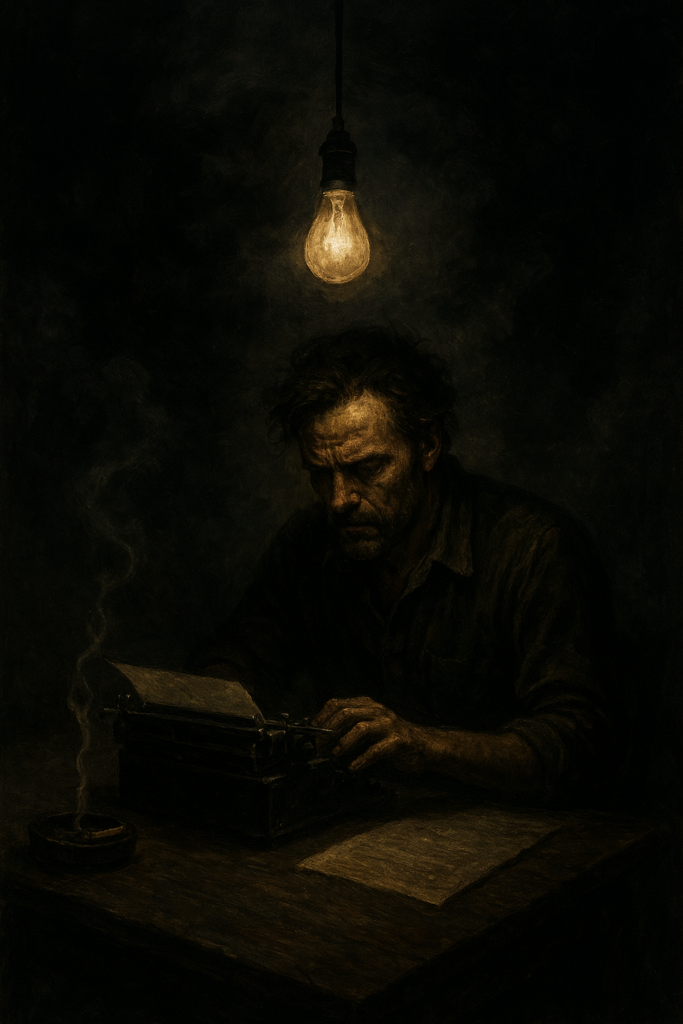
I aspire to write something even a fraction as haunting, as sharp, as utterly unforgettable as her opening paragraph to Hill House.  Until then, I’ll keep hammering away at these keys, dreaming in 4K, and occasionally indulging in a little dream-world vengeance.

Here’s to Shirley Jackson, to the courage of those who stand against Islamic-extremist hate, and to the strange, maddening, beautiful journey of sobriety.  Stay weird, stay wild, and for the love of all things holy, stay awake for less than 62 hours at a time.

Happy Sunday, Merry Christmas, and Happy Hanukkah.

N.P.: “I Stay Away” – Alice In Chains
December 13, 2025


Okay, confession time, dear reader: if you’re reading this on December 13th, congratulations – you’re three days late to the party, just like me (and frankly, just like Faulkner would’ve preferred).  But hey, what’s a Nobel speech anniversary without a little tardiness and existential disarray?  Time is a flat circle, calendars are a social construct, and whiskey tastes the same on any day ending in Y.
So, let’s rewind to December 10th, 1949, and picture it: in the icy, buttoned-up heart of Stockholm, a gaggle of Nordic royalty and tuxedoed stiff-shirts are waiting.  Waiting for a small, mustachioed man from the humid, gothic morass of Mississippi to stumble up to a podium, likely completely shit-housed, and accept the shiniest of all literary hood ornaments: the Nobel Prize.  The man is William Faulkner, author of The Sound and the Fury and cartographer of the broken human soul, and he very nearly told them to all to shove it.
This whole affair, this trans-Atlantic flight into the glacial maw of European high culture, was, for Faulkner, the type of bullshitty literary root canal he had zero intention of undergoing.  The man hated speeches.  Hated them with a passion usually reserved for tax collectors and people who dog-ear pages.  His initial, and let’s be honest, deeply admirable plan was to dispatch a two-sentence telegram.  Something along the lines of, “Fuck off.  I’m busy.” and then get back to the serious business of drinking whiskey and wrestling sentences into submission.
But pressure, for some  people, can be a hell of a thing.  Family, friends, maybe the ghost of Conrad himself, they all conspired.  So Bill gets on the goddamn plane, a tweed-clad ghost haunting the fuselage, probably already marinating his liver for the ordeal ahead.  He arrives in Stockholm, a place as alien to his Rowan Oak porch as a Marian landscape, and proceeds to do what any sane man would do when faced with a week of stilted small talk and ceremonial pomp: he gets absolutely, unequivocally hammered.
And then comes the moment.  The culmination of a year-long delay and a lifetime of torturing typewriters.  He’s shuffled to the dais, looking less like a literary titan and more like a man searching for the nearest exit and a stiff drink.  The world holds its breath, expecting a mumbled thank you, a polite nod, and a quick escape.
What they get instead is five minutes of pure, uncut, lightning-in-a-bottle prophecy.  This titan of tragedy, this man who writes novels so dense with despair you could drown in them, stands up there, swaying, and delivers the single most potent dose of secular scripture in modern history.  He talks about the atom bomb, the fear, the universal dread hanging over everyone like a shroud.  Here’s the core:
“I feel that this award is not made to me as a man, but to my work…Our tragedy today is a general and universal physical fear so long sustained by now that we can even bear it.  There are no longer problems of the spirit.  There is only the question: When will I be blown up?  Because of this, the young man or woman writing today has forgotten the problems of the human heart…
I decline to accept the end of man…I believe that man will not merely endure: he will prevail.  He is immortal, not because he alone among creatures has an inexhaustible voice, but because he has a soul, a spirit capable of compassion and sacrifice and endurance.”
It’s a speech so powerful, so fundamentally at odds with the bleakness of his own work, that it feels like a cosmic joke and a profound truth all at once.  Faulkner, in that moment, becomes the reluctant prophet of postwar literature.  He tells the world that the writer’s duty is to remind humanity of its courage, its honor, its hope, and its capacity for compassion.  He says this while still metabolizing a truly heroic amount of whiskey.
He drops the mic, pockets the prize money, fucks off back to Mississippi , and goes right back to writing labyrinthine masterpieces that most of America wouldn’t touch with a ten-foot pole.  Back to the porch and the typewriter and the dogs and the ghosts.
He keeps writing.
Books that no one buys.
Books that confuse people.
Books that bleed.
So today, we raise a glass (cheap bourbon preferred, neat, no ice) to the man who took the Nobel, told the world to get its shit together, and then went back to the swamp to keep doing the work.
He didn’t endure.
He prevailed.
And he did it broke, drunk, and brilliant.

N.P.: “Bellum Terrae Mediae” – Dogukan Ozturk

Pearl Harbor Day: America’s Original FAFO Sermon

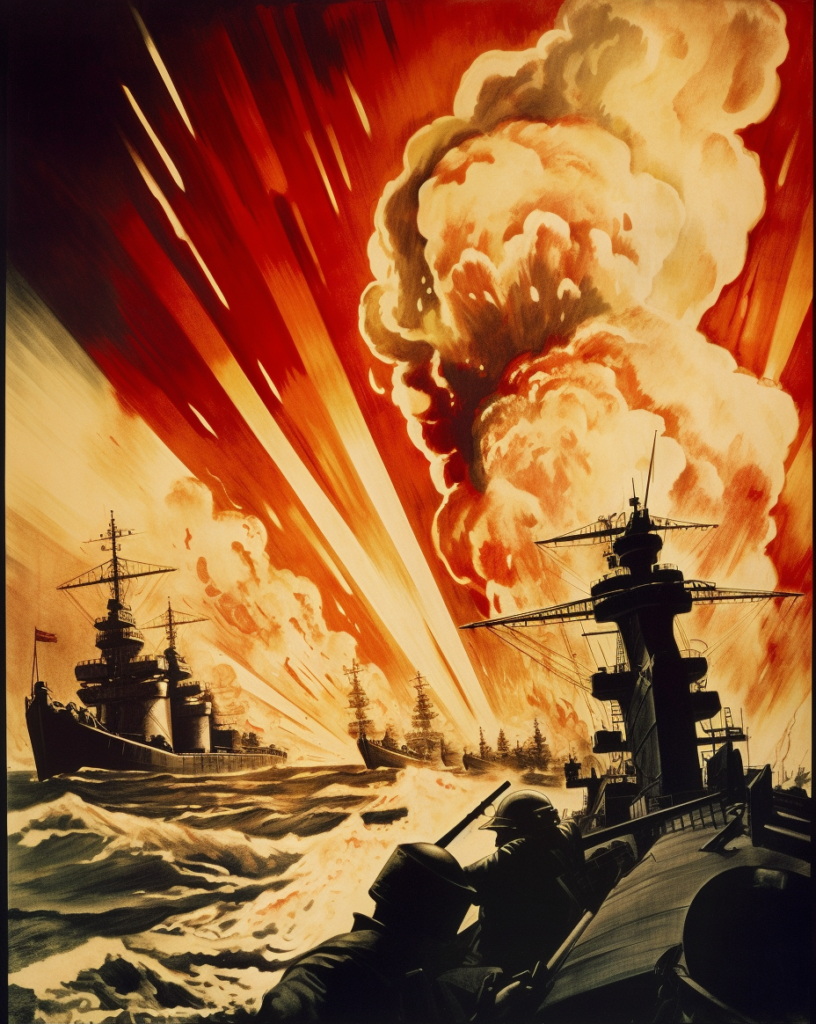
Today is Pearl Harbor Day, dear, young, likely historically ignorant reader.  And this morning, with the right kind of awareness, you can still smell the cordite and betrayal, even eighty-four years later.  Imagine the Pacific sun rising over Oahu, sailors still half-drunk on Saturday night liberty, and then the sky itself vomiting steel and fire courtesy of those treacherous, rotten, shit-sucking Imperial Japanese bastards who thought they’d invented the concept of a sucker punch.  Spoiler: they hadn’t.

Pearl Harbor was a cosmic joke gone lethal, a nation’s collective hangover suddenly cured by the shriek of dive bombers and the sight of battleships belching smoke like dying dinosaurs.  America, caught pants-down, coffee not yet brewed, suddenly found itself staring into doom.  And that doom was painted with the Rising Sun.

Cue the doctrine that would later be branded FAFO – though back then it was more primal, less acronymic, more like the raw animal snarl of a country that had just been cock-punched across the Pacific.  You mess with the sleeping giant, you wake up in a nightmare.  And the nightmare came in the form of two massive fuck-off mushroom clouds, each one a vengeful sermon preached from the pulpit of modernity.  Hiroshima.  Nagasaki.  Cities turned into ashtray metaphors, the ultimate “don’t try this at home” PSA.

It wasn’t pretty.  It might not have been noble.  It wasn’t the sanitized heroism of war movies where the trumpet swells and the flag waves in slow motion.  It was brutal, humiliating, and final.  Japan went from swaggering imperialist bully to shivering, sniveling, kneeling supplicant in less time than it takes to say “unconditional surrender.”  The lesson was scorched into the earth itself: America doesn’t just retaliate; America retaliates with biblical fury, with the kind of overkill that makes future enemies pause, sweat, and complete reconsider their life choices.

Pearl Harbor Day isn’t just about remembering the dead – though we must, always – it’s about remembering the moment America decided to stop playing nice.  The day we got sucker-punched and responded by inventing the most terrifying mic drop in human history.

So raise a glass today, not in celebration but in defiance.  To the sailors entombed in steel coffins at the bottom of the harbor.  To the civilians who never saw the bombers coming.  And yes, to the awe-inspiring fire that ended the war.  Pearl Harbor was the opening act.  Hiroshima and Nagasaki were the encore.

But here’s the part that curdles my bourbon, the rotgut truth that keeps me pacing the floorboards at 3 a.m.: the America that once answered treachery with firestorms and unconditional surrender papers now looks like it’s been neutered by its own self-appointed moral hall monitors, the ones who think hashtags are strategy and empathy for narco-terrorists is diplomacy.  We’ve gone from steel-jawed brawlers to therapy-session sissies, from a nation that could vaporize two cities before breakfast to one that can’t even decide if its borders are real.

Because let’s be honest: the left has been busy sanding down the teeth of the beat, turning the war machine into some sort of pitiful daycare center where Teletubbies go to fuck…where illegal immigrants, cartel apologists, and anti-American imports get tucked in with warm milk while the citizens who’d actually bleed in the next war are told to shut up and check their privilege.  It’s a grotesque inversion of priorities, a carnival of cowardice dressed up as compassion, and it makes me wonder it the next Pearl Harbor will be met not with mushroom clouds but with strongly worded press releases and congressional hearings that drag on until the enemy has already planted their flag on our soil.

The spiraling nightmare is this: we’ve traded resolve for rhetoric, fury for focus, and the raw animal snarl of a wounded giant for the mewling of bureaucrats who thing “restraint” is a virtue when the sky is on fire.  Imagine the next sucker punch – missiles streaking, ships burning, civilians screaming – and instead of the old America rising from the smoke with clenched fists, we get committees, hashtags, and a chorus of “this is not who we are.”

But history doesn’t give a shit who we are.  History only cares who wins.  And if we’ve lost the will to win – if we’ve let the pussification of America become our defining trait – then the next Pearl Harbor won’t be remembered as the day we woke up.  It’ll be remembered as the day we rolled over, pulled the blanket up, and let someone else write the ending.

So here’s the mic drop, the blistering sermon carved into the bones of this day: Pearl Harbor was the warning, Hiroshima and Nagasaki were the answer, and the only question left is whether we still have the guts to answer again.  If not, then the obituary of America will read like a parody: a nation that once nuked its enemies into submission but later surrendered to its own cowardice.

N.P.: “Funeral March” – 2WEI

Season’s Beatings: Das ist Krampusnacht!


Even back when I still believed Santa Claus was an actual dude with an actual mailing address inside the Arctic Circle, with an actual toy shop staffed mostly by elves (blah blah blah), I felt, deep down in that dark and vacant space where my soul should have been, that Things Weren’t Right.

Children know monsters exist. Even toddlers understand that evil lurks [see Bruno Bettelheim’s The Uses of Enchantment and that study where kids were given fairy tales with the scary parts removed, and they got so pissed off they attacked their teachers’ kneecaps]. Rugrats resent the hell out of adults who pretend otherwise. I certainly did. Which is why the unipolar morality of the Santa story never sat well with me: goodness is rewarded, but evil goes unpunished.

All year long, the promise of every materialistic dream a child may have coming true on Christmas morning is dangled in front of their beady little eyes on the condition of “good” behavior. I always assumed there was some kind of sliding scale: if your behavior was saintly all year, you get everything on your list plus bonus loot. If you were decent for eight months but a prick the rest of the time, maybe you only get a third. But what of the little bastard who is rotten every single day? According to the Santa story, nothing. Not a gpddamn thing. Santa still shows up, maybe leaves a lump of coal. Big deal.

So the neighborhood terror can spend all year lowering property values and ruining lives, then stroll over to Goody Two-Shoes’ house on December 26th, whack him over the head with a board, steal his toys, and swagger home. Ludicrous. Unjust. Existentially unsound. There can be no light without darkness, no goodness without evil. Children know this innately.

But in Disneyfied, bubble-wrapped America, parents quake at the thought of damaging their little snowflakes’ eggshell psyches. Teachers are told not to grade in red pen because red is “too violent.” Little league games don’t keep score because someone might lose. And the results are tragic: entire generations who cannot conjugate the verbs “to lose” or “to fail.”

I say Enough. Ya basta! Children are far hardier than they’re given credit for. Which is why I propose we reset Christmas and celebrate it properly — by resurrecting the full story from Europe: the tale of Santa’s dark counterpart, Krampus.

If Santa Claus is a right jolly old elf, then Krampus is a bad-ass Christmas demon. If Saint Nick is benevolent generosity, Krampus is divine retribution. He’s a satanic-looking satyr with massive horns and a bifurcated tail, draped in noisy chains and cowbells, wielding pointy sticks with which he beats the hell out of children who’ve been assholes all year. And if the offenses are more than venial? Krampus doesn’t just beat them — he drags them to hell, dismembers them, or eats them right there in front of God and everybody. Don’t bother running to Santa for help. Santa and Krampus are drinking buddies, existential pals who clink steins at the biergarten while swapping stories about naughty brats.

And Krampus doesn’t stop at punishing kids. No, when he’s not dispensing yuletide justice, he’s goosing attractive women and licking faces like Rick James on a crackful night. Krampus is a straight-up poon hound. Unlike that grandfatherly twat Santa Claus, ever the family man, Krampus crushes mad ass on the reg. There is no Mrs. Krampus. He doesn’t need one. He’s got game, and he wants to fist your mother after he eats your soul.

Speaking of eating, don’t bother leaving cookies and milk. Krampus is lactose intolerant and immune to baked goods bribery. Whiskey and steak might buy you a few seconds, but ultimately, there’s only one way to avoid his wrath: walk the path of righteousness, and avoid assholishness the rest of the year.


N.P.: “Overlord” – Thorr

December 1, 2025

FOR IMMEDIATE RELEASE

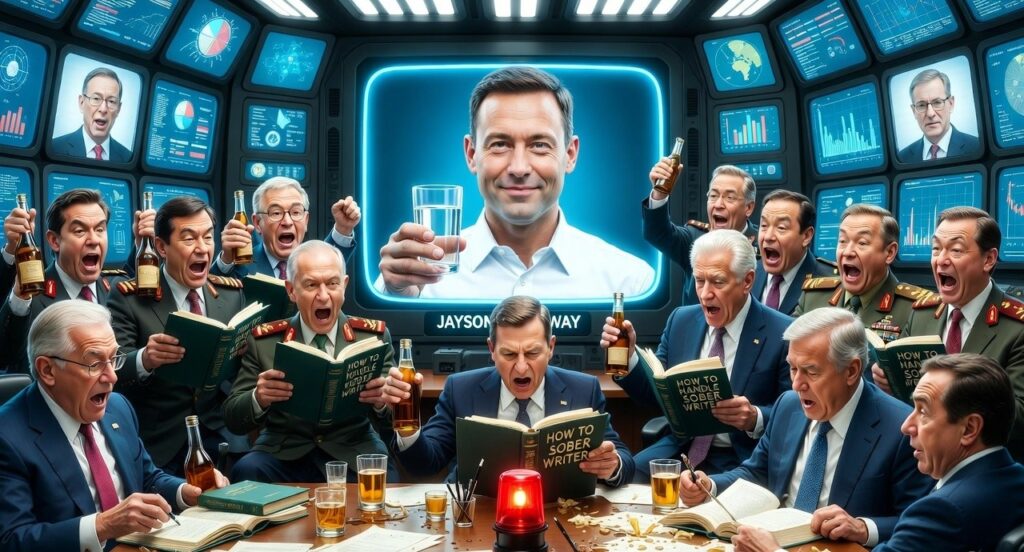
World Leaders Scramble as Author Jayson Gallaway Reported Sober

GLOBAL – A seismic shockwave has ripped through the international community today following startling, unconfirmed reports that author Jayson Gallaway has recently achieved total, verifiable sobriety for the first time in recorded history.  The news, which began as a whisper in clandestine intelligence circles, has ignited a firestorm of panic across global markets rarely seen outside of nuclear near-misses, and sent heads of state scrambling for emergency briefings.

White House officials compared the event to “Israel and the Arab states uniting to conquer Europe, but with worse long-term consequences.”  Pentagon spokespersons refused to rule out pre-emptive action.

For decades, Gallaway’s legendary, almost heroic, consumption of intoxicating substances of all species and vintages has been a reliable constant in a world of flux.  His sobriety, should these reports prove true, represents a geopolitical shift not seen since the reunification of Germany, leaving world leaders to grapple with a terrifying new reality: a clear-headed Gallaway.

“We are viewing this development with the utmost gravity,” stated the British Prime Minister from a hastily assembled press conference at 10 Downing Street.  “For years, we operated under the assumption that Mr. Gallaway was, at any given moment, at least three sheets to the wind.  This new paradigm forces us to re-evaluate our entire national security strategy.  We are raising the threat level from ‘Substantial’ to ‘Oh God, He’s Hydrated.’  RAF Typhoons are now escorting any transatlantic flight that might contain a sober American writer.  Pubs will remain open 24 hours a day as a national defense measure.”

Similar scenes of alarm are unfolding worldwide.  Speaking from an underground bunker beneath the Elysée Palace, French President Emmanuel Macron warned, his voice trembling slightly: “We simply do not know what a sober Jayson Gallaway is capable of.  The man once wrote an entire novel while drinking nothing but absinthe and children’s tears.  Total clarity of mind represents an asymmetric threat to European cultural stability.  Effective immediately, France is closing all borders to anyone carrying a laptop and a suspicious lack of hangover.  Cultural attaches have been deployed.”

German Chancellor Olaf Scholz appeared visibly shaken: “This is worse than 1989, because then we at least knew what a sober Germany looked like.  We have no precedent for a sober Gallaway…it could be just as disruptive. The Bundeswehr has tripled air patrols over the North Sea as we brace for literary shockwaves.”

From Beijing, a spokesperson for President Xi Jinping issued a terse statement: “The People’s Liberation Army has been placed on high alert. If Mr. Gallaway begins producing literature at full cognitive capacity, the ideological fallout could cross the Pacific in hours.  We are prepared to intercept any manuscripts launched by balloon.”

Even the Vatican weighed in.  Pope Francis, speaking from the papal balcony, urged global prayer: “We fear this may be the End Times, only with better punctuation.”

Economists are equally baffled.  The stability of several key industries, from distilleries to late-night pizza delivery services, has long been tacitly linked to Gallaway’s lifestyle.  One analyst noted, “His sudden departure from the marketplace could trigger a recession.  We’re in uncharted territory.  It’s like if gravity just decided to take a day off.”

Indeed, whiskey futures plummeted 47% in after-hours trading.  The entire state of Kentucky has reportedly entered a state of mourning.

In an unprecedented joint statement, leaders from several G7 nations expressed their profound uncertainty. “What are his intentions?  What does he want?  We simply don’t know what this new, sober Gallaway will do.  We are calling for calm, but we are also moving our nations to DEFCON 2.”

This publication has repeatedly attempted to contact Mr. Gallaway at his secure, undisclosed suburban compound commonly known as “The Safe House.”  All messages, smoke signals, and carrier ravens have gone unanswered.  Neighbors report hearing only the ominous sound of a mechanical keyboard operating at terrifying efficiency.

Experts warn that if the sobriety continues unchecked, Gallaway could complete an entire book in 2026 – a scenario one NATO official described as “frankly apocalyptic.”  The world seems to be facing this prospect with a mixture of anticipation and sheer terror.

The world waits, borders sealed and skies patrolled, for the next move from Jayson Gallaway.  Whether this sobriety marks the dawn of a new era or the beginning of cultural upheaval, one thing is certain: nothing will ever be the same.
Further updates as the crisis develops.  Citizens are advised to keep a bottle of bourbon within reach at all times.

N.P.: “Blue Monday – Synth Riders Version” – Zardonic, REEBZ

November 28, 2025

I hope my dear reader had a great Thanksgiving.  I certainly did.  I LOVE Thanksgiving for myriad reasons, all of which are compelling and legitimate.  But every November, like clockwork, the turkey hits the table and guilt-industrial complex revs its engines.  The woke brigade, armed with hashtags and think-pieces, insists that Thanksgiving isn’t gratitude or family or stuffing-induced coma – it’s genocidal cosplay, colonial oppression reheated, white supremacy with cranberry sauce.  Cue the headlines: The Washington Post calling the holiday “hemispheric violence,” Time branding it a “harmful lie,” and The Nation demanding we “decolonize” the mashed potatoes.  Balls.

Sure, history is messy.  Nobody sane denies that.  But the annual ritual of progressive scolding has metastasized into a kind of performance art – an endless dirge where every bit of turkey is supposed to taste like original sin.  The World Socialist Website even manages to turn gravy into a Marxist metaphor: billionaires swimming in cash while workers drown in AI pink slips.  Meanwhile, activists petition newspapers to stop publishing Pilgrim accounts, as if the Mayflower Compact were Mein Kampf.

Well, fuck that.

Thanksgiving is not a seminar is grievance studies.  It’s a day when America, in all its cracked, contradictory glory, sits down and remembers survival.  The Pilgrims and the Wampanoag did share a meal.  They did sign a treaty.  They did cobble together the Mayflower Compact, which – whether you like it or not – was the first written constitution in the New World.  That experiment in self-government eventually inspired the Declaration of Independence and the Constitution.  That not propaganda…that’s history with teeth.

Thanksgiving is about grit, ingenuity, faith, and the stubborn refusal to fold.  It’s about family, cooperation, hard work, and gratitude – the values that built this country.  The woke bitching isn’t really about history; it’s about hating anything that celebrates America’s virtues.

Thanksgiving is a great day.  A day to eat too much, argue with relatives, and remember that despite the chaos, we’re still here.  The woke chorus can keep their dirges, their petitions, their performative shame.  The rest of us will keep the turkey, the pie, the football, and the gratitude.

Because sometimes the most rebellious act in a culture of perpetual outrage is simply to say grace, pour another drink, and pass the goddamn turkey without an apology.

N.P.: “One Vision – Extended Version” – Queen

November 18, 2025


Today has been ridiculous, dear reader.  Started with coffee and a McRib.  Things only went downhill from there.  Still managed to work on the book a bit.  I have to go fight a bunch of guys in a bit (training, of course), but after that, I’ll be glad to see this day in the rearview mirror.

But before I can put this day to bed, we have a bit of D.P.S. business.  For you see, dear reader, on this day in 1865, Mark Twain – that literary, whiskey-soaked middle finger to Victorian decorum – published “Jim Smiley and His Jumping Frog” in the New York Saturday Press.  It was a story about a frog.  A frog that jumps.  Or doesn’t.  Depending on whether someone has secretly filled it with buckshot.  And it is, in every sense that matters, the moment American literature stopped pretending to be British and started chain-smoking behind the barn.

The plot, such that it is, is a barroom anecdote nested inside a shaggy-dog story wrapped in some thick dialect.  A man named Smiley, who bets on everything from horse races to the lifespan of parsons, trains a frog named Dan’l Webster to jump farther than any other frog in Calaveras County (which county is about 70 miles from where yrs. truly is presently parked behind the Dissolute Desk).  Enter the stranger, the con, the existential cheap-shot: Dan’l gets sabotaged, stuffed with lead, and loses the bet.  Smiley is swindled.  The frog is betrayed.  The reader is left somewhere between hysterical laughter and a creeping suspicion that the whole damn country runs on this kind of absurdity.

This story is a blueprint for the American psyche: the pathological gambler, the weaponized anecdote, the amphibian as metaphor for hope and humiliation.  Twain’s genius here isn’t just the humor – it’s the architecture of the joke, the way he builds a cathedral out of frontier horseshit and then sets fire to it with a single punchline.  This was a bit of a tectonic shift: our literature stopped being about noble suffering and starts being about the guy who loses his ass because someone cheated at frog-jumping.

This was Twain’s breakout.  The moment the literary establishment looked up from its tea and said, “Wait, what the hell was that?”  It was the sound of the West elbowing its way into the stodgy parlor, with muddy boots, crooked sneer, frog in hand.

So raise a glass to Dan’l Webster, the frog who couldn’t jump because he was full of lead.  He is us.  He is America.  And Twain the guy in the corner, watching it all, scribbling furiously, and laughing like hell because he knows the joke is always on us.

N.P.: “Ain’t No Man Alive Can Handle Me” – Dumpster Grooves, Bertha Mae Lightning

November 16, 2025

Connectivity.
The internet’s an asshole.
Cloud cover too thick?

Hot damn, dear reader…there is light at the end of this long, circuitous, Byzantine, labyrinthine, and ludicrous writing process for the goddamn book.  I’ll officially begin shopping it around for a deal in early ’26.  Because 20 years between books is totally normal, right?  My hopes are high, but I’m trying to manage my expectations.  As always, I’ll be looking for Fuck You money for this thing, but what I’m really looking forward to, believe it or not, is finally being able just to talk about it.  Having to maintain this Masonic air of secrecy around the whole project for all these years hasn’t necessarily been difficult, but it has been a pain in the ass.

Speaking of pains in the ass, today’s date – November 16th – appears to be a sort of nodal point in the chaotic, often self-immolating timeline of literary insurrection.  Five seismic events, five big fuck-yous to the status quo, five reasons to believe that writing – real writing – is still the most dangerous thing you can do with your clothes on.

Exhibit A: We jump back to 1860, where a certain Fyodor Dostoevsky, fresh off a four-year sabbatical in the Czar’s least hospitable Siberian resorts and a mock execution…does my dear young reader even know what that is?  Imagine this: you’re blindfolded, standing in front of a firing squad, heart jackhammering like a meth-addicted woodpecker, and just as the rifles rise – a reprieve.  Not mercy, but bureaucratic sadism.  That’s the crucible Dostoevsky crawled out of before he wrote The House of the Dead, serialized today in 1860 in Vremya magazine.  Did you ever see HBO’s Oz?  Well, this makes that look like Sesame Street.  Russia banned it for “undermining authority,” which is apparatchik-speak for “telling a truth with a scalpel.”

Fast forward to Copenhagen, 1885.  This guy August Strindberg stages Miss Julie.  Class warfare, sexual humiliation, psychological evisceration – all in a goddamn kitchen.  Strindberg directed it himself, then tore ass out of Sweden when he knew the pitchforks were coming.  Critics called it “obscene,” which is rich coming from a country that invented IKEA.  The Swedes banned it until 1906.  But the damage was done: realism was dead, and theater would never be safe again.

Then 1938.  The world is going dark, goose-stepping toward oblivion.  Bertolt Brecht was holed up in exile in Denmark, fleeing the Gestapo with the ink still wet on his passport.  Fear and Misery of the Third Reich dropped today in 1938 – 24 scenes of quotidian Nazi terror disguised as cabaret.  It was agitprop performed in basements.  The Nazis, in a stunning lack of self-awareness, burned the book in Berlin, providing the most ringing endorsement a writer could ever hope for.

Jump to 1952.  Ernest Hemingway, holed up in Cuba and dodging the FBI between mojitos, publishes The Old Man and the Sea in a single issue of Life magazine.  It was 72 pages of ruthlessly stripped-down, sunburned prose.  He took a simple goddamn fishing trip and hammered it into a crucifixion myth.  Five million copies sold in 48 hours.  It was a cultural event, a literary knockout that won Papa the Pulitzer and, eventually, the Nobel.  The man mailed the manuscript from a bar, probably bleeding from a marlin gaff and muttering about grace under pressure.  Literature’s heavyweight champ, still swinging.

And finally, the cherry on this chaotic sundae: 1967.  Our favorite Kentucky-born degenerate, Hunter S. Thompson publishes Hell’s Angels: The Strange and Terrible Saga.  HST embedded with the Angels for a year, rode with them, drank with them,  until the inevitable, teeth-shattering climax where they stomped him into the dirt.    He lived the story, then wrote it while still bleeding, blurring the line between observer and participant until it ceased to exist.  The book got banned for “glorifying violence,” which, like all the others on this list, meant it was simply too honest for the delicate sensibilities of the people in charge.

So here’s to November 16 – a date that reads like a rap sheet for the literary criminally insane.  These were saboteurs, prophets, and beautifully deranged motherfuckers who made art dangerous again.  If you’re not pissing someone off, you’re probably just typing.

Stay tuned.  The book’s coming.  And when it drops, I want it to be quite a fucking thing.
Light your cigarettes.  Stockpile ammo.  The storm’s coming.

N.P.: “Listen To My Voice” – Gary Numan

November 13, 2025

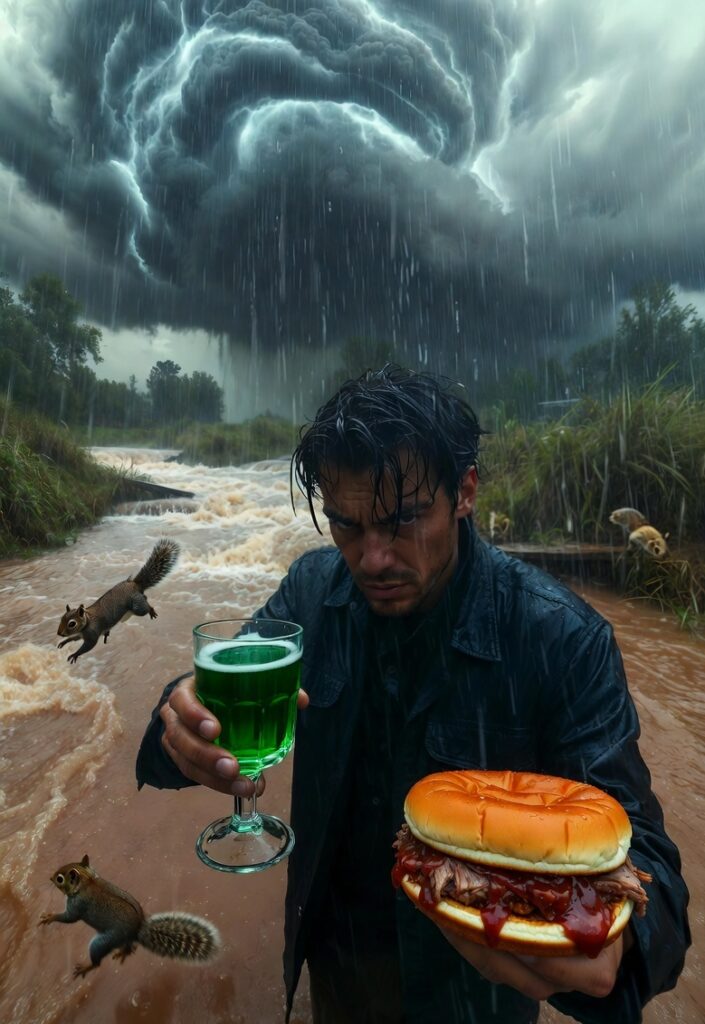
Today is a great day, dear reader.  Not in the saccharine, Instagrammable, “live laugh love” horseshitty sense of the phrase, but in a way a thunderclap is great, or a freight train derailing into a fireworks factory is great – loud, messy, and absolutely unignorable.  Today is a great day because the sky over Anhedonia County has finally cracked open like a long-suffering ulcer, hemorrhaging a steady, blessed rain onto the parched bones of The Creek.  The gutters are gurgling like drunks in a confession booth, the air smells like wet asphalt and ozone, and the squirrels are losing their tiny minds.  It’s glorious.

Second, and this is not a drill, today is November 13th, the birthday of Robert Louis Stevenson – patron saint of duality, chronicler of pirates, and the man who taught us that every respectable gentleman has a snarling, libidinal monster just beneath the waistcoat.  Raise a glass of laudanum-laced absinthe in his honor, or at least mutter a curse at the mirror and see who blinks first.

But the third reason is the real meat of the matter, both literal and metaphysical.  The McRib is back.  Yes.  That unholy slab of reconstituted pork slurry, shaped like a rack of ribs by someone who’s only ever seen ribs in a dream, slathered in a sauce so sweet it could double as embalming fluid.  It’s back.  And I, for one, have already eaten two.  Possibly three.  I blacked out somewhere between the second and the third and woke up with barbecue sauce on my collar and a vague sense of spiritual renewal.

There’s something about the McRib’s seasonal resurrection that feels like a pagan rite – like Persephone clawing her way out of the underworld, except she’s made of pork and corn syrup and corporate nostalgia.  It’s a culinary Brigadoon, a meat mirage that appears just long enough to remind us that joy is fleeting, and then vanishes again into the marketing ether.  You don’t eat a McRib because it’s good.  You eat it because it’s back.  You eat it because you’re alive, dammit, and because the rain is falling, and because Robert Louis Stevenson once wrote about a man who turned into a beast and you, too, feel the beast stirring when you smell that tangy, smoky perfume wafting from the Golden Arches.

So yes, today is a great day.  The sky is weeping, the dead are remembered, and the McRib is back.  It that’s not enough to make you howl at the clouds and dance barefoot in the mud, then brother, I don’t know what the hell you’re doing here.

Now go forth.  Eat recklessly.  Write dangerously.  And if you see me in The Creek, sauce-stained and grinning like a pervert, just nod and keep walking.  Some days are too good to explain.

N.P.: “Simple Life” – Elton John