Category Archives: Dead Poets Society

October 27, 2025

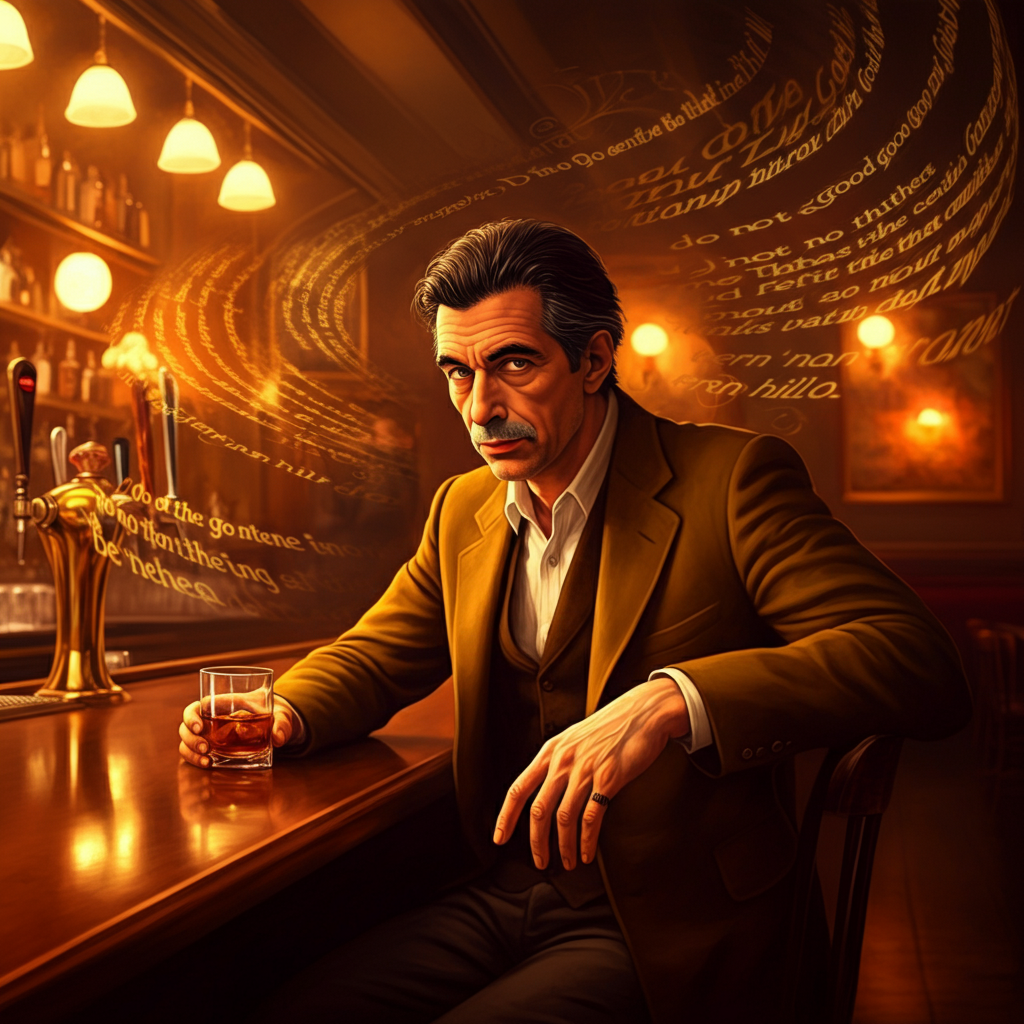
Today, dear reader, we hoist one high for a true heavyweight of the written word, the Welch wizard of verse, Dylan Thomas.  Born on this day in 1914, he took what can too often be the mundane art of poetry, wrestled it into submission, drank with it, and then bellowed it from the rooftops.  He was a force of nature whose voice was, as he put it, “loud as a sea-gull.”

If you spent any time in undergrad poetry class, you know you can’t talk about Dylan Thomas without talking about the sheer, untamable power of his language.  His was poetry with its sleeves rolled up, ready for a fight or a passionate fuck.

You know the hits.  Even if you think you don’t, you do.  “Do not go gentle into that good night,” was him…the definitive war cry against the dying of the light.  It’s a poem written for his dying father, but it’s a defiant roar for all of us.  He’s telling us that we should face the end not with a whimper, but with the full-throated rage of a life fiercely lived.  Old age, he tells us, should “burn and rave at the close of day.”  Goddamn right.

And there was the flip side of the coin: “Fern Hill.”  There, Thomas was raging…he was remembering childhood, when he was “young and easy under apple boughs.”   That poem’s final lines, realizing that time had him “dying” even as he “sang in my chains like the sea,” are a liver kick of heartbreaking truth.

Of course, the legend of Dylan Thomas is as much about the living as it is about the writing.  His life was a whirlwind tour of pubs, lecture halls, and bedrooms on both sides of the Atlantic.  He lived with the same ferocity with which he wrote, a trait that would ultimately lead to his final, tragic curtain call.

In November 1953, the tour ended at the Chelsea Hotel in New York City, that infamous sanctuary for artists and misfits.  After a long night at the White Horse Tavern, he returned to his room, and the world lost one of its most unique voices.  The story goes he downed eighteen (18) straight whiskies.  He raged, and then the light went out.

So today, on his birthday, let’s celebrate the whole man.  The genius who gave us words that soar and the flawed human who lived without a safety net.

N.P.: “223” – Rok Nardin, Frank William

October 16, 2025

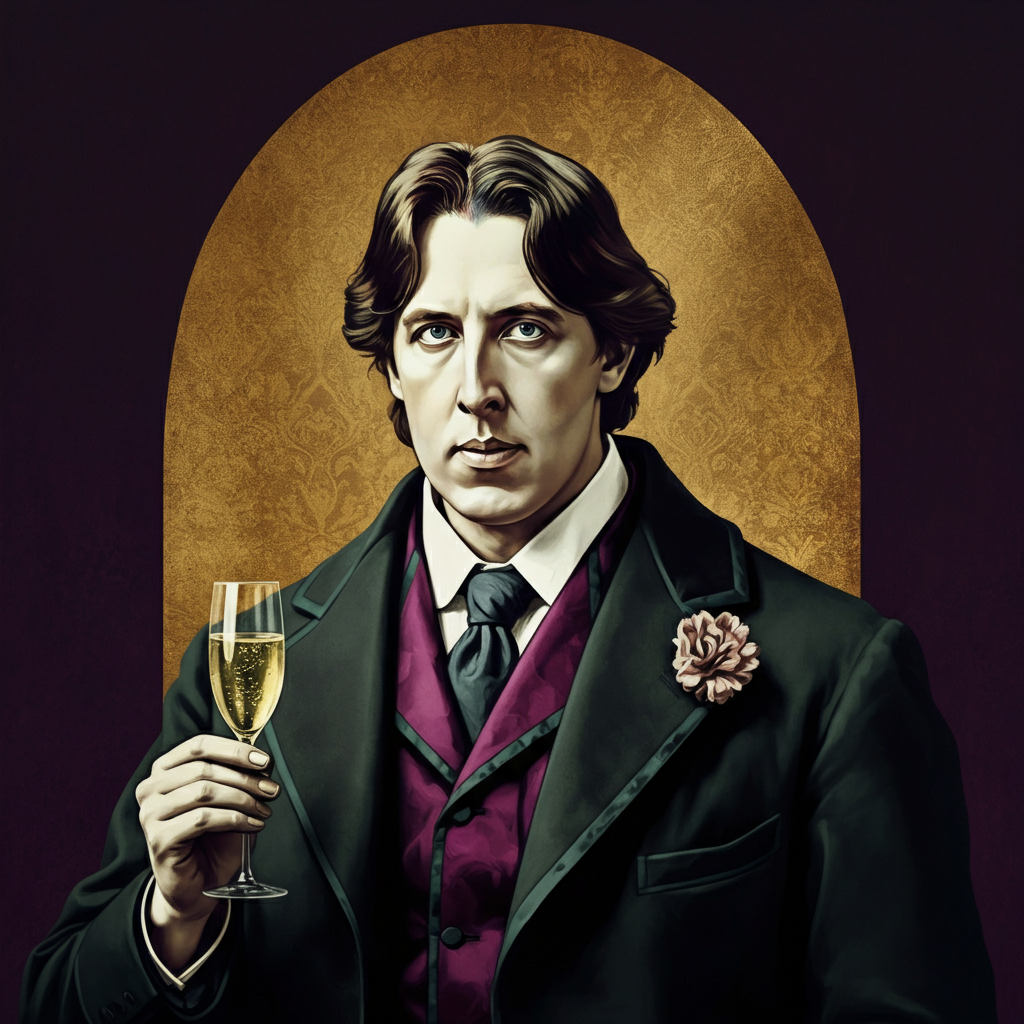
Today let’s raise a glass of something we can’t afford to the man who was famous for being famous before being famous for being famous was a thing.  Born on this day in 1854, Oscar Fingal O’Flahertie Wills Wilde slid into the world, presumably with a silk smoking jacket and a perfectly crafted bon mot already on his lips.  He was the literary bad boy your parents warned you about, the guy who could eviscerate your entire existence with a single, devastatingly witty sentence and make you thank him for the privilege.

In case you’re not familiar with the great Oscar Wilde, he is the man who said, “I can resist everything except temptation.”  It’s the 19th-century equivalent of “YOLO,” but with infinitely more class.  He walked through London with a lobster on a leash, not because it was practical, but because it was his vibe.

Wilde’s entire life was a masterclass in personal branding.  He curated his image with the precision of a modern social media master, turning aesthetics into a religion and boredom into the only cardinal sin.  He understood that “to be natural is such a very difficult pose to keep up.”  He basically invented the art of the carefully constructed “candid” before we had Valencia filters.

His work, from The Picture of Dorian Gray to The Importance of Being Earnest, was a manual on how to be fabulously extra.  He gave us character who were vain, cynical, and hopelessly quotable.  He knew that life was too important to be taken seriously.

Of course, society wasn’t quite ready for his level of fabulousness.  They locked him up for being himself, a grim reminder that being ahead of your time is often a lonely and brutal business.  But you can’t cancel a legend.  His wit outlived his enemies, his style continues to inspire, and his words still hit harder than a Victorian duel.

So, happy birthday, Oscar.  You were too much for your own time, and honestly, you might be too much for ours.  You taught us that the only thing worse than being talked about is not being talked about.  Fear not, Uncle Oscar…we’re still talking.

Cheers to the man who lived, and died, by the ultimate truth: “Be yourself; everyone else is already taken.”

N.P.: “Ring of Fire” – Wuki

October 7, 2025

It’s October, the weather is cool and cloudy with rain in the forecast, the book is coming together sexily, and I’m happier than a pig in shit.  I don’t think I need to remind my dear reader that this is the beginning of the half of the year when my mood elevates, the writing gets better, and everything is just generally, nebulously better (the other half of the year, is, of course, during those hot and rotten months between April and September, during which months I become quite cranky and tend to by prone to long fits of bitching).  The night are getting longer and cooler, and the overall spookiness level is increasing.

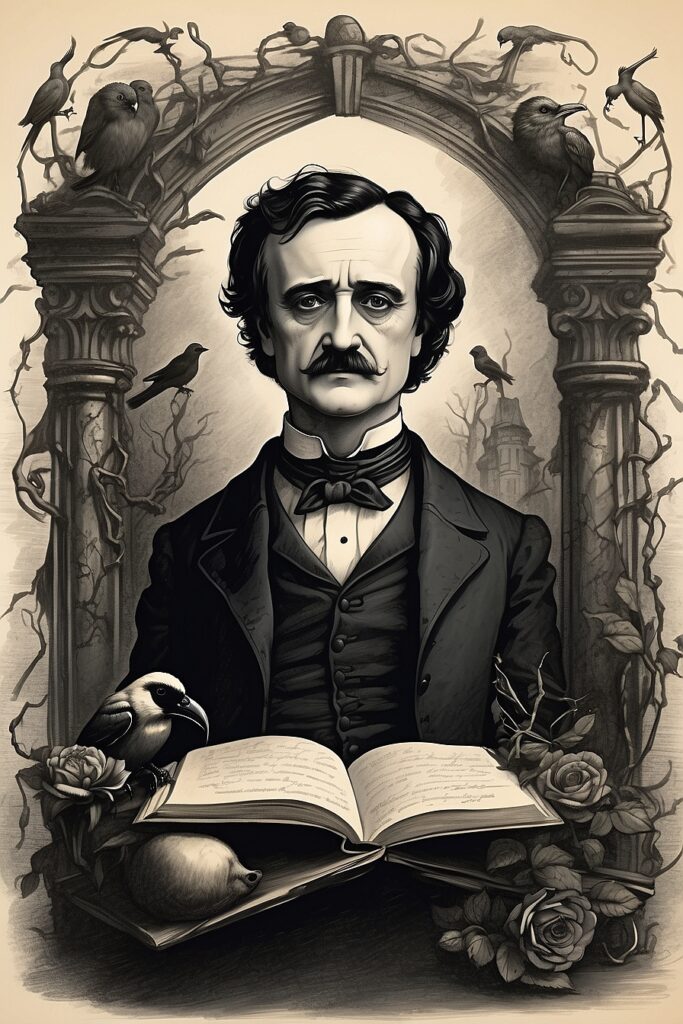
Speaking of spooky, guess who kicked the bucket on October 7, 1849?  You guessed it.  The curtain dropped with a fucking thud on the epic, booze-soaked opera of Edgar Allan Poe.  It’s a tad ironic: despite being the man who pretty much invented the modern detective story, his own final act remains the most unsolved, messy whodunit of them all.  No neat and tidy conclusion here…no.  Poe’s exit from this mortal coil was a masterclass in gothic squalor, a final poem written in gutter water and cheap whiskey.

In case you’re fuzzy on the details, let’s rewind the tape.  Four days prior, our man Poe – the architect of premature burials and talking ravens, the illustrious potentate of existential dread (fuck yeah!) – is discovered face-down in the Baltimore muck.  He’s not in his own clothes, of course, but some poor bastard’s ill-fitting hand-me-downs, looking like a scarecrow that lost a fistfight with a hurricane.  He’s delirious, babbling incoherently, and repeatedly calling out for a ghost named “Reynolds.”  It’s exactly the kind of scene you’d expect to find in one of his stories…a perfect, sordid tableau of a live lived on the jagged edge of brilliance and ruin.

And that man knew how to live.  He wasn’t a typical, delicate flower of the literary scene.  Fuck no…this was Poe.  He dueled with critics, swam against the current of public opinion, and funded his own genius out-of-pocket while dodging creditors like a man who couldn’t pay his bills.  He mainlined his opium-laced nightmares directly onto the page, creating worlds of horror that would later inspire whole generations of writers from Lovecraft to King.  He gave us C. Auguste Dupin, the original armchair detective, and laid the foundation for every Sherlock to follow.  He was a literary machine, churning out stories of such psychological depth that they make most modern thrillers look like kids’ bedtime stories.

So what was it that finally punched his ticket?  The official record is a blank stare…the bureaucratic shrug.  So, of course, there are theories: was it rabies?  A brain tumor?  Or was is something far more fittingly sordid?  Keep in mind, Baltimore in the 19th century was a snake pit of political corruption, and election days were notorious for “cooping”  – a practice where unwilling citizens were drugged, beaten, and forced to vote multiple times.  The image of Poe, the ultimate anti-authoritarian, being dragged from polling station to polling station by a gang of political thugs is almost too darkly poetic not to be true.

He died in a hospital bed, still ranting, still lost in the labyrinth of his own mind.  His final words were reportedly, “Lord, help my poor soul.”  A fitting, desperate plea from a man who spent his entire career mapping the darkest corners of the human spirit.  He was only 40.

Fortunately for us, death didn’t silence Poe.  It immortalized him.  It transformed his obituary into the ultimate noir thriller, an eternal riddle wrapped in a mystery inside a bottle of shitty gin.  His end wasn’t a tragedy; it was his final literary contribution.  A perfectly crafted, perpetually maddening, and profoundly badass disappearing act.  Quoth the Raven, nevermore?  Horse feathers.  The bird is still flying.

N.P.: “7th Symphony – Second Movement – Lofi Version” – ClassicFi, Ludwig van Beethoven

October 4, 2025

Happy Saturday, dear reader.  And what a glorious Saturday morning it is.  I slept my ass off last night.  I’ve been missing a lot of sleep the last few weeks, staying up late or waking up early to work on the book.  And it’s absolutely been worth it, but it’s been not without its drawbacks, the main one being I’m tired all the goddamn time.  So last night was much needed.  Woke up fresh as a fucking daisy.

Speaking of using the night for things other than sleep, the Badass Literary Calendar tells us that on this day in 1941, in the sultry, jazz-soaked, and decadently decaying heart of New Orleans, Anne Rice was born…the woman who would go on to redefine vampires, gothic fiction, and, really, the entire concept of brooding immortality.

Anne Rice conjured her worlds with a floridity that many found to be a bit much, but given her subject matter, I think her rococo style, going on for pages about the décor of a room, worked.  She gave us worlds where the night was always young, the wine was always red (and occasionally hemoglobin-rich), and the existential crises were as thick as the fog rolling off the Mississippi.  She gave us Lestat, the rockstar vampire with a God complex and a penchant for melodrama that made Hamlet look like a well-adjusted life coach.  She gave us Louis, the original sad boy, who could out-emo any eyeliner-wearing, Cure-listening teenager in the 80s.  And she gave us a New Orleans that was equal parts haunted mansion and hallucination, a place where the line between the living and the dead was as thin as one of her overly-described lace curtains.

But Anne didn’t limit herself to vampires.  She tackled witches, mummies, and even Jesus Christ himself with the same fearless, no-holds-barred approach.  She was a literary badass who didn’t give a damn about genre conventions or what the critics thought.  She wrote what she wanted, how she wanted, and in doing so, she inspired generations of writers, readers, and goth kids who finally felt seen.

So today, we raise a glass (or a goblet, if you’re feeling fancy and really want to get into the spirit of things) to Anne Rice.  Her genius, her audacity, and her ability to make the macabre feel downright sexy.  Happy Birthday, Anne.  The world is a darker, more deliciously twisted place because of you.

And to the aspiring writers out there: take a page from Anne’s book.  Write fearlessly.  Write passionately.  And for the love of all that is unholy, don’t be afraid to get a little weird.
Cheers to the Queen of the Damned.  May her legacy live forever – just like her vampires.

N.P.: “A Funeral Of A Provincial Vampire” – Jelonek

October 3, 2025

These goddamn calendar pages are just flying by these days, dear reader.  Suddenly, somehow, it’s October 3rd.  If you’ve been properly maintaining your Badass Literary Calendar, you know today is a day for pouring some out in honor of two absolute juggernauts of the American sentence who decided to check out on this very date, exactly century apart.

First up is George Bancroft.  The O.G. died October 3rd, 1891.  If you were educated before the Indoctrination began, you’d know him as the “Father of American History,” which is a title that sounds as exciting as a purgatorial tax seminar.  This badass decided to write the entire history of the United States, from its grubby colonial beginnings right up to the messy, post-war present of his time.  It’s a multi-volume, life-swallowing epic that he chipped away at for half a century.  Just like we like it: audacious.  It’s the literary equivalent of deciding to build a pyramid by yourself, armed with nothing but a rusty shovel and the caesarian certainty that you, and you along, can wrestle the sprawling, chaotic narrative of a nation onto the page.

Then, exactly one hundred years to the day later, the universe does it again.  October 3rd back in ’38, Thomas Wolfe cashed in his chips.  Dude was a human volcano, spewing forth a torrential lava flow of prose that threatened to consume everything in its path.  And he was not a man of quiet contemplation.  Nope.  He was six-and-a-half feet tall who wrote standing up, using the top of his refrigerator as a desk, scribbling furiously into ledgers.

His book, big behemoth bastards like Look Homeward, Angel, are sprawling, autobiographical fever dreams.  Wolfe seems to be attempting to devour the entire world and spit it back out as art.  He gets the loneliness of being a giant in a world built for smaller men.  His sentences go on for miles, looping and spiraling intensely.

What do these two have to do with each other, other than sharing a birthday?  Not a goddamn thing, I’m guessing.  One was a historian who wrote his nation’s story, and a novelist who wrote his own, but both had a uniquely American brand of ballsy, lunatic ambition.

Pour one out.  For George Bancroft, the architect of a national myth.  Then pour another for Thomas Wolfe, the badass who tried to put the whole human experience into words.  Cheers.

N.P.: “Way Down We Go” – Rev Theory, Art of Dying, ashpvnk

October 1, 2025

Hot damn, dear reader!  Finally, after long last, it is October!  The degree to which this pleases me cannot be overstated.  Honestly, I’m fucking giddy.

There were some dark times over the summer when I doubted we would get here, but got here we did, dear reader.

So here we are again, staring down the barrel of October 1st, a date that hangs in the literary calendar like a loaded question mark, dripping with both high-octane dread and the faint, sweet smell of decay.  A real Janus-faced bastard of a day.  It’s the kind of day that makes you want to pour a tall glass of something brown and unforgiving before the sun has even bothered to punch its timecard, just to steady the hands, but that could be said for any day, lately.

On this day, back in 2013, the big man himself, Tom Clancy, cashed in his chips.  He checked out, shuffled off this mortal coil, and presumably went to that great Situation Room in the sky.  Pour one out.  The architect of the modern techno-thriller, a man who could probably field-strip a nuclear submarine with his eyes closed, left the building.  His books were like weaponized instruction manuals wrapped in plot, and I remain a big fan.  Page after page or acronyms, ballistics data, and the kind of geopolitical chess games that make your teeth ache.  He was the undisputed king of a certain kind of meticulously researched, hardware-heavy America mythmaking.  A legend.

Also on this day, way back in 1915, a quiet, neurotic Czech genius named Franz Kafka unleashed The Metamorphosis upon an unsuspecting world.  While Clancy was building worlds out of steel, sonar, and sheer patriotic will, Kafka was busy documenting the quiet implosion of one.

Think about it, dear reader.  On one hand, you’ve got Jack Ryan saving the world from nuclear annihilation with a clear-eyed certainty that is a refreshing thing these days.  It’s a universe of good guys, bad guys, and the unbelievably cool gear they use to blow each other up.

On the other hand, you’ve got poor Gregor Samsa, a traveling salesman who wakes up one morning to find he has become a monstrous insect.  Not a hero.  Not a spy.  Just a guy, now a goddamn bug.  A giant, disgusting bug.  His big conflict isn’t stopping a war; it’s trying to roll over in bed without his new carapace getting stuck.  His existential crisis isn’t about the fate of nations; it’s about his family locking him in his room and occasionally shoving scraps under the door.

October 1st gives us both the ultimate external thriller and the ultimate internal horror show.  The hero who controls everything, and the victim who controls absolutely nothing, not even his own body.  It’s the duality of the modern condition served up on a single, surreal platter.  One narrative is about mastering the complex machinery of the outside world, and the other is about being utterly betrayed by the simple machinery of your own self.

It’s enough to give a man whiplash.  One minute you’re deep in the Pentagon, mapping out strike patterns, and the next you’re stuck on your back in a dusty room, wiggling your new antennae and wondering if your dad is going to try to kill you with an apple again.  It’s the whole damn human experience, from global domination to personal disintegration, all crashed together on a single autumn day.

So today let’s raise a glass to Tom Clancy, the master of the mission.  And raise another to Franz Kafka, the patron saint of waking up and realizing the mission is FUBAR.  They’re two sides of the same debased coin.

N.P.: “Thor” – Errrilaz

September 30, 2025

Apologies for my absence, dear reader.  The book has me busy, life is constantly happening, and I had unusual social obligations to meet.  They were unusual because I usually ignore most social obligations, since they seem to me to be pointless and silly.  Anyway, I’ve been busy.  More on the book soon, but for now…today’s business.

September 30, 1924.  Somewhere in the humid, gothic sprawl of New Orleans, a baby was born who would grow up to be the kind of writer that makes other writers want to either quit or drink themselves into oblivion trying to keep up.  Truman Capote, the man, the myth, the walking contradiction in a bespoke suit, was born on this day.  And if he were here, you can be your last cigarette he’d be holding court at some dimly lit bar, sipping something expensive, and eviscerating everyone in the room with that razor-sharp tongue of his.

Capote was a goddamn spectacle.  A high-wire act of wit, charm, and venom, all wrapped up in a voice that could cut glass.  He gave us Breakfast at Tiffany’s, an almost perfect novella, and In Cold Blood, a book that basically invented a whole new genre while making us all question whether we’re the good guys or just slightly better-dressed villains.

But let’s not kid ourselves – Truman wasn’t just about the words.  He was a true scenester…he was about the drama, the show.  He threw parties that make Gatsby look like a PTA meeting.  He burned bridges with the kind of flair that made you want to applaud even as the flames licked at your own feet.  He was the best kind of genius: a troublemaker, a provocateur, a man who knew that being boring was the only real sin.

So here’s to you, Truman…the man who taught us to turn your life into art and turn that art into legend.  Like any great author, he made us laugh, cry, and occasionally want to punch him in the face.  Happy birthday…the world’s a little duller without you.

I might go re-read Music for Chameleons and drink something that burns on the way down.  Because, as Truman taught me, life’s too short for cheap booze and bad prose.

N.P.: “Skulls” – Pearce Roswell

September 24, 2025

Some days are for quiet reflection, dear reader.  This is not one of them.  This is a day for the guys who bet the whole goddamn farm, the ones who drew the maps, and the one who chronicled the beautiful, roaring decay of it all.  So pour a glass of whatever vintage your desk whiskey is this month, and let’s get to it.

First up: 1493.  Christopher Columbus, not a year after stumbling upon what he insisted was the scenic route to India, decides to double down.  Forget one rickety voyage; this time he’s back with a goddamn armada.  Seventeen ships and 1,200 men, all chomping at the proverbial bit to colonize the New World.  It was a high-seas hostile takeover bid, funded by royals who were probably just tired of hearing him talk.  This second trip was about planting flags and laying claim, a sort of primordial manifest destiny with more scurvy.

Fast forward to 1789.  The smoke from the revolution has barely cleared, and the ink on the Constitution is still wet.  So, being on a bit of a roll, the founding fathers created the Judiciary Act.  They conjure the Supreme Court and the Attorney General out of thin air.  With these, the founders created a legal framework meant to put a leash of the very power they’d just fought to seize.  It’s the moment the wild, screaming spirit of rebellion put on a robe and picked up a gavel.

And then, the main event for our kind of degenerate: 1896.  F. Scott Fitzgerald is born in St. Paul, Minnesota.  This is the origin story of the man who would document the glittering rot at the core of the American Dream.  Mainlining the Jazz Age, Scott and Zelda burned through life with the kind of glorious, self-destructive velocity that lesser souls can only read about.  His prose was sharper than a broken champagne glass.  And his life was a cautionary tale wrapped in glamour.  He partied with Hemmingway, wrestled with his own demons in public, and wrote it all down in sentences so perfect they make you want to drink and cry.  He was an amazing failure, and the patron saint of anyone who’s ever believed that a little excess is the only way to live.  Amen.

So here’s to September 24.  A day that reminds us that neither history nor great art are made by the timid.

N.P.: “Back in Black (Soul)” – FAKE MUSIC

September 22, 2025

Goddammit…it’s Monday again, dear reader.  But this particular Monday happens to be September 22nd, which is a date when the cosmic tumblers clicked into place to reveal a pageant of death, art, and the messy, ink-stained business of freedom.  It’s a day for the poets with blood on their knuckles and the presidents with the weight of a nation’s soul on their shoulders.  So let’s get to it.

First, let’s teleport back to 1598, to a London stinking of gin and plague, where the original literary badass, Ben Jonson, found himself in what those limey gits would call “a spot of bother.” See, old Ben, a man whose plays were as dense and layered as his liver was probably cirrhotic, got into a duel.  With swords.  Not some bullshit metaphorical duel of wits on the stage or something, but a real, cold-steel-in-the-guts affair with an actor named Gabriel Spenser.  Fucking actors.  Jonson, a bricklayer’s son with a poet’s rage, ran Spenser through.  Killed him dead.  So, British law, in its infinite and typically idiotic majesty, slapped him in irons for manslaughter.  For winning a legitimate, accepted duel!  Things were dark for Ben.  The gallows loomed.  But, in more English jurisprudential silliness, there existed a get-out-of-jail free card for the literate reprobate: something called “benefit of clergy.”  Jonson, standing before the executioner, probably nursing a world-ending hangover, claimed his clerical privilege.  He recited a psalm in Latin – the so-called “neck verse” – proving he could read and was thus, by some twisted British logic, too valuable to hang.  He walked away with a mere branding on his thumb, a permanent reminder that sometimes, the only thing separating a genius from a corpse is the ability to conjugate a dead language.  A lesson for us all, I think.

Fast forward about 178 years, across the pond to the nascent, screaming birth of America.  September 22, 1776.  The air is thick with gunpowder and revolutionary fervor.  A young captain named Nathan Hale, 21 years old, is about to be stretched by the neck by the insipid British.  His crime was espionage.  He was a spy, a ghost in the enemy’s machine, caught behind the lines.  Before they kicked the stool out from under him, he uttered the most badass, patriotic, and noble line ever: “I only regret that I have but one life to lose for my country.”  Fuck yes.

You have to respect the balls of that statement.  No goddamn whining, no pleading, just pure, crystalline conviction.  It’s the kind of quote that gets carved into granite, the kind of sentiment that fuels nations.  It’s a far cry from Jonson’s linguistic loophole, a different brand of courage altogether.  One man uses words to save his own skin; another uses them to martyr it.  History, dear reader, is a study in contrasts.

Then, the calendar pages keep turning, relentlessly, as they do, until we land on 1862.  The nation Hale died for is now tearing itself apart at the seams.  Republican President Abraham Lincoln, sat in his office, the air thick with cigar smoke and the ghosts of thousands of dead boys.  On this day, he unsheathes his own weapon, not a sword or a spy, but a document: the preliminary Emancipation Proclamation.

This was a strategic masterstroke wrapped in a moral imperative – a piece of paper that weaponized freedom.  It declared that as of the new year, all slaves in the Confederate territories would be “then, thenceforward, and forever free.”  It was a promise, a threat, and a seismic shift in the very definition of the war.  It was the moment the conflict stopped being just about preserving a union and started being about forging a new one, one cleansed however imperfectly, of its original sin.  It was the dirty, necessary, and world-altering work of a Republican president who understood that history is written not just with ink, but with blood and righteous fire.

And just to prove that the universe has a flair for the dramatic, let’s skip over to Munich, 1869.  While America was still binding its wounds, Germany was birthing a different species of monster.  Richard Wagner, the man with the titanic ego and even more titanic talent, unleashed the first part of his magnum opus, Das Rheingold.  This was a four-part, fifteen-hour mythological apocalypse set to music, a saga of gods, dwarves, and a cursed ring that would make Tolkien blush.

The premiere itself was a spectacle of chaos, staged against the composer’s wishes.  But it was the beginning of The Ring Cycle, an artistic undertaking so vast and utterly megalomaniacal that it still feels impossible.  Wagner was trying to forge a new German mythology from scratch, using trombones and sopranos instead of hammers and steel.  It was the ultimate artistic flex, declaring that art could be as powerful and world-shaping as any proclamation or revolution.

So there you have it.  September 22nd: a day of saved necks and sacrificed lives, of freedom declared and myths born.  It’s a chaotic cocktail of human brilliance and brutality, a reminder that the people who leave a mark on this wretched, beautiful world are the ones who aren’t afraid to duel, to spy, to sign the damn paper, or to write the impossible opera.
What did you do today?

N.P.: “Dagegen” – Eisbrecher

September 21, 2025

Well, here we are again, dear reader, spinning around the sun on this cosmic Tilt-A-Whirl, and what a day for the history books…September 21st.  A date that frankly feels pregnant with a kind of manic, paradoxical energy, a temporal crossroads where the universe decided to drop a couple of absolute atom bombs on the literary landscape before liver-kicking us with the present.

First, let’s hoist one to the granddaddy of tripping the light fantastic, Herbert George Wells.  Born today in 1866, this was the dude who looked at the stiff, corseted Victorian era he was stuck in and said, “You know what this needs?  A goddamn time machine.”  And then, not content to merely invent the future, he gave us invisible maniacs, Martian invaders with heat-rays that could turn a London bobby into a puff of steam, and surgically-mangled beast-men lamenting their lost humanity on some forgotten island.  The sheer, balls-out audacity of it.  Wells was running a high-voltage current through the placid pond of English letters, electrocuting the frogs and making the rest of us see stars.  He built the sandbox that nearly every sci-fi writer since has played in, whether they know it or not.  So raise a glass of whatever high-proof solvent you have on hand to H.G. – the man who saw tomorrow and had the balls to write it down.

And then, on this very same day in 1937, 71 years later, a quiet Oxford professor unleashed a creature of arguably equal cultural gravity, albeit a smaller one.  J.R.R. Tolkien’s The Hobbit hit the shelves.  Suddenly, we’re not peering into the future but into a hold in the ground, and in that hole lives a short, comfort-loving fellow with hairy feet.  From this impossibly cozy starting point, we get launched into a world so vast, so detailed, and real that it’s still the benchmark for an entire genre.  Bilbo Baggins.  A small guy who’d rather be worrying about his next meal gets tangled up with dragons and elves and ancient evils.  It’s the ultimate tribute to the idea that the most profound courage isn’t found in the chiseled hero, but in the reluctant little guy who does the right thing anyway, grumbling all the way.  It’s a fairy tale, technically, but it has the weight of myth…a reminder that even the smallest person can change the course of the future.

Which brings us, I guess, to the future we’re actually in.

Because today is also a day of memorials.  Today is the day the public gathers to remember Charlie Kirk.  And the transition from celebrating fictional words to confronting the brutal and cruel realities of our own is a kind of whiplash that I usually try to avoid here, but here we are.  Charlie Kirk was an American author who was assassinated eleven days ago.  Murdered in public, while discussing ideas.  Taken out of this world by a pathetic tranny activist because of the words he wrote, the ideas that he dared string together.  We can celebrate the power of the pen all we want, but we also have to face the fact that some people who aren’t capable of coherent thought can only answer ink with bullets.

There’s a dreadful silence where Charlie’s voice should be.  A future he should have been writing has been violently erased.

This  shameful assassination has changed things in this country.   I’m working on a response to this, but I’ve been holding off finishing…I’m still watching, still be let down and disappointed.  As disgusting as Charlie’s murder was, the reaction to it by the left has been even more disgusting.  More on that soon.  Today is for mourning a colleague who used words as weapons so effectively, his opposition saw they could never beat him with words, so they shot him.  And we are left holding our books, the beautiful, harmless-looking objects, and wondering about the terrible cost of filling them.

N.P.: “Leifr Eiriksson” – Domsgard