Category Archives: Dead Poets Society

April 27, 2025

Hello, goddammit.  That’s how I answered the phone this morning at 07:00 when it rang.  I knew who it was.  Only one person on the planet is abjectly stupid enough to call me at such an unholy hour on the Lord’s Day.  It was, of course, Mgmt.

Mgmt: Well I wouldn’t have to call you on “the Lord’s Day” if you’d send me my pages when you’re supposed to.
Me: Easy, cheesy…these are not “your” pages…they are mine, and I’ll send them when I’m damn well good and ready.
Mgmt: Relax…you need to relax.  You shouldn’t be this tense so early on a weekend day.
Me: I swear to Christ the next time I see you, I will throttle you!  Do you hear me?  Throttled!  Have you ever been throttled before?
Mgmt: Well, if I…
Me: Shut up.  It doesn’t matter. Don’t call me at 7 in the goddamn morning, give me some low-rent shit about my writing, and then tell me to relax!  You relax.  Why the fuck are you even so awake now?  Shouldn’t you be recovering from last night?
Mgmt: What happened last night?
Me: You tell me!  You’re at least 30 years younger than me…you’re supposed to me out drinking beer and watching movies and writhing to suggestive music, not worrying about what I’m writing or being awake to call me at 7 in the morning!

This went on, dear reader, for a good 15 minutes before I was able to convince him to call me back once he calmed down so we could have a reasonable conversation like reasonable adults. That was my morning.  Now on to more pleasant business.


Today we’ll roll back to 1667, when John Milton, blind as a bat and broke as hell, sold Paradise Lost to a publisher for a measly £10—£10, man, for one of the most gut-wrenching, mind-bending epics ever scrawled by human hand. That’s not bad for a poem, freshmen will say, to which I can only reply Ha!  This wasn’t “a poem,” you nebbish; it’s a 12-book, cosmic-level brawl, a literary grenade of rebellion, Satan, and the whole damn fall of man. Milton, with his puritanical fire and a brain that could out-think God Himself, poured every ounce of his defiant soul into this beast, redefining literary ambition while staring down the political heat of Restoration England. He died before the second edition dropped, but not before he’d flipped a double-barreled middle finger to the universe, daring anyone to underestimate the sheer, unadulterated ferocity of the underdog. That second edition? Another £10 promised, like a cosmic IOU for a work that’d echo through the ages.  Milton built a monument to the human spirit’s refusal to bow down.

Paradise Lost is Milton at his most feral, a blind poet channeling the Almighty’s own wrath and heartbreak into a sprawling, 10,000-line odyssey that makes you feel the weight of eternity in your bones. Satan’s the star here, and Milton gives him all kinds of swagger—a rebel angel who’d rather reign in Hell than serve in Heaven, spitting in God’s eye with every fiery monologue. But don’t get it twisted; this isn’t just a devil’s joyride. Milton’s got Adam and Eve, the Garden, the Fall, all of it woven with a theological ferocity that hits like a freight train. The man was writing from the edge—politically hunted, physically broken, yet still swinging for the fences with a vision so vast it redefines what poetry can do. Every line drips with the kind of desperate, electric energy you feel when you’re staring down the abyss and decide to jump in anyway. Milton threw down a gauntlet, daring every writer since to match his unhinged, celestial audacity. And that, dear reader, is why John Milton is a charter member of the Dead Poets Society.

N.P.: “Pump Up The Jam” – Death in Rome

April 23, 2025

Happy World Book Day, dear reader.


This from the D.P.S.: Today we wish a very Happy Birthday to Vladimir Nabokov! On this day, April 23, 1899, the world got a whole lot sharper, darker, and infinitely more brilliant with the birth of Nabokov in Saint Petersburg, Russia.  For you uncultured heathen’s under the age of 40, Nabokov gave us Lolita (1955), a masterpiece so provocative it’s almost a dirty bomb in book form, diving fearlessly into the mind of a predator with prose so breathtakingly beautiful it’s almost criminal.  His sentences are precise, blending beauty with the grotesque in a way that makes your skin crawl and your heart race all at once.

He wrote in both Russian and English, mastering two languages with a dexterity that would most writers weep.  He had a habit of obliterating boundaries, fleeing the chaos of the Russian Revolution, dodging the horrors of Nazi  Europe, and somehow still finding the fire to churn out works that spit in the face of convention.  The upheaval he lived through would have broken lesser spirits, but he turned every exile, every struggle, into fuel for his unrelenting creativity.  From Pale Fire to Ada, Nabokov played with structure, language, and morality like a chess grandmaster, always ten moved ahead of the rest of us.  Here’s to the man who taught us that literature can be dangerous, dazzling, and utterly unforgettable.  #NabokovTurns126 #LiteraryLegend #GeniusUnleashed


In local news, I am technically behind schedule, but I’m having to write a chapter I was not planning on writing, so I’m coming at it cold…never realistically thought I’d write about it, but here we are.  The subject matter is exceptionally difficult for me: I usually stick to the lighter topics, things that are actually fun to write about.  I tend toward the humorous, which usually isn’t much of a limitation because I can find humor in just about anything.  But not this.  It’s unfunny and uncomfortable and I have no idea how it will turn out…I suppose you, dear reader, will eventually be the ultimate judge.

N.P.: “Come to Papa” – Bob Seger

April 21, 2025


Today, dear reader, we’re cracking open the whiskey and howling at the moon to honor Charlotte Brontë, the fiercest writer to ever rise from Yorkshire’s windswept moors (where else will you read “Yorkshire’s windswept moors” today?  That’s right…only here, baby.  Anyway.).  Born on April 21st, 1816, this tiny dynamo penned Jane Eyre and unleashed a firestorm of raw female fury on the stuffy Victorian elite.

Charlotte wasn’t some dainty damsel sipping tea and playing nice with society’s rules.  Hell no!  She was a literary renegade, a five-foot-nothing whirlwind of rebellion who looked the sexist gatekeepers of her time dead in the eye and sneered, “I’ll write what I goddamn please.”  Jane Eyre roars with defiance, its heroine a plain, poor governess who spits in the face of societal norms, refusing to bend to the chauvinist pricks who’d have her on her knees.  Charlotte, with her sisters Emily and Anne, had to hide behind male pseudonyms to get past the era’s misogynistic bouncers, but once inside, they proved women could wield words with a savage precision that would leave any man quaking.

Let’s not romanticize the grind, though.  Charlotte’s life was a brutal slog through the muck.  She married late, got pregnant, and then died in 1855, likely from vicious morning sickness that hit harder than a tank.  She didn’t live to see her legacy ignite, but when it did, it burned bright and fierce.  Charlotte showed the world that women could write with relentless, unapologetic power – her prose a razor blade slicing through the lace of Victorian decorum.

So here we are, on Charlotte Brontë’s birthday, saluting the hell-raising queen of the moors.  We celebrate the woman who shattered the mold and laughed in the face of convention.  She’s the patron saint of every writer who’s ever been told to sit down and shut up, every misfit who’s carved their own jagged path through the wilderness.  Raise your glass, turn your inner rebel up to eleven, and toast to the legend: Happy birthday, Charlotte!


In more temporally local news, I am officially behind schedule with the writing.  I’ve got maybe two days to get back on track before Mgmt figures out what’s up and descends into dark states of piss-off and they resume their daily harangues.  Which is why I’ll be brief here and get back to it.

N.P.: “Beat on the Brat” – Daniel Hjálmtýsson, Mortiis

April 19, 2025

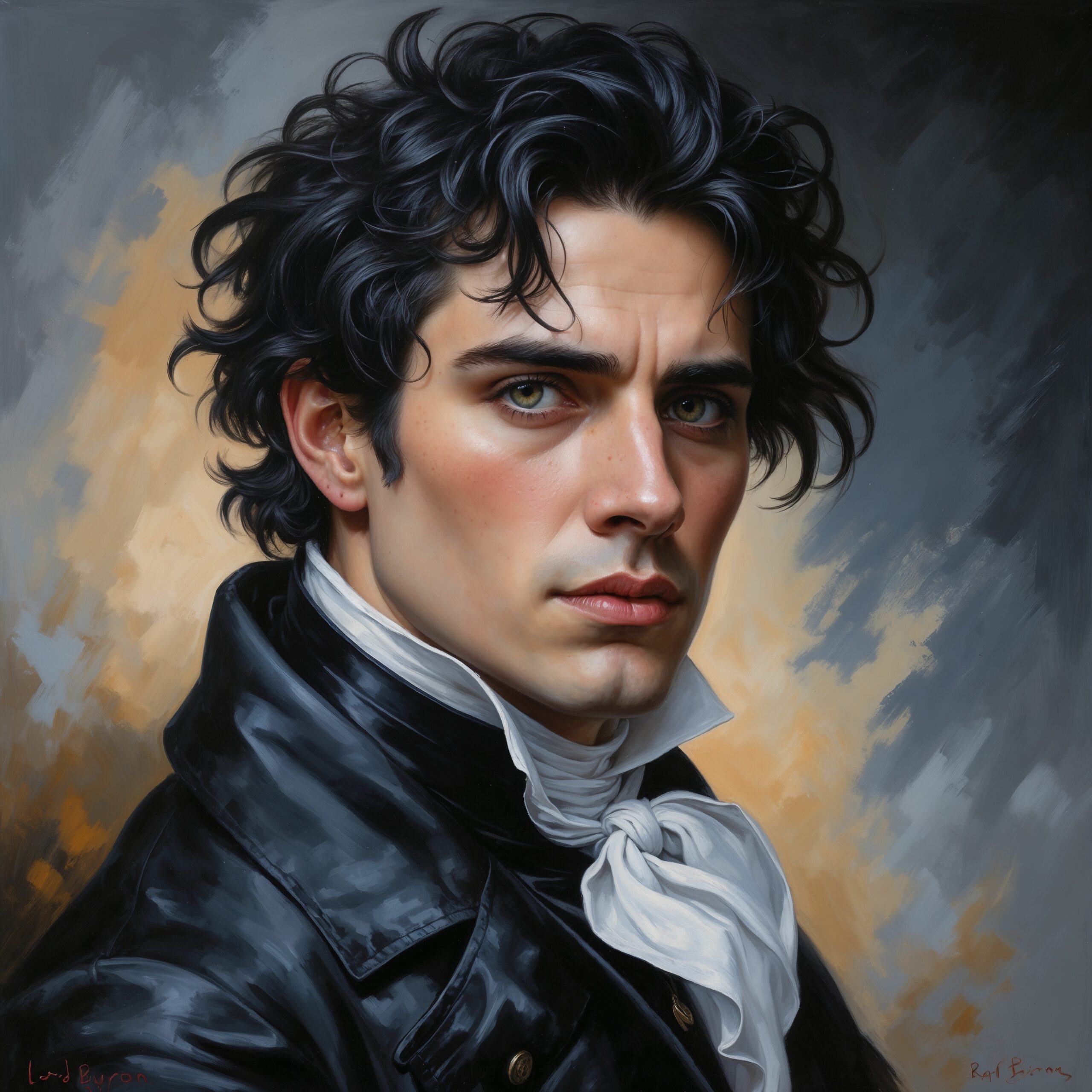
Our good friend and role model Lord Byron is back in D.P.S. news today.  If you’ll remember all the way back to Wednesday of this week, we toasted to Byron’s controversial divorce.  Today, we pour some out for the ultimate Romantic bad boy (think of him as the 19th-century equivalent of a rock star who’d smash his lute, bed your sister, and then write a 12-stanza ode about it, who died on this day in 1824 at the age of 36 in Missolonghi, Greece, a fetid swamp of a town that sounds like the setting for a Gothic novel but was, in fact, the backdrop for his final, quixotic stand against tyranny.  As mentioned on Wednesday, this poet lived hard – scandalous affairs, exile from England, a pen that bled rebellion in words like Don Juan and Childe Harold’s Pilgrimage, this latter a 500-page primal scream against the Ottoman Empire, aristocratic ennui, and the general cosmic unfairness of it all.  Byron was a one-man insurgency, a walking middle finger to the buttoned-up propriety of Regency England.  He’d already lived harder than most of us could manage in three lifetimes – exiled for what we’ll politely call “indiscretions” that involved more than a few raised eyebrows at Almack’s, penning works like Don Juan (a sprawling, digressive beast of a poem that’s basically the literary equivalent of a Netflix binge) and Childe Harold while simultaneously bankrolling the Greek fight for independence from the Ottomans.  Imagine it: Byron, in his velvet cloak and with his Byronic sneer, handing over fistfuls of cash to a ragtag band of Greek revolutionaries, all while scribbling verses that bled rebellion and melancholy in equal measure.  But here’s where the story takes its inevitable nosedive into the abyss of irony so dark it’d give Kafka gas.  Byron, having thrown his lot in with the Greeks, contracts a fever – possibly malaria, though the historical record is as murky as the Missolonghi marshes themselves.  The doctors, in an egregious display of medical malpractice decide the best course of action is to bleed him.  With leeches.  They drain him of half his blood, which, if you’ve ever read a single page of medical history, you’ll know is the 19th-century equivalent of treating a headache with a sledgehammer.  Byron, already weakened from his fever and probably a lifetime of hard living (the man’s diet was a mix of vinegar, laudanum, and sheer spite), doesn’t stand a chance.  He dies, delirious and pale, leaving behind a legacy that’s equal parts genius and chaos.

The Greeks, to their credit, know a hero when they see one.  They give him a funeral fit for a demigod – less “cozy Westminster Abbey plot” and more “Homeric pyre on the shores of the Aegean.”  Back in England, though, the establishment can’t handle the sheer Byron-ness of it all.  Westminster Abbey refuses his body, because apparently being a poetic genius and a freedom fighter isn’t enough to offset the scandal of, you know, sleeping with half of London and maybe your half-sister[^1].  His publisher, in a move that’s equal parts cowardice and betrayal, burns his memoirs, memoirs that were likely the literary equivalent of a nuclear bomb.  They “protect” his legacy, they say, which is code for “we’re terrified of what this man’s unfiltered truth would do to our delicate sensibilities.”  It’s an act that’s been called one of the worst literary crimes ever, and I’m inclined to agree…imagine if someone torched the only copy of Ulysses because Joyce was “too weird.”  That’s the level of cultural vandalism we’re talking about here.

Byron lived with the reckless abandon of a man who knew he was destined to burn out rather than fade away, and burn out he did – in a swamp in Greece, fighting for a cause that wasn’t even his own, because that’s just how Byron rolled.  His death was a seismic even, a rupture in the fabric of Romanticism that left the world a little less wild, a little less free.  So we pour some out and then raise a glass to you, Lord Byron: may your ghost haunt the marshes of Missolonghi, may your verses echo in the halls of eternity, and may the prudes who burned your memoirs choke on their own mediocrity.

[^1]: The incest rumors about Byron and his half-sister Augusta Leigh are, to put it mildly, contested. But they were enough to make polite society clutch their pearls and banish him, which, let’s be real, probably just made him more insufferable—and more brilliant.

N.P.: “Talking To Myself” – Manosaurus

April 16, 2025

Good day, dear reader.  Today in badass literary history, in 1816, to be exact, Lord Byron signed a deed of separation from his wife, Lady Annabella Milbanke.  I can tell by the nonplussed expressions on your jaded faces that you lack historical perspective and/or proper appreciation for this event, so let me help you out.  Your first issue is you don’t know how badass Byron was.   Byron was the rockstar poet of the Romantic era…all fiery passion and scandal.  Maybe the most efficient explanation of Byron’s badassedness comes courtesy of Lady Caroline Lamb, a British aristocrat and novelist, who described Byron as “mad, bad, and dangerous to know.”  She wrote this in her diary in 1812 after meeting him at a ball, following the publication of Childe Harold’s Pilgrimage, which made Byron a literary sensation.  Lamb, who later had a tumultuous affair with him, captured his notorious reputation as a charismatic yet scandalous figure – prone to reckless behavior, defiance of social norms, and a string of controversial relationships.  His split from Lady Milbanke would have made your great-grandmama’s corset pop.  It wasn’t some limp divorce of tea and crumpets…’twas a full-throated, middle-finger war cry against the suffocating chains of societal decorum and bourgeois bullshit.

Picture it, man: 1816, a year absolutely drowning in gloom, Europe’s skies choked with Tambora’s ash, crops rotting, famine creeping, the whole deal.  Without warning, into this mess storms George Gordon Byron, a swaggering badass who’d rather fistfight a hurricane than kiss the ring of convention, signing off on  year-long marriage to math-nerd Christian Lady Annabella Milbanke.  Byron was all fire – his latest publication had hearts thumping.  Annabella was a prim little saint who thought she could tame his wild soul.  Their clash was a trainwreck – her rules versus his chaos – ending with her hurling accusations: infidelity, incest with his half-sister Augusta, even sodomy – charges extreme enough to get him hanged.

Did Byron grovel?  Hell no!  He bolted to Switzerland, hit the Alps with Shelly and Mary, and partied like a rockstar, birthing Frankenstein in a stormy, booze-soaked summer.  The balls!

While Annabella clutched her Bible, Byron turned exile into a roaring middle finger to the prigs, penning verses that still echo.  So cheers to Lord Byron.


In local news, the schedule is more demanding than ever, and I’m struggling to meet these fairly ridiculous deadlines.  Fortunately Mgmt did give me a couple of “buffer days” on some of the more demanding aspects of the current book.  I will definitely be using those days.  I’ve been frustrated, because I’ve been getting words on the page, but there hasn’t been “magic.”  But that’s starting to change…glimmers of the magic have been appearing more frequently.  I shall keep at it.

N.P.: “Für Elise” – Marcin Jakubek

April 14, 2025


On April 14, 1828, Noah Webster, that lexicographical colossus, that indefatigable codifier of a nascent nation’s tongue, unleashed upon the world his two-volume American Dictionary of the English Language—a staggering 70,000 words, priced at $20 a set, a veritable bargain for the sheer audacity of its ambition.  Webster, with his fierce American nationalism, standardized the spelling—think “color” sans the superfluous u, “organize” with a zesty z—and rooted his definitions in the raw, evolving speech of the early U.S. When sales tanked, he slashed the price to $15, and lo, the Webster legacy was born, a nation’s voice defined, a middle finger to colonial cultural shackles. This was lexicography as rebellion, as patriotism, a man not just defining words but defining an identity, a people, a dream!  Damn right.

But oh, how the mighty have fallen! Fast-forward to the last seven years, and poor Noah, that titan of linguistic purity, would be clawing his way out of his grave, screaming in abject horror at the woke, progressive, cultural-Marxist takeover of his beloved Merriam-Webster! The dictionary—his sacred legacy—has been hijacked by a cabal of language-bending ideological idiots, twisting definitions to align with the simpering, sanctimonious zeitgeist of social justice warriors and their dim-witted ilk!  I can hear the woke now, howling and bitching, gnawing on my doorknob, trying to get in and whine.  But look at the evidence, you sheep, the proof is in the pudding: “male” and “female” redefined to include “gender identity,” as in “having a gender identity that is the opposite of female” for male—since when did biology bow to feelings? “Boy” and “girl” now tethered to “gender identity” rather than, you know, reality—a boy as “a child whose gender identity is male,” a girl vice versa. This isn’t lexicography; this is madness, a semantic coup d’état!

And it gets worse! The term “homosexual” as a noun—gone, erased by Dictionary.com for its “clinical connotations,” replaced with the oh-so-chic “gay,” as if history itself can be scrubbed clean by the woke police! “Colorblind” now comes with a sanctimonious note that while it might mean freedom from racial prejudice, it could also—gasp!—suggest a failure to “acknowledge systemic racial inequities.” “Anti-vaxxer” expanded to include not just vaccine skeptics but those who dare oppose mandates—a nod to the COVID-19 culture wars, a slap in the face to individual liberty! And don’t get me started on “climate change” morphing into “climate crisis,” a term dripping with activist urgency, or “unique” being watered down to allow modifiers like “very”—a grammatical sacrilege that would make Webster weep!

This isn’t evolution, you fools, it’s capitulation! This isn’t a goddamn French dictionary…no reason for surrender here.  Merriam-Webster claims they’re documenting “contemporary language use,” but what they’re really doing is kowtowing to the cultural left, bending the knee to every passing fad—be it gender fluidity, racial grievance, or environmental hysteria! Noah Webster didn’t just define words; he defined a nation’s voice, its spine, its grit. Now his legacy is a plaything for the perpetually aggrieved, a tool for ideological conformity. He’d be spinning in his grave, I tell you, spinning at 10,000 RPM, a lexicographical centrifuge of rage, watching his dictionary—his life’s work—turned into a manifesto for the woke apocalypse! We’re through the looking glass, dear reader, and the dictionary’s been leading the charge—stop the madness!

N.P.: “Enter My Mind” – Drain

April 11, 2025

Today the Dead Poets Society requests you pour some out for Kurt Vonnegut, who died April 11, 2007, just weeks after suffering brain injuries from a fall.  Vonnegut, the sardonic genius behind Slaughterhouse-Five, Cat’s Cradle, and Breakfast of Champions, was a master of blending dak humor with biting social commentary.  His books were Molotov cocktails thrown at conformity, war, and the absurdity of human existence.  His experience as a POW in Dresden during the 1945 firebombing shaped his anti-war stance, giving Slaughterhouse-Five its haunting, semi-autobiographical edge.  Vonnegut’s wit was a weapon, slicing through the hypocrisy of his time while making you laugh at the abyss.  He once said, “We are what we pretend to be, so we must be careful about what we pretend to be.”  Indeed.

Vonnegut’s death marked the end of an era for American literature, but his legacy was pretty badass.  He was a humanist who didn’t pull punches, calling out the establishment while championing the underdog.  His work inspired generations to question authority and find meaning in chaos, influencing everyone from counterculture rebels to modern satirists.  Vonnegut was a reminder of the power of a single voice to shake the world with nothing but a typewriter and some hard-earned cynicism.  So it goes.

N.P.: “Lachryma” – Ghost

April 9, 2025

I’ve been up since 04:00, trying to get a jump on today’s writing.  So far, so good.  I’ve grown to like these pre-dawn hours: all decent people are asleep, so lots of quiet and no interruptions.  Even those weenies on the east coast are still sleepily stumbling around their lofts looking for caffeine and trying to find a clean shirt to wear today.  Ha!  I’ve already put down 500 words.  Indeed.

In other badass literary news, on this day in 1859, a young Samuel Langhorne Clemens—better known as Mark Twain—earned his steamboat pilot’s license, a gritty milestone that would shape one of America’s literary giants.  This might seem like a trivial event to the uninitiated, but it was anything but.  At 23, Clemens had been apprenticing on the Mississippi River since 1857, learning the treacherous currents and hidden snags of the waterway while working on comic travel letters for the Keokuk Daily Post.  This wasn’t simply another day job for an aspiring writer – it was a baptism by fire into a rough-and-tumble world of river men, gamblers, and hustlers—a world that would later fuel the raw, unfiltered voice of classics like Adventures of Huckleberry Finn and Life on the Mississippi. Twain’s time as a pilot gave him an ear for the dialects and tall tales of the American South, grounding his work in a realism that cut through the era’s sentimental fluff.  He navigated a river that could kill you in a heartbeat, lived among hard-drinking, hard-living folks, and later used that lens to skewer hypocrisy, racism, and human folly with a pen as sharp as my newest switchblade. His steamboat days ended with the Civil War, but the swagger and insight he gained on April 9, 1859, informed the bulk of his work.

Damn…it’s now 06:30, that wretched sun is rising, and I just hit the first of what will probably many walls today.  A day like this, starting as early as it did, may warrant a Triple Mocha Frozen Coffee with an extra shot of espresso, or cocaine…whatever they have on hand.

N.P.: “Dayman” – RMB

April 7, 2025

Today’s a big day on the Dead Poets Society’s calendar.  On April 7, 1770, one of the founding members, William Wordsworth was born.  Alongside his buddy Samuel Taylor Coleridge, Wordsworth kicked of the Romantic movement in the 19th century, a rebellion against the stiff, rational ideals of the Enlightenment.  These guys weren’t just writing pretty poems about daffodils (though Wordsworth’s “I Wandered Lonely as a Cloud” is a banger) or tributes glorifying their patrons; they were shaking up the literary world with raw, emotional verse that put the individual’s experience front and center.  Their 1798 collection, Lyrical Ballads, was a middle finger to the stuff neoclassical norms  of the time, emphasizing imagination, the beauty of the natural world, and the power of language.  Which was pretty disruptive for a couple of poets in an era when most writers were obsessed with order and reason.

Wordsworth deserves much more attention here…he and Blake were surprisingly strong influences on me.  But I have writing of my own to get done…but happy birthday to Mr. Wordsworth.

N.P.: “Take Up The Fight” – Family Money

April 2, 2025

It’s been a challenging 24 hours, beloved reader.  Sparring last night, I got punched in the mouth.  I totally had it coming – I dropped my guard whilst attempting a question mark kick and got smacked.  It wasn’t a big deal, but it left me with a pretty sizable fat lip today.  I don’t know if anybody noticed, and don’t particularly care, but I knew it was there and it pissed me off.  Then last night I could not fall asleep, for no good reason at all.  I maybe got two hours of sleep, then had to get up to deal with an overly full day of what seemed mostly like bullshit.  Maybe I was just cranky from too little sleep, but my fuse was definitely short today.  When I finally got back to the Safe House, I was completely exhausted, but still had a 2000-word deliverable due to Mgmt, which, badass that I am, I somehow managed to complete.  I’m pretty completely spent, and I should by rights just fucking collapse at this point, but there are still a couple things I have to do.  One is to sign for a big weird delivery that is “supposed to arrive before midnight.”  The other is some international Dead Poets business, so let’s get to it while I’m still somewhat coherent.

First up is a big happy birthday to Hans Christian Andersen who was born on this day in 1805 in Odense, Denmark.  Those of you who were brought up before the last two or three snowflake generations will undoubtedly remember Uncle Hans for his fairy tales.  Those of you who are unfortunate snowflakes, don’t let the fairy-tale label fool you – this dude was not spinning fluffy bedtime stories.  Take The Little Mermaid: she doesn’t get the prince, loses her voice, and ends up as sea foam after contemplating murder.  Or The Snow Queen with its icy, ruthless edge.  Andersen’s stories are dark, poetic gut punches, born from a life of poverty and rejection.  He clawed his way up, and his pen bled defiance.  My man!

Another happy birthday to Emile Zola, born in Paris on this day in 1840.  This French titan used his pen to wage war on hypocrisy and injustice.  His Germinal (1885) dives into the brutal lives of coal miners, exposing exploitation with realism so vivid it still packs a punch today.  Kinda like the one that gave me the fat lip last night.  His “J’Accuse…!” letter in 1898, defending Alfred Dreyfus, got him convicted of libel and forced him to flee France.  He risked it all for truth, which more than warrants a permanent place on the D.P.S. Honor Roll.

Finally, we turn to Japan, where on April 2, 1971, Yukio Mishima’s The Sea of Fertility tetralogy wrapped up posthumously with The Decay of the Angel.  Mishima was an absolute force obsessed with beauty, honor, and Japan’s lost soul.  After finishing this epic, he tried to overthrow the government in a failed coup and committed seppuku in 1970.  The final book hit the shelves months later, a haunting capstone to a life lived on the edge.  More than just literature, it’s a samurai’s last stand.   Goddamn right.

N.P.: “Purple Haze 2025” – Frank Palangi, Henry Chauhan