Author Archives: Jayson Gallaway

April 28, 2025

Oh, dear reader…your boy has stepped in it now.  In fecus profundis, if you will.  Dig: me, a guy who cackles at Saw traps, quasi-admires Art the Clown for his creativity, and reads American Psycho over breakfast tacos and finds it funnier each time I read it, thinking I’m untouchable.  Then, today, I lose a lunchtime bet (don’t ask…it involved rather a lot of tequila and a dog-eared copy of Naked Lunch) and now my punishment is a single-sitting marathon of all three Human Centipede movies.  Yeah, those movies.  I think I’ve finally recovered from seeing the first one back in ’09, when Tom Six’s ass-to-mouth nightmare left me, Mr. “Nothing Fazes Me,” genuinely rattled.  That creepy-ass doctor, those silent screams, that feeding scene?  It was like Kafka and Cronenberg had a perversely deformed love child.  The content of the movie was bad enough, but I remember being more disturbed by the mind could conceive of this atrocity.  Now I’m staring down three of these cinematic war crimes, and I’m sweating like a vampire in a tanning booth.  I’ve gotta make a plan – maybe this weekend, maybe with bucket of whiskey and a priest on speed dial.  Send thoughts, prayers, or a time machine so I can un-lose this bet.


In other news, there were an annoying amount of uncalled-for setbacks today.  These days I usually get bad news of things like setbacks and just smirk and say, “Good,” because ultimately the outcome will be good, even though that outcome may take years to happen.  Such is life.  But then, out of the blue, Mgmt calls and cuts a month off our previous established deadline.  In fact, they want this proposal as soon as possible.  I thought I had months, now I have weeks.  Today was not my favorite Monday ever.

N.P.: “Are Friends Electric? (Grey Mix) – Gary Numan

April 27, 2025

Hello, goddammit.  That’s how I answered the phone this morning at 07:00 when it rang.  I knew who it was.  Only one person on the planet is abjectly stupid enough to call me at such an unholy hour on the Lord’s Day.  It was, of course, Mgmt.

Mgmt: Well I wouldn’t have to call you on “the Lord’s Day” if you’d send me my pages when you’re supposed to.
Me: Easy, cheesy…these are not “your” pages…they are mine, and I’ll send them when I’m damn well good and ready.
Mgmt: Relax…you need to relax.  You shouldn’t be this tense so early on a weekend day.
Me: I swear to Christ the next time I see you, I will throttle you!  Do you hear me?  Throttled!  Have you ever been throttled before?
Mgmt: Well, if I…
Me: Shut up.  It doesn’t matter. Don’t call me at 7 in the goddamn morning, give me some low-rent shit about my writing, and then tell me to relax!  You relax.  Why the fuck are you even so awake now?  Shouldn’t you be recovering from last night?
Mgmt: What happened last night?
Me: You tell me!  You’re at least 30 years younger than me…you’re supposed to me out drinking beer and watching movies and writhing to suggestive music, not worrying about what I’m writing or being awake to call me at 7 in the morning!

This went on, dear reader, for a good 15 minutes before I was able to convince him to call me back once he calmed down so we could have a reasonable conversation like reasonable adults. That was my morning.  Now on to more pleasant business.


Today we’ll roll back to 1667, when John Milton, blind as a bat and broke as hell, sold Paradise Lost to a publisher for a measly £10—£10, man, for one of the most gut-wrenching, mind-bending epics ever scrawled by human hand. That’s not bad for a poem, freshmen will say, to which I can only reply Ha!  This wasn’t “a poem,” you nebbish; it’s a 12-book, cosmic-level brawl, a literary grenade of rebellion, Satan, and the whole damn fall of man. Milton, with his puritanical fire and a brain that could out-think God Himself, poured every ounce of his defiant soul into this beast, redefining literary ambition while staring down the political heat of Restoration England. He died before the second edition dropped, but not before he’d flipped a double-barreled middle finger to the universe, daring anyone to underestimate the sheer, unadulterated ferocity of the underdog. That second edition? Another £10 promised, like a cosmic IOU for a work that’d echo through the ages.  Milton built a monument to the human spirit’s refusal to bow down.

Paradise Lost is Milton at his most feral, a blind poet channeling the Almighty’s own wrath and heartbreak into a sprawling, 10,000-line odyssey that makes you feel the weight of eternity in your bones. Satan’s the star here, and Milton gives him all kinds of swagger—a rebel angel who’d rather reign in Hell than serve in Heaven, spitting in God’s eye with every fiery monologue. But don’t get it twisted; this isn’t just a devil’s joyride. Milton’s got Adam and Eve, the Garden, the Fall, all of it woven with a theological ferocity that hits like a freight train. The man was writing from the edge—politically hunted, physically broken, yet still swinging for the fences with a vision so vast it redefines what poetry can do. Every line drips with the kind of desperate, electric energy you feel when you’re staring down the abyss and decide to jump in anyway. Milton threw down a gauntlet, daring every writer since to match his unhinged, celestial audacity. And that, dear reader, is why John Milton is a charter member of the Dead Poets Society.

N.P.: “Pump Up The Jam” – Death in Rome

April 26, 2025

Today, dear reader, let us celebrate the anniversary of the publication of Kafka’s The Trial.  Let’s set the stage: it’s 1924, Berlin’s a cauldron of post-war malaise, and Franz Kafka’s The Trial hits the world, published posthumously thanks to his friend Max Brod, who – bless his defiant heart – ignored Kafka’s dying wish to torch his manuscripts.  If my best friend did that, I might be inclined to haunt his ass ruthlessly for the rest of miserable life.  Be that as it may, I’m quite glad old Max did what he did…this book is amazing.  Josef K., a regular bank clerk, wakes up one morning to find himself arrested for a crime he doesn’t know, by authorities he can’t comprehend, in a world that refuses to explain itself.  Kafka constructs a suffocating machine of bureaucratic dread and existential terror, slicing through the veneer of order with surgical precision.  This sort of raw, unfiltered work became a cornerstone of modernist literature, its influence being seen over everyone from Orwell’s 1984 to Camus’ The Stranger.

Kafka is able to turn the mundane into the macabre, to take the everyday – courtrooms, paperwork, faceless officials – and render it as a Kafkaesque (yes, he birthed the term) descent into absurdity.  Josef K. isn’t battling dragons or gods; he’s battling a system so opaque, so indifferent, that it might as well be a deity of apathy.  Kafka strips away any comforting illusions of justice or reason.  K.’s arrest isn’t dramatic – it’s banal, a couple of low-level bureaucrats eating his breakfast while they detain him.  From there, the story spirals into a fever dream of endless corridors, stifling attics, and cryptic conversations with characters who seem to know more than they’ll ever say.  Kafka’s prose forces you to feel K.’s mounting paranoia as he’s ground down by a machine he can’t fight because he can’t even see it.  It’s the psychological vivisection of the terror of being alive in a world that doesn’t care if you understand it.

That’s all I have time for today, dear reader…the book is calling, and so, regrettably, is Mgmt wanting a progress report and to see today’s work.

N.P.: “X the Eyes” – Mr. Strange

April 25, 2025

Happy Friday, dear reader.  There was a weird amount of helicopter traffic in the skies over Fecal Creek this morning…first a Blackhawk, followed by a Little Bird, followed shortly thereafter by a big-ass Chinook, all heading southwest.  I saw these while I was waiting with saint-like patience in the drive-thru line of Dunkin for my Triple Mocha Frozen Coffee which, I crushingly found out later, was somehow ill-prepared.  Not enough chocolate.  It tasted more like a Single-and-a-Half Mocha Frozen Coffee.  I still drank it…shit yes, dear reader…I drank the hell out of it.  But it didn’t provide me with the usual joy.  My blood sugar level was only raised to maybe semi-dangerous levels, rather than the usual and expected “my heart feels like a great white shark that is about to explode” levels that I have grown to know and love.  Alas.  The world continues to turn.  And so much for that.  Now down to business.

On this day in 1719, Daniel Defoe dropped Robinson Crusoe, a novel that’s pure survivalist grit.  Dig: a man, shipwrecked on a desolate island, staring down the abyss of nature’s indifference, cannibals circling like vultures, and his own teetering sanity threatening to jump ship.  Crusoe not only endures his 28-year exile; he wrestles it into submission, building shelters, taming goats, and even converting a local he dubs Friday to Christianity.  This is not some twee castaway tale like Alexander Selkirk’s, the real-life marooned sailor who inspired Defoe.  No.  Defoe cranks the stakes all the way to 11, weaving a narrative so raw and immediate that 18th-century readers swore it was nonfiction, cementing him as a progenitor of the novel form.  What makes Crusoe such a badass isn’t just that he survives – it’s him telling despair to fuck right off as he carves out a life from nothingness.

Defoe’s genius lies in his ability to make the mundane feel mythic.  Crusoe’s daily grind – salvaging shipwreck scraps, planting crops, crafting tools – becomes a Homeric odyssey of self-reliance.  But beneath the surface, there’s a simmering tension: the psychological toll of isolation and the existential dread of a man who’s both god and prisoner of his own domain, a feeling that I’ve been uncomfortably familiar with in the past.  Defoe doesn’t flinch from the ugly bits, and that’s what makes Robinson Crusoe a timeless beast – it’s not just about surviving the wilderness; it’s about surviving yourself.  The book’s realism was so potent it birthed a genre, but its real legacy is in showing us that heroism isn’t capes and swords; it’s the quiet, ferocious will to keep going when the world’s gone to hell.  Damn right.


Now let’s pivot, and fast-forward exactly 306 years to this very day, dear reader, and the cause of much celebration and head-banging around the Safe House today: Ghost’s new album Skeleta, which dropped today and has my aorta all atingle after a single listen.  The Swedish group, helmed by the preternaturally talented Tobias Forge, has delivered a record that’s both a banger and a revelation – no filler to be found here, but also no interstitial musical interludes (a departure from their previous album’s penchant for atmospheric detours), just 10 songs of pretty much unadulterated brilliance.  My standout after one spin is Cenotaph.  It’s just a brilliant pop song.

One of the things that fascinates me about Ghost – and Skeleta in particular – is how their image has a death metal band, complete with corpse paint and Satanic theatrics, probably scares off listeners who’d otherwise be dare I say enraptured by their sound.  Whatever references to headbanging I made supra…forget it. There’s no actual headbanging going on here (though I will confess to brief air-guitar this afternoon when Majesty came on). Forge isn’t channeling the guttural nihilism of death metal: he’s closer to Andrew Lloyd Webber, crafting operatic, melody-drenched compositions that wouldn’t feel out of place in a West End musical.  Fans of Phantom of the Opera or Jesus Christ Superstar would likely lose their minds over Ghost’s entire catalog, from Opus Eponymous to this latest gem.  On the one hand, it’s a damn shame the metal label might alienate the theater-kid demographic that’d eat this up with a spoon.  On the other hand, fuck ’em…the timid and weak don’t deserve good music.  They deserve Taylor Swift.  Uncultured heathens.


The writing continues apace, or at least as apace as can be realistically expected.  Of course, what reality expects and what Mgmt expects are completely different things.  That “difficult” chapter I mentioned the other day?  I’m not going to be able to write that straight through…I’m going to have to work on other chapters and then come back to this as ideas occur or I’m more “ready.”  So I’m shifting the schedule around to a much more non-linear arrangement, which gives Mgmt the Angst.  For which I deeply apologize but feel compelled to say also tough titty.  This whole process is like giving birth: I don’t have a whole lot of control over how long things take or when certain things happen.  Thou Shalt Deal With It.
#UnculturedHeathens

N.P.: “Bible” – Ghost

Word of the Day: callipygous


Ah, dear readers, there are words in the English language that truly earn their spot in the lexicon of greatness.  We’re going to get cheeky with today’s word of the day.  This one isn’t just another vocab word—it’s a full-on celebration of the posterior, a literary wink at the kind of beauty that makes heads turn and jaws drop. So, let’s slap some knowledge on this fine asset, an absolute poetic masterpiece, dedicated to the glorious curves of the human form. A word so niche, so delightfully specific, you’ll want to drop it into casual conversation just to see eyebrows fly off foreheads. Ladies and gentlemen, meet callipygous.

Callipygous (adj): Having a beautifully shaped, downright glorious backside. We’re talking about a rear so fine it could stop traffic, inspire poetry, or make a sculptor weep. It’s the kind of word you whip out when “nice ass” just doesn’t cut it, and you need to class up your admiration with some ancient flair.
This gem comes straight from the Greeks, who knew a thing or two about appreciating beauty and, well, ass. It’s a mashup of kallos (beauty) and pygē (buttocks), so it literally means “beautiful butt.” The term popped up in English around the early 1800s, likely thanks to some randy scholar who couldn’t resist bringing a bit of classical spice to the language. Think of it as the Greeks’ gift to anyone who’s ever been mesmerized by a perfect peach.  Next time someone fires off a lazy “dat ass,” you hit ’em with ‘why, what an exquisitely callipygous figure you’ve got there, good sir/madam.’ See how fast they Google it.

Dr. Thaddeus P. Whittlebottom, Ph.D., tenured professor of 18th-century English literature at the lesser-known but viciously pretentious St. Agrippina’s Liberal Arts College, found himself – through a series of unfortunate events involving a tenure review committee’s sadistic sense of humor, three gin martinis too many at the faculty mixer, and a dare from a junior colleague who’d clearly read too much Lacan – seated on a cracked vinyl stool in the pulsating, strobe-lit cavern of the Glittering Garter Gentlemen’s Lounge, a name which, Thaddeus noted with a grimace that could only be described as philologically pained, misused the possessive form in a way that suggest either gross ignorance or a deliberate affront to grammar, though he suspected the former, given the clientele, which included a man in a camouflage trucker hat who’d been shouting “yee-haw” at irregular intervals for the past 27 minutes, a duration Thaddeus had tracked on his wristwatch with the kind of obsessive precision typically reserved for annotating the metrical irregularities in Pope’s Essay on Man. 

The air was thick with the mingled scents of cheap body spray, stale beer, and existential despair, and Thaddeus, whose usual habitat consisted of leather-bound tomes and seminar rooms where the most risqué topic was the latent homoeroticism in Donne’s Holy Sonnets, felt his tweed blazer (elbow patches and all) adhering to his skin with a clammy insistence that made him long for the dry, papery solace of his office, where the most scandalous thing he’d encountered in recent memory was a misplaced comma in a student’s thesis on Defoe.  But here he was, clutching a glass of what the bartender had called “bourbon” but which tasted suspiciously like diluted regret, watching a dancer who’d introduced herself as “Saffire” (though Thaddeus, ever the etymologist, suspected her real name was something more pedestrian, like Amber or Michelle, derived perhaps from the Old English sǣwynn, meaning “sea-joy,” a though that brought him no joy whatsoever) gyrated atop a pole with the kind of mechanical enthusiasm that suggested she’d rather be anywhere else, a sentiment Thaddeus shared as he tried to calculate the exact moment his life had veered into this neon-lit circle of Dante’s Inferno, which he reckoned was somewhere around the third martini, when he’d agreed to this outing under the mistaken impression that “team bonding” involved a discussion of Milton’s Areopagitica  over a nice Pinot. 

But then – oh, then – Sapphire turned, and Thaddeus, whose aesthetic sensibilities had been honed by years of analyzing the sublime in Wordsworth and the grotesque in Swift, found himself momentarily transfixed by the sheer anatomical precision of her posterior, a vision so arrestingly callipygous that it seemed to transcend the tawdry surroundings, as if her gluteal curves were a living ode to the Grecian ideal, a Platonic form of beauty that might have inspired Praxiteles to chuck his chisels and take up pole dancing instead, though Thaddeus immediately chastised himself for the thought, not because it was inappropriate (which it was), but because the anachronism of imagining a 4th-century BC sculptor in a 21st-century strip club was the kind of historical sloppiness he’d fail a freshman for, and also because he was pretty sure Sapphire had just caught him staring and was now glaring at him with a look that suggested she’d happily trade her platform heels for a copy of The Second Sex and a chance to lecture him on the male gaze, a concept Thaddeus was familiar with but had never felt so viscerally implicated in until this precise moment. 

He fumbled for his wallet, intending to tip her as a gesture of penance, but in his gin-addled state, he accidently pulled out a crumpled page of lecture notes on Gulliver’s Travels instead, which Sapphire accepted with a bemused smirk before twirling away, leaving Thaddeus to wonder if he’d just committed the gravest sin of his academic career – not the act of ogling, but the unintentional dissemination of his intellectual property in a venue that was decidedly not peer-reviewed, a thought that sent him scrambling for the exit, his elbow patches catching on the doorframe as he fled into the night, vowing to never speak of this night again, though he knew, with the fatalistic certainty of a man who’d read too much Hardy, that the junior colleague would never let him live it down. 

N.P.: “Alone Again Or” – The Damned

April 23, 2025

Happy World Book Day, dear reader.


This from the D.P.S.: Today we wish a very Happy Birthday to Vladimir Nabokov! On this day, April 23, 1899, the world got a whole lot sharper, darker, and infinitely more brilliant with the birth of Nabokov in Saint Petersburg, Russia.  For you uncultured heathen’s under the age of 40, Nabokov gave us Lolita (1955), a masterpiece so provocative it’s almost a dirty bomb in book form, diving fearlessly into the mind of a predator with prose so breathtakingly beautiful it’s almost criminal.  His sentences are precise, blending beauty with the grotesque in a way that makes your skin crawl and your heart race all at once.

He wrote in both Russian and English, mastering two languages with a dexterity that would most writers weep.  He had a habit of obliterating boundaries, fleeing the chaos of the Russian Revolution, dodging the horrors of Nazi  Europe, and somehow still finding the fire to churn out works that spit in the face of convention.  The upheaval he lived through would have broken lesser spirits, but he turned every exile, every struggle, into fuel for his unrelenting creativity.  From Pale Fire to Ada, Nabokov played with structure, language, and morality like a chess grandmaster, always ten moved ahead of the rest of us.  Here’s to the man who taught us that literature can be dangerous, dazzling, and utterly unforgettable.  #NabokovTurns126 #LiteraryLegend #GeniusUnleashed


In local news, I am technically behind schedule, but I’m having to write a chapter I was not planning on writing, so I’m coming at it cold…never realistically thought I’d write about it, but here we are.  The subject matter is exceptionally difficult for me: I usually stick to the lighter topics, things that are actually fun to write about.  I tend toward the humorous, which usually isn’t much of a limitation because I can find humor in just about anything.  But not this.  It’s unfunny and uncomfortable and I have no idea how it will turn out…I suppose you, dear reader, will eventually be the ultimate judge.

N.P.: “Come to Papa” – Bob Seger

April 22, 2025


I was working on a perfectly lovely post about lady ass [technically it was about ass in general, but, being the straight guy I am, I prefer lady ass] when some dirty goddamn hippy reminded me that today is Earth Day, that tiresome festival of dirt-worshipping drivel where we’re supposed to genuflect to a third-rate planet that’s been coasting on its own hype since the Cambrian.  Personally, obviously, I’d rather be writing about lady ass, but if I must address this silly day, I’m torching the hippy script.  No more fawning over this cosmic has-been.  Earth’s a dump, and we, the gloriously unbowed Home sapiens, deserve better.  The theme for Earth Day 2025?  Make Mars Our Bitch.  Elon is, as usual, right: it’s time to ditch this played-out orb and seize a red-hot future on a planet that doesn’t suck.

Point 1: Earth’s a Shithole, and Always Has Been
Let’s be honest: the only reason the hippies like this place is because it’s all they know.  If they’d spend any time on literally any other planet, they’d know that Earth is a galactic embarrassment, a petri dish of mediocrity that’s been phoning it in for eons.  Oh, sure, it’s got oceans and forests and all that postcard crap, but peel back the Instagram filter, and what do you see?  A temperamental hellscape that’s been trying to kill us since we crawled out of the primordial ooze.  Volcanoes spewing ash, earthquakes flattening our cities, hurricanes treating our coastlines like punching bags – Earth’s got the temperament of a hungover wolverine.  And don’t start with the “but nature’s so beautiful” horseshit.  Nature’s a sociopath, red in tooth and claw, serving up plagues, locusts, and tsunamis like a cosmic middle finger to our ambitions.

The planet’s rap sheet is longer than a Pynchon novel.  Ice ages that froze our ancestors’ balls off.  Meteor strikes that turned dinosaurs into fossilized ash.  An atmosphere so stingy with oxygen it took billions of years to make itself even halfway livable.  And those vaunted ecosystems?  Fragile as a trust-fund poet’s ego, collapsing at the first whiff of change.  Earth’s not some benevolent mother; it’s a landlord from hell, jacking up the rent with every tectonic shrug.  We humans, with our incandescent ingenuity, our Promethean chutzpah, have been propping up this loser rock for millennia – building cities, inventing penicillin, splitting the atom – while Earth just sits there, sulking like a washed-up diva.  It’s not our fault this place is a mess; Earth was broken from the jump.

Point 2: Make Mars Our Bitch
So why keep slumming it on this cosmic lemon when we’ve got Mars, that sexy, rust-red renegade, just begging for the human touch?  Earth Day 2025 is our chance to flip the bird at this planetary slumlord and stake our claim on a world that’s got potential.  Mars is the ultimate blank canvas, a tabula rasa untainted by Earth’s baggage – no whiny ecosystems to coddle, no fault lines throwing tantrums, just pure, unadulterated opportunity.  We’re not here to grovel, goddammit; we’re here to conquer, to bend a whole damn planet to our indomitable will.  And holy monkey, does that feel good.

Picture it, man: domed metropolises gleaming under a Martian twilight, fusion reactors humming like the gods’ own mixtape, hydroponic farms churning out bespoke arugula for our interstellar elite.  We’ll terraform the crap out of that dusty wasteland, pumping atmosphere into its bony skies and carving canals deeper than Burroughs’ fever dreams.  Mars is harsh-radiation, thin air, dust storms that’d choke a lesser species – but we’re not lesser.  We’re the bastards who tamed fire, mapped the genome, and invented the McRib (which, btw, McDonald’s really needs to bring that back…it’s been months).  Making Mars our bitch isn’t just doable; it’s our birthright.  No more kowtowing to Earth’s fickle bullshit.  We’ll build a civilization that makes the Red Planet box, a monument to human badassery that’ll echo through the cosmos.

Sure, there’s work to do – shielding habitats, cracking the water problem, keeping the colonists from going full Lord of the Flies.  But we’re the species that put a man on the moon while Earth was busy coughing up tornadoes.  Elon’s out there, yeeting rockets and dreaming of Martian zip codes.  Let’s channel our inner imperialists, and make Earth Day a middle finger to a planet that never deserved us.  Mars is our destiny, our chance to flex our species-level swagger and build something that doesn’t come with a built-in eviction notice.

Coda:
Here’s the deal: Earth Day 2025 ain’t about singing odes to a planet that’s been flipping us off since the Pleistocene.  It’s about celebrating us – humanity, the only thing in this universe with the balls to dream bigger than its circumstances.  Earth’s a has-been, a cosmic dive bar with bad lighting and worse service.  Mars?  That’s our Penthouse suite, waiting for us to kick in the door.  So raise a flask of hypothetical Martian hooch and toast to the future, where we’re not tenants but overlords, turning a barren rock into humanity’s magnum opus.  Make Mars Our Bitch, you glorious bastards.

N.P.: “The Killing Moon” – Stabbing Westward

April 21, 2025


Today, dear reader, we’re cracking open the whiskey and howling at the moon to honor Charlotte Brontë, the fiercest writer to ever rise from Yorkshire’s windswept moors (where else will you read “Yorkshire’s windswept moors” today?  That’s right…only here, baby.  Anyway.).  Born on April 21st, 1816, this tiny dynamo penned Jane Eyre and unleashed a firestorm of raw female fury on the stuffy Victorian elite.

Charlotte wasn’t some dainty damsel sipping tea and playing nice with society’s rules.  Hell no!  She was a literary renegade, a five-foot-nothing whirlwind of rebellion who looked the sexist gatekeepers of her time dead in the eye and sneered, “I’ll write what I goddamn please.”  Jane Eyre roars with defiance, its heroine a plain, poor governess who spits in the face of societal norms, refusing to bend to the chauvinist pricks who’d have her on her knees.  Charlotte, with her sisters Emily and Anne, had to hide behind male pseudonyms to get past the era’s misogynistic bouncers, but once inside, they proved women could wield words with a savage precision that would leave any man quaking.

Let’s not romanticize the grind, though.  Charlotte’s life was a brutal slog through the muck.  She married late, got pregnant, and then died in 1855, likely from vicious morning sickness that hit harder than a tank.  She didn’t live to see her legacy ignite, but when it did, it burned bright and fierce.  Charlotte showed the world that women could write with relentless, unapologetic power – her prose a razor blade slicing through the lace of Victorian decorum.

So here we are, on Charlotte Brontë’s birthday, saluting the hell-raising queen of the moors.  We celebrate the woman who shattered the mold and laughed in the face of convention.  She’s the patron saint of every writer who’s ever been told to sit down and shut up, every misfit who’s carved their own jagged path through the wilderness.  Raise your glass, turn your inner rebel up to eleven, and toast to the legend: Happy birthday, Charlotte!


In more temporally local news, I am officially behind schedule with the writing.  I’ve got maybe two days to get back on track before Mgmt figures out what’s up and descends into dark states of piss-off and they resume their daily harangues.  Which is why I’ll be brief here and get back to it.

N.P.: “Beat on the Brat” – Daniel Hjálmtýsson, Mortiis

April 19, 2025

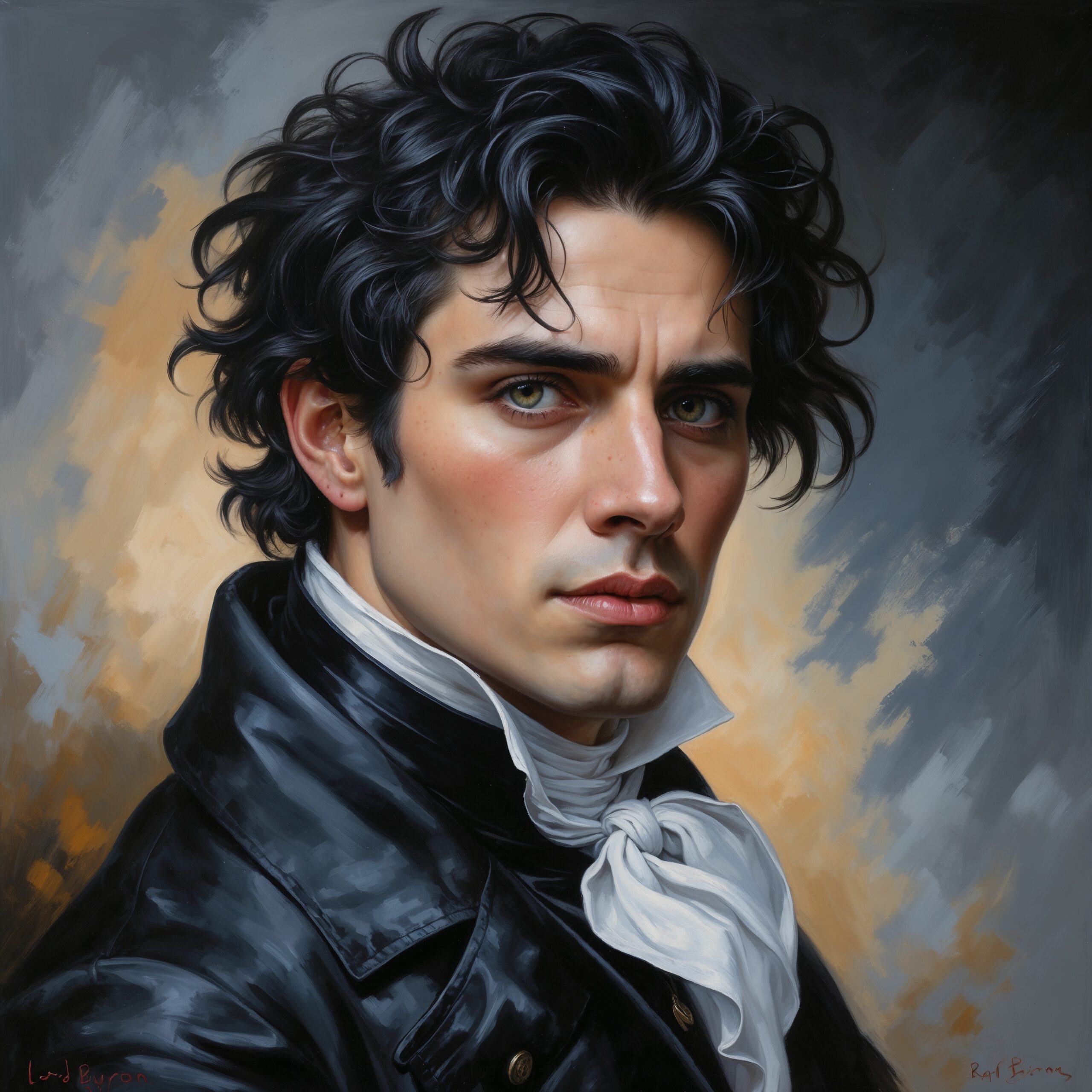
Our good friend and role model Lord Byron is back in D.P.S. news today.  If you’ll remember all the way back to Wednesday of this week, we toasted to Byron’s controversial divorce.  Today, we pour some out for the ultimate Romantic bad boy (think of him as the 19th-century equivalent of a rock star who’d smash his lute, bed your sister, and then write a 12-stanza ode about it, who died on this day in 1824 at the age of 36 in Missolonghi, Greece, a fetid swamp of a town that sounds like the setting for a Gothic novel but was, in fact, the backdrop for his final, quixotic stand against tyranny.  As mentioned on Wednesday, this poet lived hard – scandalous affairs, exile from England, a pen that bled rebellion in words like Don Juan and Childe Harold’s Pilgrimage, this latter a 500-page primal scream against the Ottoman Empire, aristocratic ennui, and the general cosmic unfairness of it all.  Byron was a one-man insurgency, a walking middle finger to the buttoned-up propriety of Regency England.  He’d already lived harder than most of us could manage in three lifetimes – exiled for what we’ll politely call “indiscretions” that involved more than a few raised eyebrows at Almack’s, penning works like Don Juan (a sprawling, digressive beast of a poem that’s basically the literary equivalent of a Netflix binge) and Childe Harold while simultaneously bankrolling the Greek fight for independence from the Ottomans.  Imagine it: Byron, in his velvet cloak and with his Byronic sneer, handing over fistfuls of cash to a ragtag band of Greek revolutionaries, all while scribbling verses that bled rebellion and melancholy in equal measure.  But here’s where the story takes its inevitable nosedive into the abyss of irony so dark it’d give Kafka gas.  Byron, having thrown his lot in with the Greeks, contracts a fever – possibly malaria, though the historical record is as murky as the Missolonghi marshes themselves.  The doctors, in an egregious display of medical malpractice decide the best course of action is to bleed him.  With leeches.  They drain him of half his blood, which, if you’ve ever read a single page of medical history, you’ll know is the 19th-century equivalent of treating a headache with a sledgehammer.  Byron, already weakened from his fever and probably a lifetime of hard living (the man’s diet was a mix of vinegar, laudanum, and sheer spite), doesn’t stand a chance.  He dies, delirious and pale, leaving behind a legacy that’s equal parts genius and chaos.

The Greeks, to their credit, know a hero when they see one.  They give him a funeral fit for a demigod – less “cozy Westminster Abbey plot” and more “Homeric pyre on the shores of the Aegean.”  Back in England, though, the establishment can’t handle the sheer Byron-ness of it all.  Westminster Abbey refuses his body, because apparently being a poetic genius and a freedom fighter isn’t enough to offset the scandal of, you know, sleeping with half of London and maybe your half-sister[^1].  His publisher, in a move that’s equal parts cowardice and betrayal, burns his memoirs, memoirs that were likely the literary equivalent of a nuclear bomb.  They “protect” his legacy, they say, which is code for “we’re terrified of what this man’s unfiltered truth would do to our delicate sensibilities.”  It’s an act that’s been called one of the worst literary crimes ever, and I’m inclined to agree…imagine if someone torched the only copy of Ulysses because Joyce was “too weird.”  That’s the level of cultural vandalism we’re talking about here.

Byron lived with the reckless abandon of a man who knew he was destined to burn out rather than fade away, and burn out he did – in a swamp in Greece, fighting for a cause that wasn’t even his own, because that’s just how Byron rolled.  His death was a seismic even, a rupture in the fabric of Romanticism that left the world a little less wild, a little less free.  So we pour some out and then raise a glass to you, Lord Byron: may your ghost haunt the marshes of Missolonghi, may your verses echo in the halls of eternity, and may the prudes who burned your memoirs choke on their own mediocrity.

[^1]: The incest rumors about Byron and his half-sister Augusta Leigh are, to put it mildly, contested. But they were enough to make polite society clutch their pearls and banish him, which, let’s be real, probably just made him more insufferable—and more brilliant.

N.P.: “Talking To Myself” – Manosaurus