

Monthly Archives: March 2026

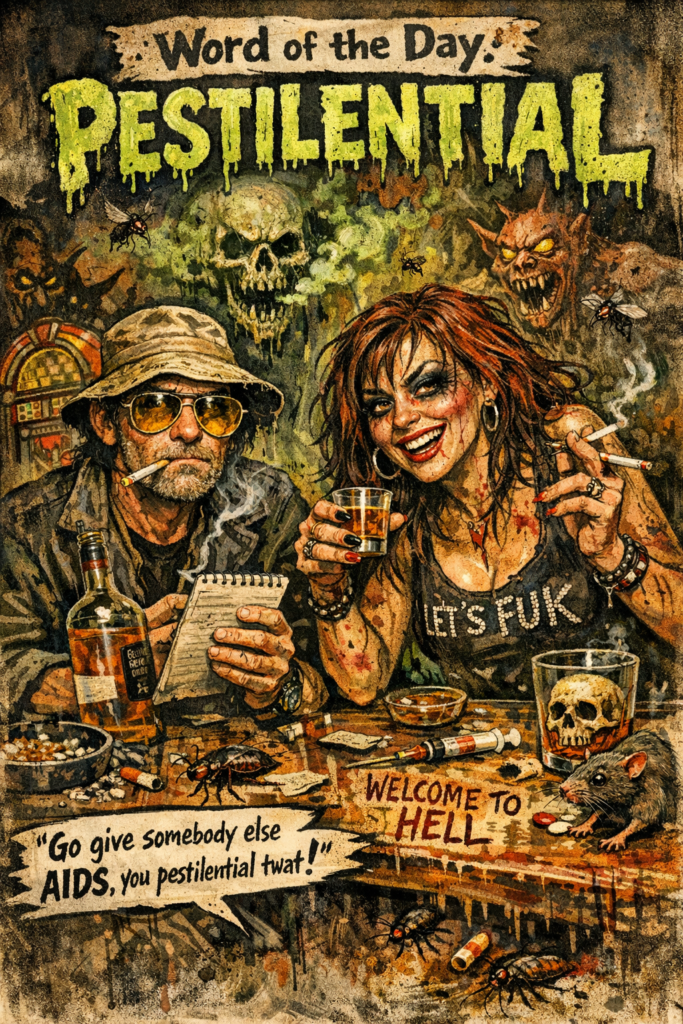
Word of the Day: pestilential

Pestilential, adj

  1. Relating to or tending to cause infectious diseases; producing or tending to produce infectious or contagious disease.
  2. Morally harmful or pernicious.
  3. Annoyingly troublesome; a colossal, unrelenting pain in the ass.

Basically a plague, a moral contagion, or an atmosphere so toxically, soul-rottingly foul that it makes the very air feel it’s been gang-raped by a committee of lesser demons and then left to fester in the sun.  Not merely bad.  Not merely evil.  Something that spreads corruption, contamination, or general human misery.  Also a person whose mere presence seems to lower the property value of the room.

Dragged kicking and screaming into Middle English around the late 15th century, derived from the Late Latin pestilentialis, which itself mutated from pestilentia (plague, unwholesome atmosphere).  Ultimately, it all boils down to the Latin pestis, meaning a deadly disease, plague, or destruction.  A long, noble lineage of words used to describe things that make you regret having a nose.

Thursday night in some dim-lit felony lounge off Mission Street, the kind of place where the jukebox only play Tom Waits B-sides and songs about dead hookers.  The air is thick with the perfume of spilled PBR, regret sweat, and the faint metallic tang of someone’s fresh tattoo infection.  I’m there because writing is a disease that requires cheap liquor and worse company, and tonight the disease has prescribed both.
She not so much slides as much as oozes onto the stool next to me like gravity owes her money.  Hair the color of bad decisions at 2 a.m., lips painted the shade of arterial spray, wearing a tank top that says “Let’s Fuck” in rhinestones that have mostly fallen off, much like her standards.
“I like you shirt,” I say, because that’s what I’m supposed to do.
“It likes you,” she says, looking me directly in the eye.  Because of course.
She smells like vanilla body spray trying heroically to cover the scent of three different men’s cologne and one pack of close cigarettes.  Her eyes are the glassy, predatory blue of a Great White that’s already decided I’m chum.
She orders a shot of Jameson and sidecar of desperation, then turns those eyes on me like I’m the last functioning cock in the zip code.
“You look like you write things,”  she says, voice raspy from too many Marlboros and not enough apologies.  I want to retort, “You look like you inspire massive regret.”  But I don’t.  So she continues: “Bet you’re deep.”
I tell her I’m shallow as a puddle in hell but I’ve got a library card and a drinking problem, which is close enough.  She laughs – sounds like a hyena gargling broken glass – and puts her hand on my thigh like she’s checking my pulse for later reference.
We talk.  Or rather, she talks and I nod while calculating the half-life of my dignity.  She sounds like Keith Richards’ older sister and has man hands.  She tells me about her ex who’s in county for something involving a chainsaw and a Pomeranian, about the OnlyFans tier she’s about to unlock called “Emotional Damage,” about how she once fucked the dead lead singer of Type O Negative (unclear if the alleged coitus was posthumous or not).  Every sentence is a small war crime against taste.
She leans in.  Breath like an ashtray soaked in peach schnapps.  “You wanna get out of here?  My place is only six blocks and the roaches are usually quiet this time of night.”
I look at her – really look.  At the track marks disguised as “artistic freckles,” at the way her pupils are doing the backstroke in whatever she’s on tonight, at the smile that’s equal parts invitation and eviction notice.  She looks very much like a mistake I would have made in the ’90s.  And something in me, some last scrap of self-preservation wired directly to the lizard brain, finally fires.
I stand up.  Slowly.  Like a man who’s just remembered he has bones.
“Go give somebody else AIDS, you pestilential twat,” I say.  Not loud.  Not angry.  Just clear.  Like Jesus would if he were in my situation.  The kind of clear you get right before the guillotine drops and you realize the blade’s already falling.
The bar goes quiet for half a second, the way rooms do when someone says the thing everyone was thinking but nobody had the testicular fortitude to voice.  She blinks.  Once.  Twice.  Then she laughs again – that same broken-glass laugh – but this time it’s thinner, cracked down the middle.
“Fuck you, Hemingway,” she spits, but there’s no heat in it.  Just the sad fizz of a firework that didn’t quite launch.
I walk out into the San Francisco night, which is cold and smells like urine and possibility in roughly equal measure.  My heart is hammering like it’s trying to escape my rib cage and join the witness-protection program.  I light a cigarette with shaking hands and think: That was the cleanest kill I’ve made in years.

N.P.: “Voodoo Child” – Tom Morello

March 15, 2026 – Beware the Ides, You Bastards: Tentacles, Treason, and the Death of Cosmic Sanity

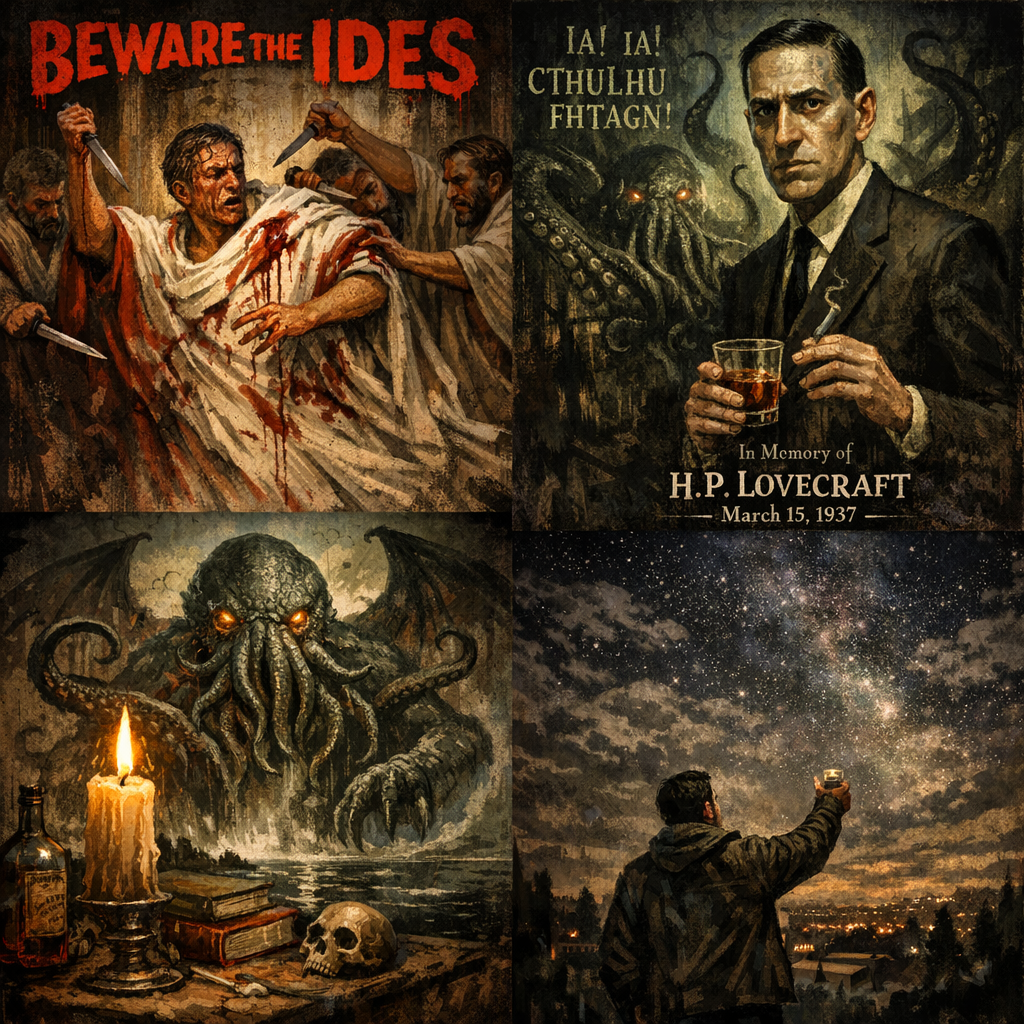
We need to get one thing absolutely and unequivocally straight before the coffee hits your bloodstream on this spectacularly cursed Sunday morning: the universe is actively conspiring against you, and it has circled March 15th on its celestial calendar with a thick, red Sharpie.  The soothsayers were not just blowing smoke up the collective togas of the Roman elite when they whispered about the Ides of March.  They were tapping into a fundamental, chronologically recurring frequency of sheer, unadulterated doom.  You know the story (or at least you’d better, dear reader).  Julius Caesar – a man who, by all historical accounts, possessed an ego large enough to require its own zip code – wandered into the Theatre of Pompey and caught 23 sharp pieces of Senate-approved metal in the ribs.  The lesson here is not merely about the pitfalls of imperial ambition or the staggering unreliability of coworkers.  The lesson is that mid-March is a phenomenologically toxic wasteland, a temporal sinkhole where bad things happen to people who forget to check their blind spots.

Beware the Ides, dear reader.  Lock your doors, pour yourself a violently strong beverage, and trust absolutely no one who approaches you wearing a poorly tailored bedsheet.

But the bleeding out of a Roman dictator is merely an appetizer in this buffet of historical madness.  If a Roman assassination isn’t enough to curdle your morning gin, remember it was on this exact day, in the thoroughly bleak and unforgiving year of 1937, in the quiet, respectable, Providence, Rhode Island gloom that smelled of mildew and unnamable regret, Howard Phillips Lovecraft – H.P. to the initiates, the Old Gent to the cultists – finally shuffled off this mortal coil and into whatever squamous, non-Euclidean dimension waits for the truly committed materialists who accidently invented a new kind of religious terror.

And brother, did he ever.

The man weaponized the absolute indifference of the universe and turned it into prose so dense, so feverish, so baroque in its despair that reading him feels like having your amygdala French-kissed by something that has no business existing in three dimensions.  While the rest of the pulp hacks were busy slapping vampires and werewolves into tidy little morality plays – good triumphs, evil gets a stake through the heart, roll credits – Lovecraft looked at the night sky and said, No.  Fuck that.  The real terror is that the sky is looking back and it doesn’t even register you as a protein.  He gave us entities that didn’t want your soul, didn’t want your women, didn’t even want your worship in any meaningful way.  They simply Were, vast, ancient, cyclopean, and utterly, serenely uninterested in the screaming little primates who’d accidentally poked the wrong corner of reality.  Cthulhu doesn’t rise to rule us; he rises because his nap alarm went off.  The color out of space doesn’t corrupt the countryside for sport; it corrupts in the way radiation corrupts tissue – because that’s what it does.  There is no moral.  There is no catharsis.  There is only the slow, inexorable realization that the universe is not hostile, which would at least be dramatic.  It’s worse.  It’s bored.

And the motherfucker did it all while half-starved, writing letters to anyone who’d listen, nursing grudges the size of Azathoth’s court, and maintaining a prose style so ornate it makes Victorian wallpaper look minimalist.  He was a walking contradiction: a materialist who dreamed like a mystic, a racist who created a mythology so transcendently misanthropic it eventually outgrew every ugly personal tic that birthed it, a recluse who accidentally founded a literary religion that now has more true believers than most actual religions.

So today, on the Ides that also happens to be the anniversary of his exit, raise whatever you’re drinking – coffee, whiskey, the black bile of existential nausea, whatever – and tip it toward Providence.  Not in mourning, exactly.  Lovecraft would have hated that.  More like a salute between two people who both know the joke, and the joke is that there is no punchline, on the endless, star-strewn, indifferent dark.

And beware the Ides.  Not because you’ll be stabbed in a senate – though, hey, read the group chat – but because March 15 is an annual reminder that two things are true at once: power gets checked, and the universe does not care about your press release.  Light a cheap candle for Lovecraft today, then go outside and notice how ordinary the sky looks, which is exactly what makes it terrifying.

N.P.: “Ritual” – Ghost

March 9, 2026


On March 9, 1994, the universe finally collected the tab on the “Dirty Old Man” himself, Charles Bukowski, who checked out of this absurd mortal coil in San Pedro, California.  At 73, leukemia accomplished what decades of catastrophic whiskey consumption, violently cheap cigars, and the existential horror of the United States Postal Service could not.  He died having thoroughly dismantled the polite, cellophane-wrapped fiction of the American Dream, leaving behind a staggering mountain of visceral, beautifully unvarnished poetry that made the literary establishment collectively clutch its pearls.

The man spent the vast majority of his adult life operating aggressively on The Fringe.  He was a creature of the racetrack and the dive bar, a guy who effectively treated his own liver like a hostile combatant while typing out literature that bypassed the brain entirely and punched you squarely in the balls.  He was the patron saint of the spectacularly flawed, the chronically unemployable, and anyone who ever looked at a nine-to-five job and felt the urgent, biological need to vomit.

The most magnificent detail of his departure – the absolute chef’s kiss on a life lived with middle fingers permanently raised – is his gravestone.  It features the silhouette of a boxer and exactly two words: DON’T TRY.

Now, some saps, the ones who write poetry about dew drops and puppy dogs and other such horseshit, will interpret that as a resignation, a surrender to the inevitable crushing weight of existence.  And if you think this was some sort of slacker mandate or an endorsement of perpetual lethargy, you are entirely missing the point.  Those of us who’ve actually read the man, who’ve tasted the bile and beauty in his sprawling, messy oeuvre, know better.  This was certainly not an invitation to lie back and let the world roll over you.  It was the opposite of laziness, a middle finger to effort that pretends, to straining after immortality or Cadillacs or applause.  Don’t force it.  Don’t posture.  Don’t grind your teeth and squeeze out art likes it’s a dump you scheduled.  Wait.  Watch.  When the thing – the line, the image, the liver-kick truth – crawls close enough, you reach out and slap it down or pet it, depending.  But you don’t chase it down the street waving a net made of MFA workshops and ambition.  You do it because it’s there, aching to get out, not because you’re trying to be somebody.

He believed real art should feel effortless, gritty, unforced.  No pretentions.  No counterfeited depth.  Just the raw spill of whatever was rattling around in the skull after the bars closed.  And if didn’t come?  You waited.  You drank.  You typed anyway.  But you didn’t try.

And then came the funeral, a masterclass in cosmic irony.  You might expect a man who chronicled the chaotic, grease-stained realities of Post Office and Factotum to be sent off with a violently rowdy wake involving broken bottles and cannons (a la H.S.T).  Instead, his funeral was conducted by Buddhist monks.  Yes, a chorus of serene, chanting ascetics offered up a profoundly quiet, surreal contrast to a lifetime defined by spectacular, screaming chaos.  It is exactly the kind of wildly unpredictable punchline the old man would have loved.

He left behind a body of work that still smells like sweat and cigarette ash and the inside of a bus station at 2 a.m.  He wrote about losers, drunks, gamblers, the chronically unlucky – and in doing so, he made them mythic.  Not heroic, not redeemed, but seen.  He carved out a literary kingdom for the people who never get statues, only arrest records.

And maybe that’s why he still matters.  Because in a culture obsessed with polishing itself into oblivion, Bukowski remains a reminder that the truth is usually found in the stains, the cracks, the parts of life that don’t photograph well.

So raise a terribly cheap glass to Bukowski today.  He was a glorious, infuriating disaster of a man who accidently captured the rawest elements of the human condition while actively trying to ignore them.  And whatever you do today, just don’t try.

N.P.: “Hot Stuff” – Mythic Prophesy

March 7, 2026

Tomorrow morning, dear reader, we are voluntarily plunging headfirst into a temporal hallucination of our own making, and frankly, it makes me deeply, profoundly embarrassed to be a card-carrying member of the human race.

When you really strip it down to the studs, Daylight Saving Time is the most shamefully stupid endeavor our species collectively partakes in.  We are a supposedly advanced civilization that split the atom and put golf carts on the moon, yet twice a year we engage in this mass psychotic delusion that we can somehow manipulate the very fabric of the cosmos by manually turning a tiny piece of plastic on our kitchen walls.  It is a spectacular monument to human idiocy.

Picture this: you wake up – already pissed because the alarm is screaming at what your body insists is an hour earlier than God and nature intended – and the sun is sitting there smugly, like it’s been up for hours judging your groggy ass.  Your melatonin is still partying in your bloodstream while cortisol is late to the meeting.  You stagger around, stub your toe on the same fucking dresser you’ve owned for a decade, and somewhere in the back of your skull a tiny primal scream begins: Why the fuck are we still doing this?

Because we are idiots.  Collective, consenting, clock-fucking idiots.

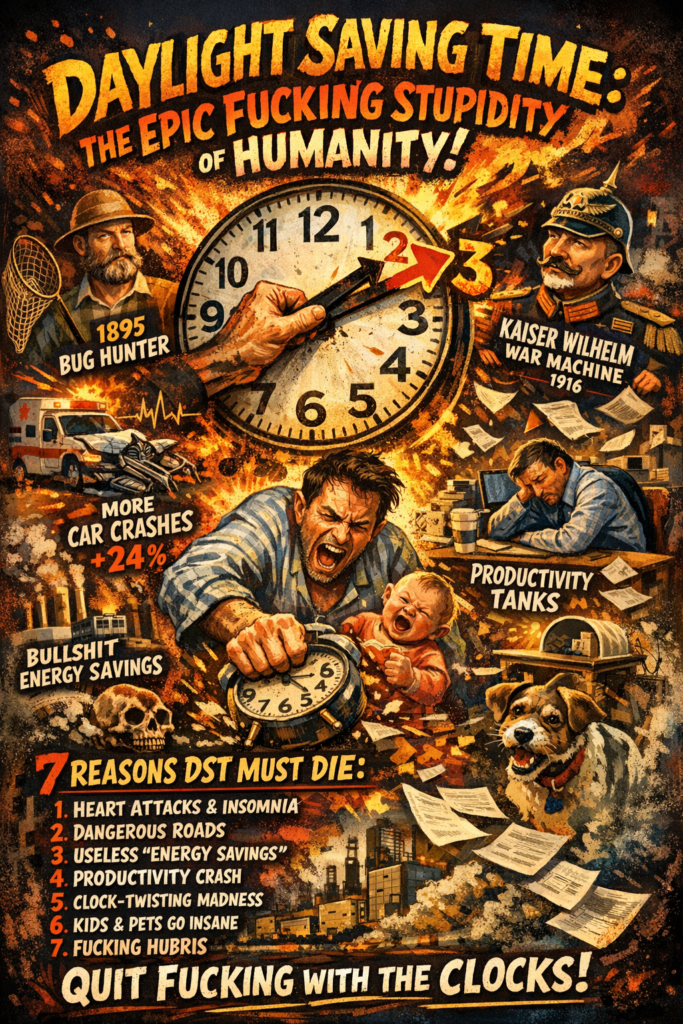
If you want to fully grasp the sheer, unadulterated absurdity of this practice, you have to look at its idiotic history.  The concept didn’t emerge from the brilliant mind of some grand temporal physicist.  Nope…the modern nightmare of DST was initially pitched by a New Zealand entomologist named George Hudson in 1895, simply because the Kiwi jackass wanted more daylight after his shift at the post office to hunt for goddamn bugs.  Decades later, the German Empire weaponized the idea during World War I in a desperate, ultimately flawed attempt to save coal for their war machine.  We are literally tethering our modern, hyper-connected circadian rhythms to the eccentricities of a 19th-century bug catcher and Kaiser Wilhelm’s wartime austerity measures.  It is a joke that has metastasized into a global psychological disease.  I remember when the U.S. tried to make it permanent in the ’70s during the Nixon-era energy panic, and now it lingers like a bad tattoo you got in Vegas. The original energy-saving claim has been debunked so thoroughly it’s basically a corpse in the corner of the room everyone politely ignores.  Modern studies show the savings are negligible at best – a fraction of a percent, if that – while the costs pile up in hospital beds, wrecked cars, and productivity craters.

We need to pull the plug on this charade right now.  Here are seven objectively irrefutable reasons why this temporal circle-jerk needs to be outlawed immediately:

  1. It is biological warfare against our own bodies.
    In fact, it fucks your health like a cheap motel mattress.  That one-hour spring-forward theft triggers a measurable spike in heart attacks (up around 24% the following Monday in some data), strokes, workplace injuries, and even digestive fuckery.  Your poor circadian rhythm – evolved over millennia to sync with the actual sun, not some congressional fiat – gets misaligned, melatonin production delays, cortisol surges wrong, inflammation markers climb.  Sleep scientists and the American Academpy of Sleep Medicine have been screaming for years: permanent Standard Time aligns better with human biology.  DST is chronic low-grade jet lag imposed on 330 million people annually.  We are literally sacrificing human lives on the altar of a fake, legislated hour.
  2. It turns roads into rolling death traps. 
    Fatal car accidents jump – 6% or more in the week after the change – because drivers are sleep-deprived zombies with slowed reaction times.  Add darkness to morning commutes (because we’ve stolen daylight from the front of the day and slapped in on the ass-end), and you’ve got higher crash risk, especially for pedestrians and cyclists.  We already have enough ways to die on American highways; we don’t need Congress mandating extra ones.
  3. The great “energy saving” lie is total bullshit.
    I mentioned it supra, but it deserves further examination.  The entire premise of the practice is built on a myth.  Modern studies consistently show that any microscopic savings in artificial lighting are immediately and violently obliterated by the massive surge in heating and air conditioning use.  We aren’t saving a goddamn thing: we are just shifting the thermodynamic deck chairs on the Titanic. 
  4. It absolutely massacres human productivity.
    Productivity tanks harder than a drunk uncle at Thanksgiving.  It’s pointlessly expensive and disruptive.  Employees lose 40-60 minutes of sleep per night for days after the shift.  That means more errors, more slacking, more “I’m just gonna stare at this spreadsheet until it makes sense.”  Workplace accidents spike.  Decision-making degrades.  And don’t even start on the mood disturbances – irritability, depression flares, seasonal affective bullshit amplified because we’re forcing unnatural light exposure patterns on a species wired for sunrise-triggered wakefulness.  The economic cost of this collective exhaustion is staggering, purely because some bureaucrat decided we needed to pretend the sun rises at a different time.  Think of the sheer administrative drag: IT departments scrambling to patch systems that didn’t auto-update right, scheduling SNAFUs for international calls, missed flights, confused kids showing up an hour early (or late) to school.  Farmers – yes, the people this was supposedly for – hate it; the cows don’t give a shit about your clock, they milk when the sun says so.  The whole exercise is a bureaucratic circle-jerk with zero net upside.
  5. It is the height of arrogant, bureaucratic hubris.
    There is a profound sickness in the belief that legislation can simply override the planetary rotation of the Earth.  You cannot legislate sunshine.  Moving the hands of the clock does not magically grant us more daylight; it just cruelly redistributes the misery of darkness, completely disregarding the natural rhythms that biology spent millions of years perfecting.
  6. It turns parents and pet owners into hostages.
    Try explaining the nuances of the geopolitical time-shift to a screaming toddler or a hungry chihuahua at what is now arbitrarily 5:00 AM.  They don’t give a singular, solitary shit about the Kaiser’s coal.  They operate on biological reality, entirely exposing the flimsy, pathetic illusion we have forced upon ourselves.
  7. We could just stop. 
    Permanently.  No more biannual ritual humiliation.  Pick Standard Time (the healthier option per circadian experts) and stop the absurd twice-yearly charade.  Most of the planet doesn’t do this anymore.  Hawaii and Arizona laugh at us.  Europe’s flirting with ditching it.  Yet here we are, still springing forward like lemmings with a calendar.

Enough is enough.  The time for polite debate has long since passed.  We need to drag our lawmakers out of their comfortable, chronologically confused stupors and demand an immediate end to this madness.  We must return to Standard Time, lock it in permanently, and burn the key.  Quit fucking with the clocks.  Let time just be time.

So tomorrow morning, dear reader, when your phone betrays you and advances an hour while you sleep, when you drag your carcass out of bed feeling like someone roofied your soul, remember: this isn’t inevitable.  It’s policy.  It’s chosen.  It’s stupid.

And if you’re still defending it, kindly go fuck yourself with a sundial.

N.P.: “Links 2 3 4” – Rammstein

March 1, 2026

Yesterday and today have blurred into one, dear reader, at least over here.  I know there is separation somewhere, but you will hopefully forgive if I have trouble finding it.

A day like this demands the kind of emotional bifurcation that would make a saner man pull over, vomit into the nearest ditch, and reassess his life choices.  But not us, dear reader.  No, we ride the razor’s edge with a kind of reckless, wide-eyed gratitude, because history has finally decided to stop mumbling into its sleeve and instead shout something worth hearing.

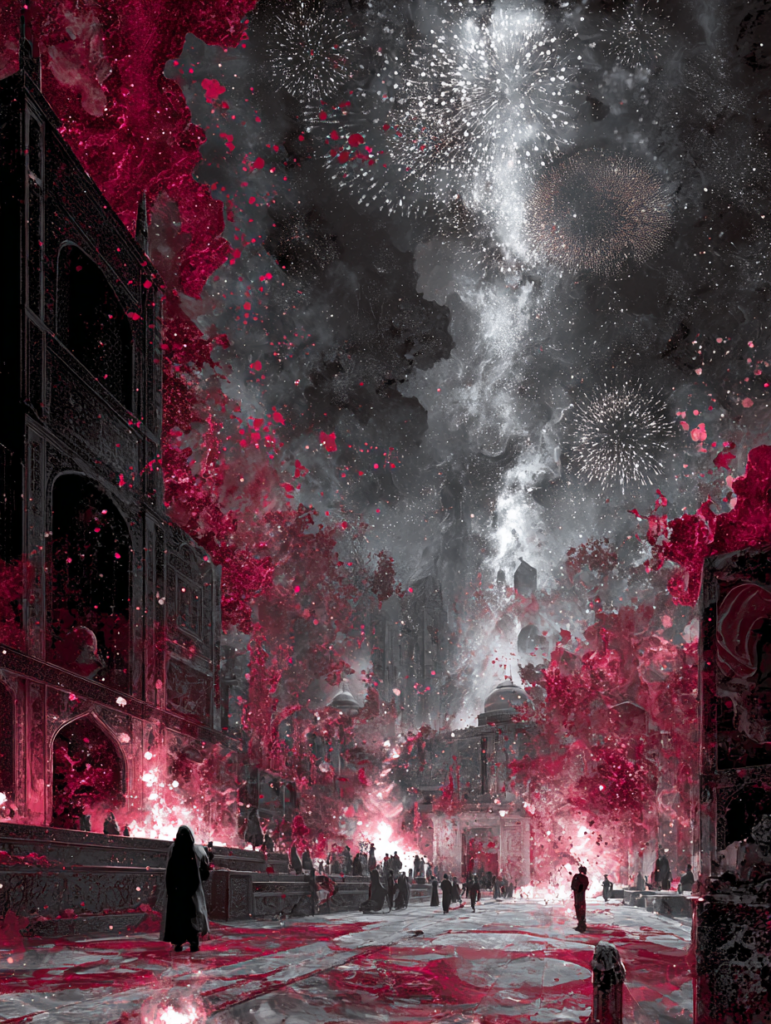
The Persians are dancing.  Not metaphorically, not in some wistful, diaspora-poetry way, but literally dancing, bodies unshackled, hair uncovered, wine flowing like the collective bloodstream of a people who have waited far too long for the boot to lift.  The downfall of the Islamic Regime, that decades-long monolith of fear and clerical sadism, is cracking open like a rotten pomegranate, and the seeds spilling out are incandescent with possibility.  I’ve been drinking Syrah with people who haven’t tasted freedom in their homeland for generations, and let me tell you, the stuff hits different when it’s paired with the sound of theocracy collapsing under it own sanctimonious weight (and the military might of the United States and Israel, both commanded by the only men in my lifetime with the sack to actually do something beyond hand-wringing and moralistic bitching).  There’s a kind of cosmic justice in the air, the sort that makes you believe the universe occasionally remembers to do its goddamn job.

But the universe, being the fickle, bipolar bastard it is, never gives without taking.  And so, while the streets of Tehran hum with the electricity of rebirth, the halls of the Dead Poets Society have gained a new resident.

Dan Simmons is gone.
Seventy-seven years old, felled by a stroke, and suddenly the world feels a little less sharp, a little less dangerous, a little less willing to stare into the abyss and report back with something other than platitudes.  Simmons was one of the rare ones, the kind of writer who carved his stories, chisel to bone, leaving behind works that felt like they’d been smuggled out of some forbidden archive where the librarians carried knives.  Song of Kali, one of my all-time favorites, remains one of the most unsettling, intoxicating pieces of fiction ever unleashed on the unsuspecting public, a book that doesn’t just frighten you but contaminates you.  And Hyperion – that cathedral of myth, machinery, and metaphysics – was proof that science fiction could still punch holes in the sky and let the dark matter leak through.  And then there was Children of the Night….

To lose him on a day like this feels like some cosmic accountant balancing the ledger with cold, bureaucratic precision.  A regime falls, a titan falls.  A people rise; a voice goes silent.  Celebration braided with sorrow, like barbed wire wrapped in silk.

And yet, dear reader, maybe that’s the only way days like this can exist.  Maybe joy without grief is too flimsy to trust, and grief without joy is too heavy to bear.  Maybe the only honest way to live in this absurd, flaming carnival of a world is to raise a glass to the living, pour one out for the dead, and keep marching forward with the kind of defiant swagger that would make both the Persians in the streets and Dan Simmons in whatever cosmic library he’s haunting nod in approval.

So drink.  Mourn.  Celebrate.  Rage.  Repeat.

N.P.: “I Know You Can Feel It – Working Men’s Club Remix” – Nine Inch Nails